Pass Your Coast Guard Licensing Exams!
Study offline, track your progress, and simulate real exams with the Coast Guard Exams app
Rules of the Road
191 images
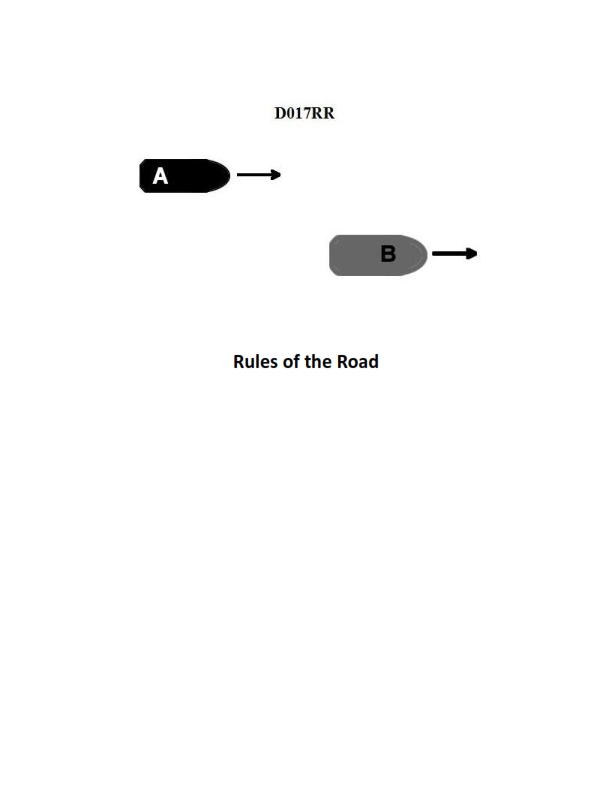
Question 1
Question: BOTH INTERNATIONAL & INLAND Vessel "A" is overtaking vessel "B" as shown in illustration D017RR below. In this situation which of the following describes vessel "B".
A. vessel B is the stand-on vessel
B. vessel B is the give-way vessel
C. vessel B is the burdened vessel
D. None of the above
The correct answer is A) vessel B is the stand-on vessel. In a situation where vessel A is overtaking vessel B, the International and Inland Navigation Rules state that vessel B is the stand-on vessel. This means that vessel B must maintain its course and speed, while vessel A, the overtaking vessel, must take necessary action to safely pass vessel B. The other answer choices are incorrect because vessel B is not the give-way vessel (that would be vessel A) and vessel B is not the burdened vessel (the burdened vessel is the one that must take action to avoid a collision, which in this case is vessel A).
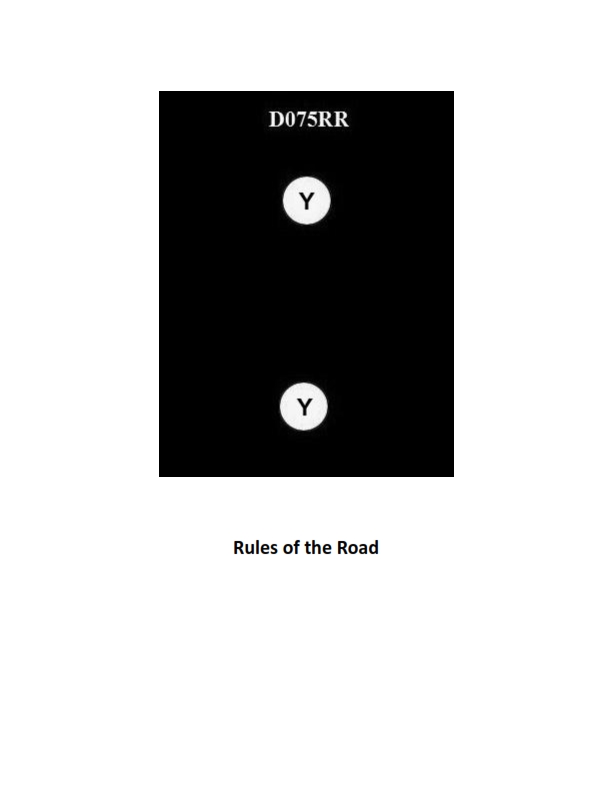
Question 6
Question: INLAND ONLY You are approaching a vessel displaying the lights as shown in illustration D075RR below. What type of situation is this?
A. Crossing situation
B. Meeting head-on situation
C. Special circumstance situation
D. Overtaking situation
The correct answer is D) Overtaking situation. This is an overtaking situation because the vessel in illustration D075RR is displaying the masthead lights, sidelights, and sternlight configuration, which indicates it is being overtaken by another vessel. According to the Navigation Rules, a vessel overtaking another vessel must keep out of the way of the vessel being overtaken, and the vessel being overtaken has the right-of-way. The other answer choices are incorrect because a crossing situation involves vessels crossing paths at an angle, a meeting head-on situation involves vessels approaching each other head-on, and a special circumstance situation does not apply in this case.
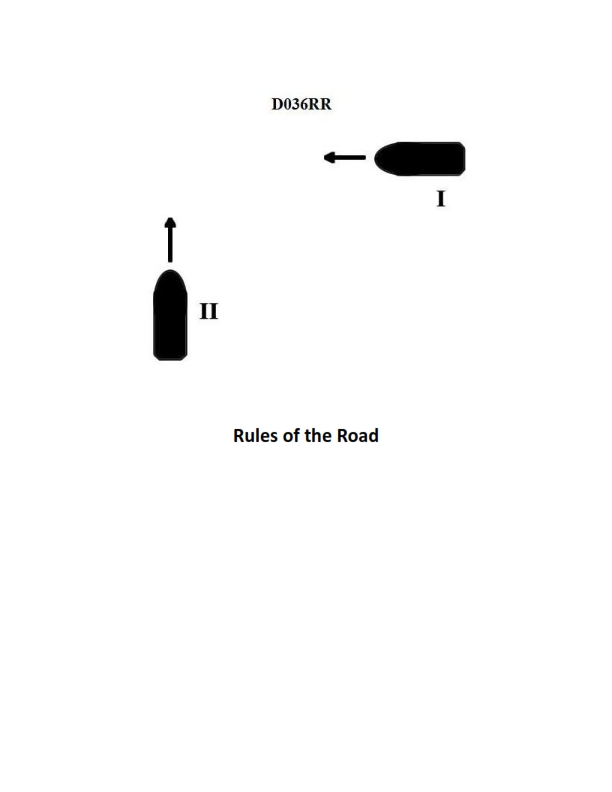
Question 14
Question: INLAND ONLY You are on power-driven vessel "I" and in sight of power-driven vessel "II" as shown in illustration D036RR below. Vessel "II" sounds one short blast. What action should you take if you agree?
A. sound one short blast and hold course and speed
B. hold course and speed and sound no signal
C. sound the danger signal and slow to moderate speed
D. sound one short blast and slow down or turn to starboard
The correct answer is A) sound one short blast and hold course and speed. According to the Inland Navigation Rules, if you are the power-driven vessel "I" and you agree with the one short blast signal from the power-driven vessel "II", you should sound one short blast in response and hold your course and speed. This is the appropriate action to indicate that you have understood and will comply with the other vessel's maneuver. The other options are incorrect because B) holding course and speed without sounding a signal would not properly communicate your intent, C) sounding the danger signal and slowing down is not the correct response when you agree with the other vessel's signal, and D) sounding one short blast and turning to starboard is unnecessary if you are already in agreement with the other vessel's action.
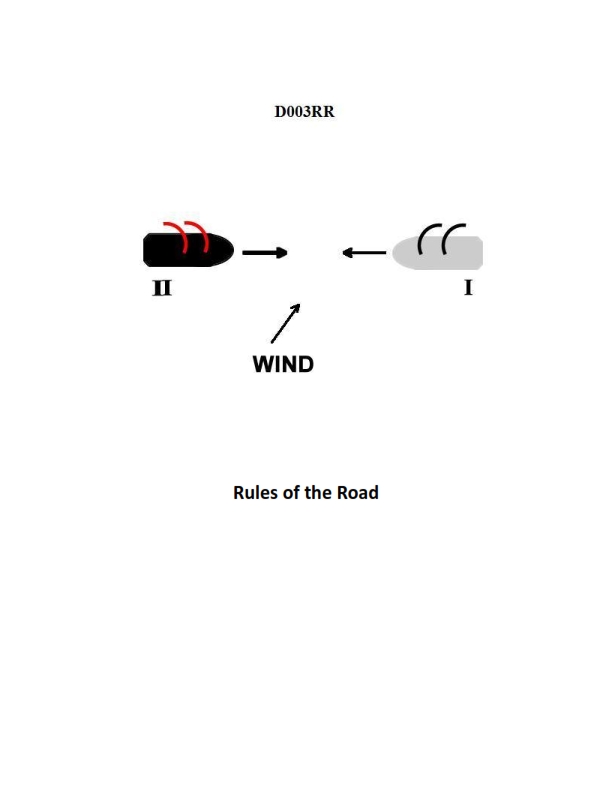
Question 18
Question: BOTH INTERNATIONAL & INLAND Two sailing vessels are approaching each other as shown in illustration D003RR below. Which statement is correct?
A. Vessel "I" should stand-on because she has the wind on her port side.
B. Vessel "I" should stand-on because she is close-hauled.
C. Vessel "II" should stand-on because she has the wind on her starboard side.
D. Neither vessel is the stand-on vessel because they are meeting head-on.
The correct answer is C) Vessel "II" should stand-on because she has the wind on her starboard side. According to the International Regulations for Preventing Collisions at Sea (COLREGS), which apply to both international and inland waters, in a head-on situation, the vessel with the wind on her starboard side (Vessel II) is the stand-on vessel and must maintain her course and speed. The other vessel (Vessel I) is the give-way vessel and must take early and substantial action to avoid a collision. The other options are incorrect because: A) being close-hauled does not determine the stand-on vessel in a head-on situation, and D) both vessels are required to take action in a head-on encounter, with one being the stand-on vessel.
Question 28
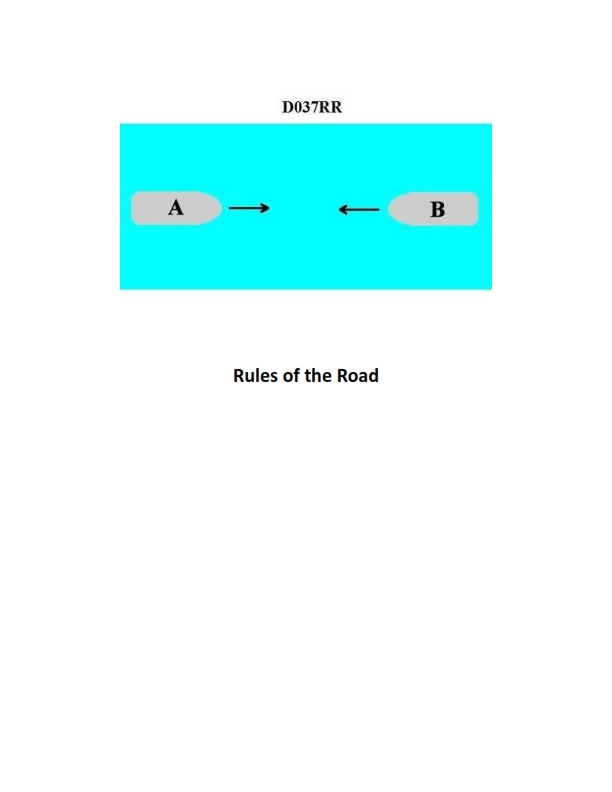
Question: INLAND ONLY Two power-driven vessels are meeting in a narrow channel on the Great Lakes as shown in illustration D037RR below. Vessel "A" is downbound with a following current. Vessel "A" shall do which of the following?
A. Initiate the maneuvering signals
B. Propose the manner of passage
C. Have the right of way
D. All of the above
The correct answer is D) All of the above. According to the Inland Navigation Rules, when two power-driven vessels are meeting in a narrow channel, the downbound vessel (Vessel "A") has the right-of-way. As the downbound vessel with a following current, Vessel "A" shall initiate the maneuvering signals, propose the manner of passage, and have the right-of-way over the upbound vessel. The other options are incorrect because they do not fully address the responsibilities of the downbound vessel in this scenario.
Question 30
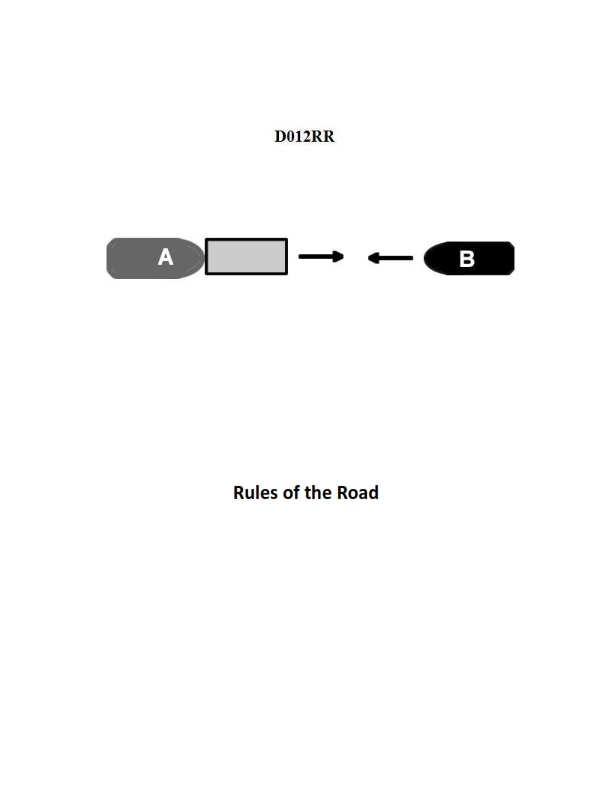
Question: BOTH INTERNATIONAL & INLAND Vessel "A" (towing) and vessel "B" are meeting as shown in illustration D012RR below. In this situation, which statement is TRUE?
A. Both vessels should alter course to port and pass starboard to starboard.
B. Vessel "A" should hold course while vessel "B" alters course to starboard.
C. Both vessels should alter course to starboard and pass port to port.
D. Vessel "A" is the stand-on in this situation.
The correct answer is C) Both vessels should alter course to starboard and pass port to port. This is the correct answer because the International Regulations for Preventing Collisions at Sea (COLREGS) Rule 14 states that when two power-driven vessels are meeting head-on, they shall alter course to starboard so that they will pass port-to-port. Since both vessels "A" (towing) and "B" are meeting head-on, they must both alter course to starboard to pass port-to-port. The other options are incorrect because A) would be the improper action, B) only requires vessel "B" to alter course when both should do so, and D) is incorrect as vessel "A" is not the stand-on vessel in this head-on meeting situation.
Question 34
Question: INLAND ONLY Vessel "A" is power-driven and overtaking power-driven vessel "B" as shown in illustration D017RR below and will pass without changing course. What signal should vessel "A" sound?
A. one short blast
B. no signal
C. two short blasts
D. one prolonged blast
The correct answer is C) two short blasts. According to the USCG Navigation Rules, when a power-driven vessel is overtaking another power-driven vessel in an inland waterway, the overtaking vessel (vessel "A") should sound two short blasts to indicate its intention to pass. This signals to the other vessel (vessel "B") that the overtaking maneuver is about to occur, allowing both vessels to coordinate their actions and ensure a safe passing. The other answer choices are incorrect because one short blast is not the appropriate signal for this situation, and sounding no signal or one prolonged blast would not properly communicate the overtaking vessel's intentions to the other vessel.
Question 37
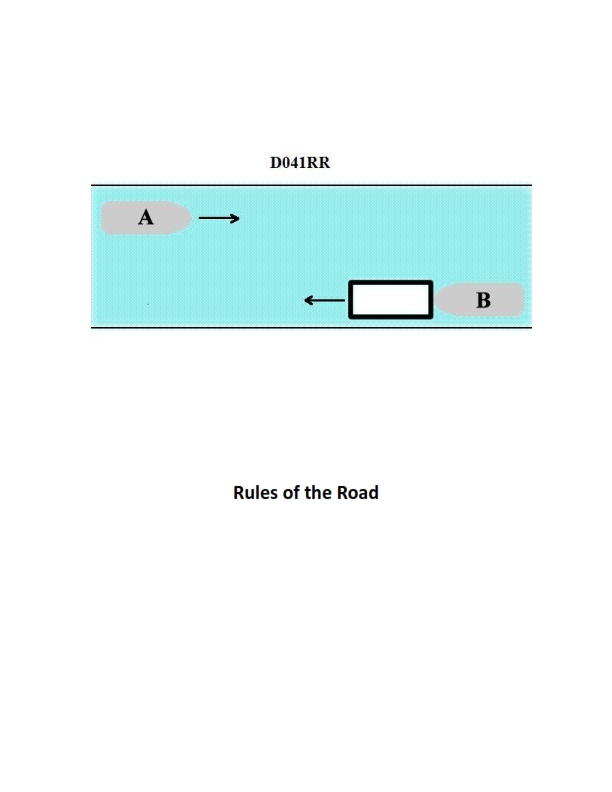
Question: INLAND ONLY Vessels "A" and "B" are meeting on a river as shown in illustration D041RR below and will pass 1/4 mile apart. Which statement is TRUE?
A. If a passing agreement is reached by radiotelephone whistle signals are still required.
B. Whistle signals must be exchanged in all situations when passing within one half mile.
C. If a passing agreement is reached by radiotelephone, whistle signals are optional.
D. None of the above
The correct answer is C) If a passing agreement is reached by radiotelephone, whistle signals are optional. The reason this is correct is that under the Inland Navigation Rules, if vessels are meeting on a river and will pass at least 1/4 mile apart, they are not required to exchange whistle signals if they have made a passing agreement via radiotelephone communication. The whistle signals are optional in this scenario, as long as the passing agreement has been reached through verbal communication. The other options are incorrect because A) whistle signals are not required if a passing agreement has been made by radio, B) whistle signals are only required when passing within 1/2 mile, not in all situations, and D) the correct answer is C, not none of the above.
Question 51
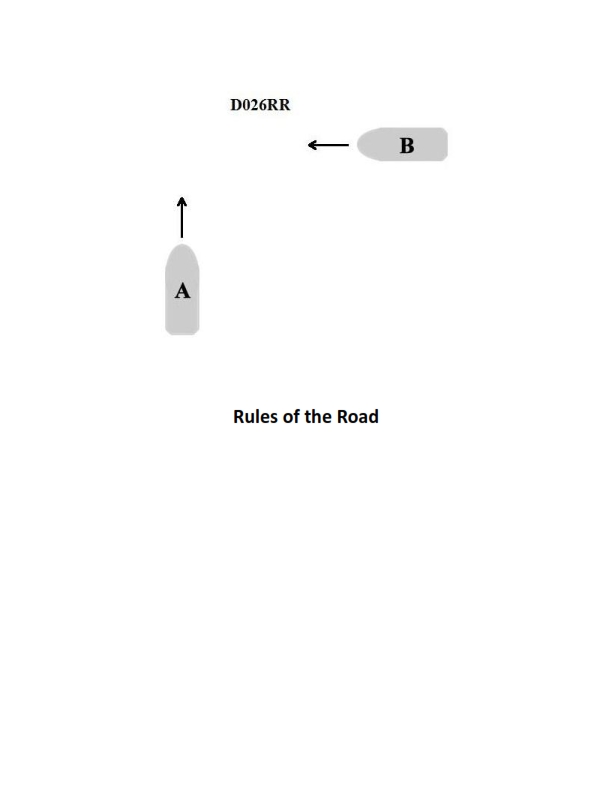
Question: BOTH INTERNATIONAL & INLAND Vessels "A" and "B" are crossing as shown in illustration D026RR below. Which statement is TRUE?
A. Vessel "A" must keep clear of vessel "B".
B. The vessels should pass starboard to starboard.
C. Vessel "B" should alter course to the right.
D. Vessel "B" should pass under the stern of vessel "A".
The correct answer is A) Vessel "A" must keep clear of vessel "B". The International Regulations for Preventing Collisions at Sea (COLREGS) state that when two power-driven vessels are crossing, the vessel that has the other on her own starboard side must keep out of the way of the other vessel. In the illustration, vessel "A" has vessel "B" on her own starboard side, so vessel "A" must keep clear of vessel "B". The other options are incorrect because: B) The vessels should not pass starboard to starboard, as that would violate the COLREGS rule on crossing vessels. C) Vessel "B" should not alter course to the right, as that would also violate the COLREGS rule. D) Vessel "B" should not pass under the stern of vessel "A", as that would not be the proper action for the give-way vessel (vessel "A") to take.
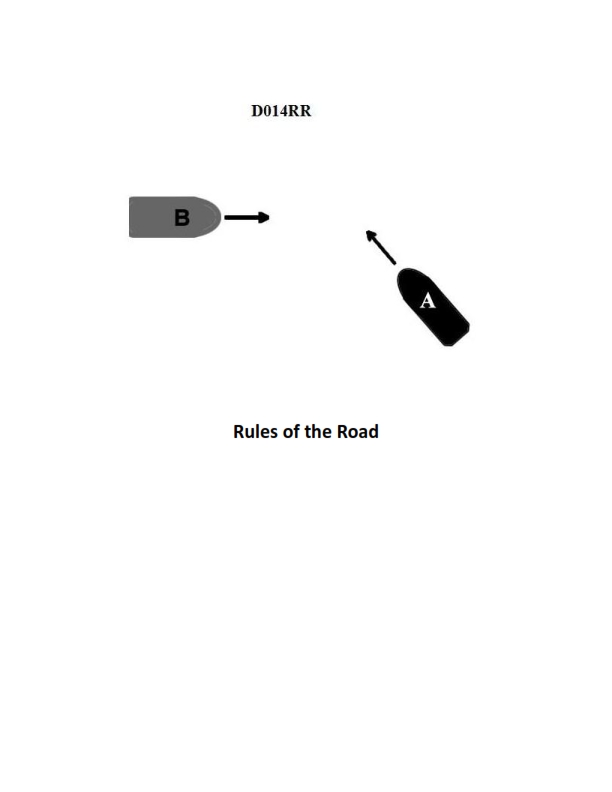
Question 55
Question: INTERNATIONAL ONLY Vessels "A" and "B" are in a crossing situation on the high seas as shown in illustration D014RR below. Vessel "B" sounds one short blast. What is the proper action for vessel "A" to take?
A. Hold course and speed
B. Sound danger signal
C. Answer with one blast and keep clear of vessel "B"
D. Answer with one blast and hold course and speed
The correct answer is A) Hold course and speed. According to the International Regulations for Preventing Collisions at Sea (COLREGS), in a crossing situation, the vessel that has the other on its starboard side (in this case, vessel "B") is the stand-on vessel and must maintain its course and speed. Vessel "A" is the give-way vessel and must take early and substantial action to keep well clear of the stand-on vessel. Sounding one short blast indicates that vessel "B" intends to hold its course and speed, so vessel "A" should respond by holding its course and speed as well. The other options are incorrect because: B) Sounding a danger signal is not the appropriate action for the give-way vessel; C) Answering with one blast and keeping clear is the incorrect action for the give-way vessel; and D) Answering with one blast and holding course and speed is the correct action for the stand-on vessel, not the give-way vessel.
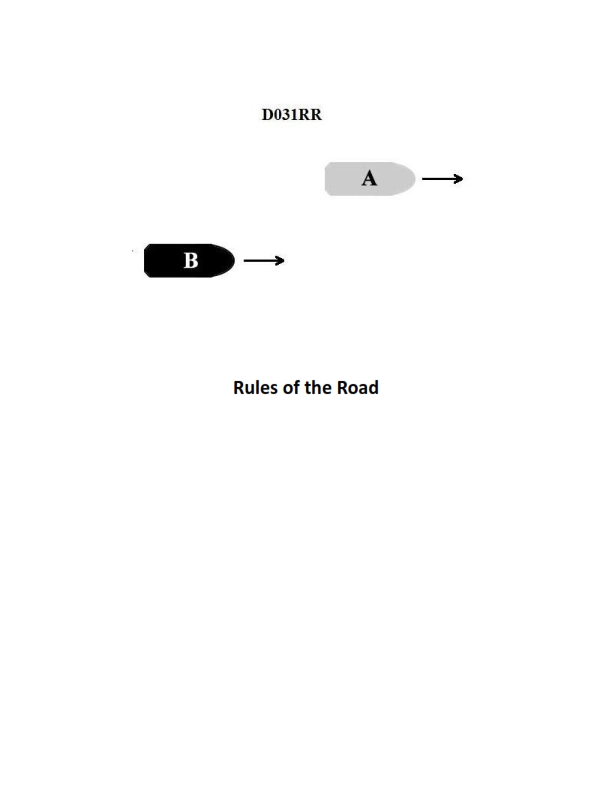
Question 59
Question: INLAND ONLY You are on vessel "A", and vessel "B" desires to overtake you on your starboard side as shown in illustration D031RR below. After the vessels have exchanged one blast signals what action should you take?
A. Alter course to the left to give vessel "B" more sea room
B. Alter course to the right to give vessel "B" more sea room
C. Hold course and speed
D. Slow your vessel until vessel "B" has passed
The correct answer is C) Hold course and speed. According to the Inland Navigation Rules, when vessels are in a overtaking situation, the overtaking vessel is required to keep out of the way of the vessel being overtaken. The vessel being overtaken (vessel "A" in this case) should maintain its course and speed, allowing the overtaking vessel "B" to safely pass. Altering course or slowing down could disrupt the overtaking maneuver and create an unsafe situation. The other answer choices would go against the Inland Rules and create unnecessary maneuvering that the overtaking vessel is responsible for.
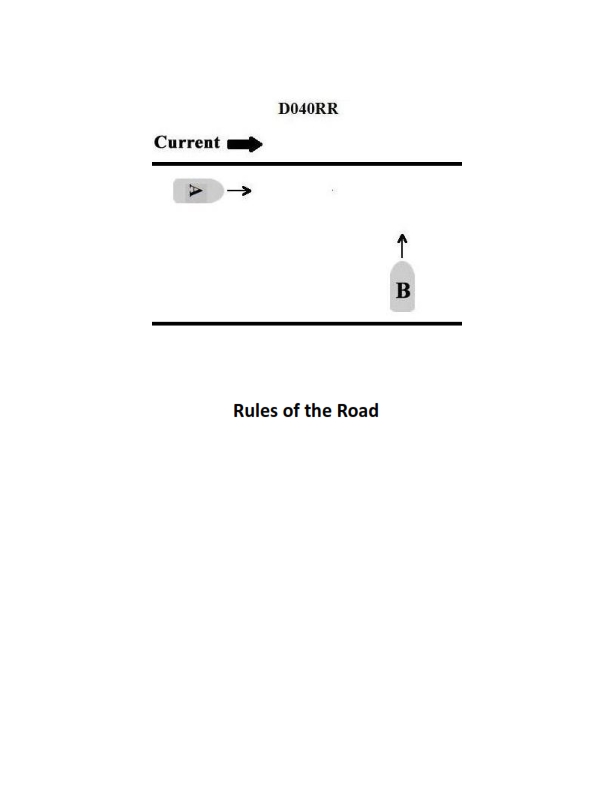
Question 63
Question: BOTH INTERNATIONAL & INLAND You are crossing a narrow channel on your 15meter vessel. A deeply loaded cargo vessel is proceeding down the channel as shown in illustration D040RR below. In this situation, which statement is correct?
A. You are the stand-on vessel because you are less than 65 feet in length.
B. The cargo vessel is the stand-on vessel because she is running with the current.
C. The Rule of Special Circumstances applies in this case.
D. You cannot impede the passage of the cargo vessel.
The correct answer is D) You cannot impede the passage of the cargo vessel. This is because in a narrow channel, the larger, less maneuverable vessel (the cargo vessel) is the stand-on vessel, and the smaller vessel (your 15-meter vessel) must avoid impeding the passage of the cargo vessel. This is a general principle of the Navigation Rules, which states that a vessel must not impede the safe passage of a vessel that can safely navigate only within a narrow channel or fairway. The other options are incorrect because: A) the size of the vessel does not determine the stand-on vessel in a narrow channel scenario; B) the direction of the current does not determine the stand-on vessel; and C) the Rule of Special Circumstances does not apply in this straightforward narrow channel situation.
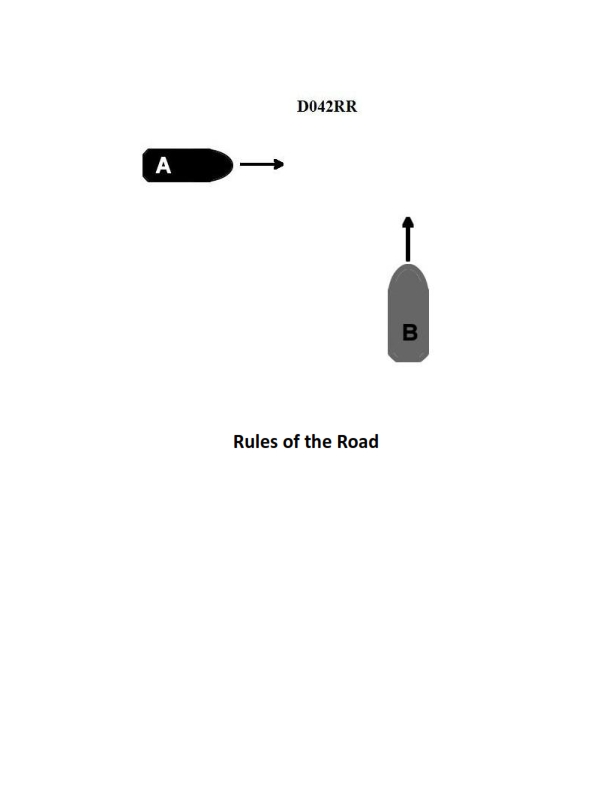
Question 77
Question: BOTH INTERNATIONAL & INLAND Two power-driven vessels are crossing as shown in illustration D042RR below. Vessel "A" sounds one short blast on the whistle. Vessel "B" is which of the following in this scenario?
A. give-way vessel
B. overtaking vessel
C. stand-on vessel
D. burdened vessel
The correct answer is C) stand-on vessel. In this scenario, Vessel "A" is the give-way vessel, as it has sounded one short blast on the whistle, indicating it intends to alter course to the right. Vessel "B" is the stand-on vessel, which means it must maintain its course and speed, allowing Vessel "A" to pass safely. The other options are incorrect because: A) Vessel "B" is not the give-way vessel, as it has the right-of-way; B) Vessel "B" is not the overtaking vessel, as it is crossing Vessel "A" at an angle; and D) Vessel "B" is not the burdened vessel, as it has the right-of-way in this crossing situation.
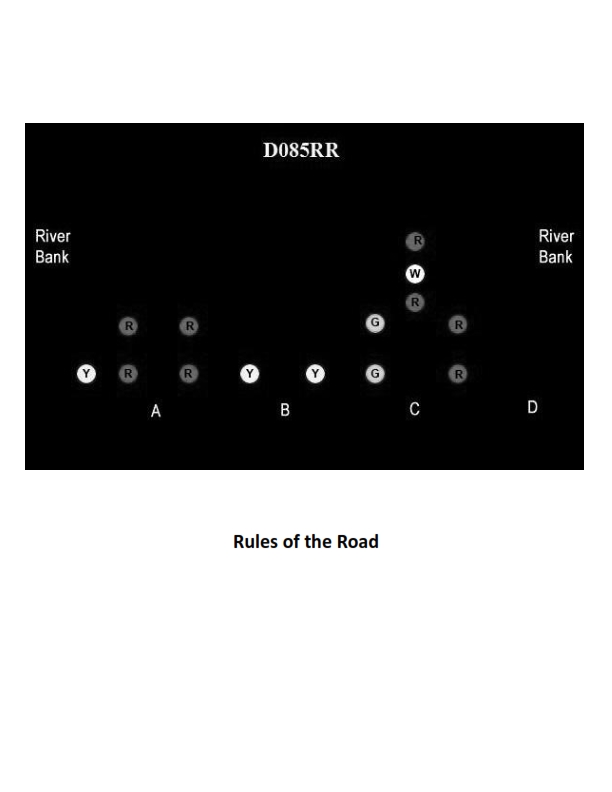
Question 91
Question: INLAND ONLY You see the lights shown in illustration D085RR below while proceeding in a channel. Where should you pass?
A. A
B. B
C. C
D. D
The correct answer is A. According to the Inland Navigation Rules, the lights shown in illustration D085RR indicate a vessel crossing a channel or fairway. In this situation, you should pass the vessel displaying these lights on the side indicated by the flashing light - in this case, the side indicated by the light at position A. The other options are incorrect because B, C, and D do not correspond to the side indicated by the flashing light, which is the proper side to pass the vessel.
Question 99
Question: BOTH INTERNATIONAL & INLAND Two vessels are meeting in a narrow channel as shown in illustration D037RR below. Vessel "A" is a sailing vessel. Vessel "B" is a power-driven vessel which can safely navigate only within the channel. Vessel "B" sounds the danger signal. Vessel "A" shall take what action?
A. sound one prolonged followed by two short blasts
B. have the right of way
C. not impede the passage of vessel "B"
D. maintain course and speed
The correct answer is C) not impede the passage of vessel "B". In this scenario, vessel "B" is a power-driven vessel that can only safely navigate within the narrow channel. The International Regulations for Preventing Collisions at Sea (COLREGS) state that a sailing vessel (vessel "A") must not impede the safe passage of a power-driven vessel (vessel "B") in a narrow channel. Vessel "B" has sounded the danger signal, indicating it is in a constrained situation and requires the sailing vessel to take action to avoid impeding its passage. The other answer choices are incorrect because: A) sounding the danger signal is the responsibility of vessel "B", not vessel "A"; B) the sailing vessel does not have the right of way in this situation; and D) maintaining course and speed would impede the passage of vessel "B", which is not allowed.
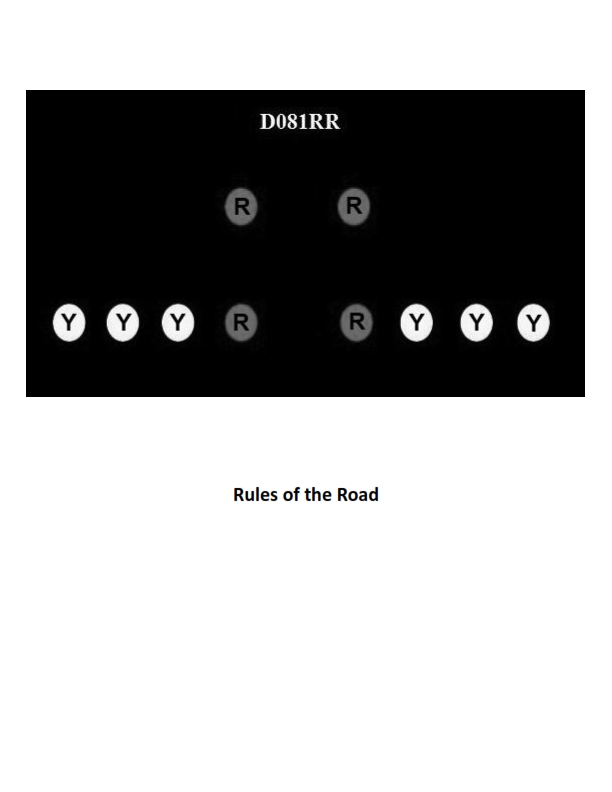
Question 114
Question: INLAND ONLY While underway you sight the lights shown in illustration D081RR below with the yellow lights flashing. The lights displayed indicate which of the following?
A. vessel aground
B. dredge pipeline
C. mine clearance vessel
D. vessel not under command
The correct answer is B) dredge pipeline. The flashing yellow lights displayed in illustration D081RR indicate a dredge pipeline, which is a submerged pipeline used for dredging operations. According to the U.S. Coast Guard regulations, vessels engaged in dredging or underwater operations are required to display these flashing yellow lights to warn other vessels in the area of the obstruction. The other answer choices are incorrect because they do not match the visual cue provided in the illustration. A vessel aground would display different lights, a mine clearance vessel would have different signaling requirements, and a vessel not under command would display different configurations of red and white lights.
Question 115
Question: INLAND ONLY Two power-driven vessels are crossing within a half a mile of each other as shown in illustration D042RR below. Vessel "A" sounds one short blast on the whistle, what does this signal mean?
A. "I intend to leave you on my port side"
B. "I intend to leave you on my starboard side"
C. "I am altering my course to starboard"
D. None of the above
The correct answer is A) "I intend to leave you on my port side". The reasoning is based on the Inland Navigation Rules, Rule 34(a), which states that "When two power-driven vessels are crossing so as to involve risk of collision, the vessel which has the other on her own port side shall hold her course and speed." By sounding one short blast, Vessel A is signaling that it intends to alter course to pass the other vessel on its port side, in accordance with the navigation rules. The other options are incorrect because: B) would indicate that Vessel A intends to pass on the starboard side, which is the opposite of the one-blast signal; C) would indicate that Vessel A is altering course to starboard, which is not the case based on the one-blast signal.
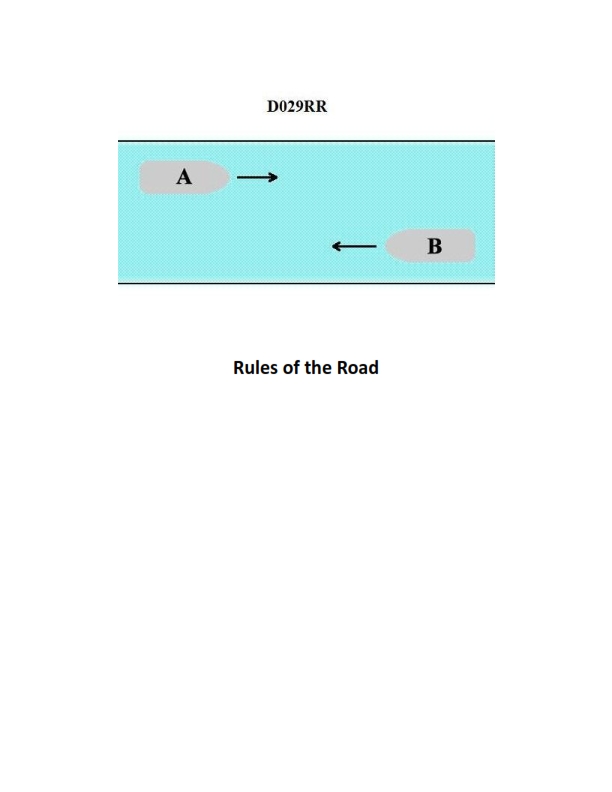
Question 128
Question: INLAND ONLY Vessels "A" and "B" are meeting on a river as shown in illustration D029RR below and will pass 1/4 mile apart. Which statement is TRUE?
A. The vessels must exchange two blast whistle signals and pass port to port.
B. The vessels may reach agreement by radiotelephone and sound no whistle signal.
C. The vessels must exchange one blast whistle signals and pass starboard to starboard
D. Both vessels should continue on course and pass without sounding any whistle signals.
The correct answer is B) The vessels may reach agreement by radiotelephone and sound no whistle signal. This is correct because under the Inland Navigation Rules, when two power-driven vessels are meeting on a river and will pass at least 1/4 mile apart, the vessels may communicate by radiotelephone and agree on the safest method of passing, without the need to exchange whistle signals. As long as the vessels can clearly see each other and reach a verbal agreement, they are not required to sound any whistle signals. The other options are incorrect because they do not align with the Inland Navigation Rules for this scenario. Options A, C, and D all prescribe the use of whistle signals, which is not necessary if the vessels can communicate by radiotelephone and agree on the passing arrangement.
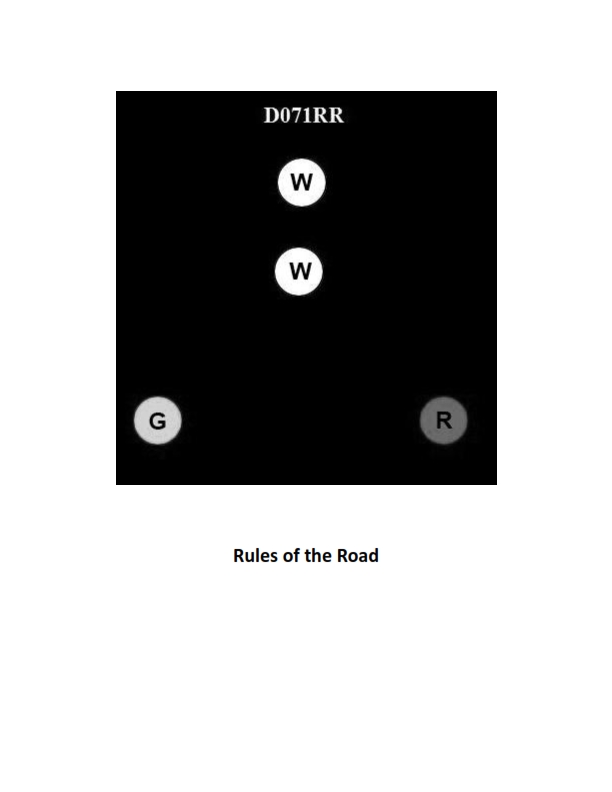
Question 132
Question: BOTH INTERNATIONAL & INLAND While underway at night, you sight a vessel ahead displaying the lights shown in illustration D071RR below. How should the vessels pass?
A. You should sound an appropriate overtaking signal.
B. Both vessels should alter course to starboard and pass port to port.
C. Both vessels should alter course to port and pass starboard to starboard.
D. Your vessel should hold course and speed and the other vessel should keep clear.
The correct answer is B) Both vessels should alter course to starboard and pass port to port. This is correct because the lights displayed in illustration D071RR indicate that the vessel ahead is a power-driven vessel underway. According to the International Regulations for Preventing Collisions at Sea (COLREGS), when two power-driven vessels are meeting head-on, they should both alter course to starboard and pass port-to-port. The other options are incorrect because: A) Sounding an overtaking signal is not appropriate in a head-on situation. C) Altering course to port would result in a starboard-to-starboard pass, which is the opposite of the COLREGS requirement. D) Holding course and speed is not the correct action for a head-on encounter.
Question 140
Question: BOTH INTERNATIONAL & INLAND You are on Vessel "A" engaged in fishing in a narrow channel as shown in illustration D037RR below. Vessel "B" is a tanker proceeding in the channel. Vessel "B" sounds five short and rapid blasts. What action should you take?
A. sound one prolonged followed by two short blasts
B. not impede the passage of vessel "B"
C. not answer the whistle signals from vessel "B"
D. maintain course and speed
The correct answer is B) not impede the passage of vessel "B". The reasoning behind this is that under the International Regulations for Preventing Collisions at Sea (COLREGS), vessels engaged in fishing are considered to be the give-way vessel when meeting a power-driven vessel (like the tanker, vessel "B") in a narrow channel. Therefore, vessel "A" should take action to not impede the safe passage of the tanker (vessel "B"), which is sounding the five short and rapid blasts to indicate that it is taking action to avoid a collision. The other answer choices are incorrect because: A) sounding whistle signals is not the appropriate action for vessel "A" to take; C) not answering the whistle signals would be improper and could be unsafe; and D) maintaining course and speed would impede the passage of the give-way vessel (vessel "B"), which is not allowed under the COLREGS.
Question 143
Question: BOTH INTERNATIONAL & INLAND You are on vessel "B" and crossing a narrow channel. Vessel "A", who can only navigate within the channel, is on your port bow and crossing as shown in illustration D040RR below. Which action should you take?
A. Give-way to the other vessel.
B. Maintain course and speed as the ship is on your port bow.
C. Sound the danger signal.
D. Increase speed and cross his bow.
The correct answer is A) Give-way to the other vessel. The reason this is the correct answer is that under both the International and Inland Navigation Rules, vessel "B" is the give-way vessel because vessel "A" is on its port bow and is constrained to the channel. Vessel "B" must take early and substantial action to keep well clear of vessel "A" by either slowing down, stopping, or altering course to starboard. Options B, C, and D would be incorrect actions that would violate the navigation rules.
Question 146
Question: INLAND ONLY While underway you sight the lights shown in illustration D081RR below with the yellow lights flashing. The lights displayed should have which of the following characteristics?
A. visible for at least one mile
B. flashing at intervals of 120 flashes per minute
C. more than 50 meters apart
D. visible at night and during periods of restricted visibility If choice D is selected set score to 1.
The correct answer is D) visible at night and during periods of restricted visibility. The lights shown in illustration D081RR are Restricted Flashing Yellow Lights, which are used to mark obstructions or hazards to navigation. According to the U.S. Coast Guard Inland Navigation Rules, these lights must be visible at night and during periods of restricted visibility, which makes option D the correct choice. The other options are incorrect because they do not fully capture the requirements for Restricted Flashing Yellow Lights. Option A is incorrect as the visibility requirement is not limited to 1 mile. Option B is incorrect as the flashing rate is not specified. Option C is incorrect as the distance between the lights is also not a requirement for this type of navigational aid.
Question 147
Question: BOTH INTERNATIONAL & INLAND Two power-driven vessels are crossing as shown in illustration D042RR below. Vessel "A" sounds one short blast on the whistle. What is Vessel "A" considered in this scenario?
A. the stand-on vessel
B. the give-way vessel
C. the overtaking vessel
D. None of the above
The correct answer is B) the give-way vessel. In this scenario, the power-driven vessels are crossing, and Vessel "A" sounds one short blast on the whistle. According to the International Regulations for Preventing Collisions at Sea (COLREGS), the vessel that sounds the one short blast is considered the give-way vessel, which must take early and substantial action to keep well clear of the other vessel. The other options are incorrect because: A) the stand-on vessel is the vessel that maintains its course and speed, which is not the case here; C) the overtaking vessel is the vessel that is overtaking another from a direction more than 22.5 degrees abaft the beam of the other vessel, which is not the situation described.
Question 161
Question: INLAND ONLY You are on a power-driven vessel "I" as shown in illustration D036RR below. Vessel "II" is a power-driven vessel engaged in fishing that will pass within 1/2 a mile of your vessel. You sound one short blast on the whistle. Vessel "II" does not sound any signal. Which action should you take?
A. Sound the danger signal and reduce speed.
B. Hold course and speed without giving a signal.
C. Sound one short blast, reduce speed and turn to starboard.
D. Sound two short blasts and change course to port.
The correct answer is A) Sound the danger signal and reduce speed. The reasoning behind this is that based on the International Regulations for Preventing Collisions at Sea (COLREGS), when two power-driven vessels are meeting on reciprocal or nearly reciprocal courses such that there is a risk of collision, the vessel that has the other on its own starboard side is the stand-on vessel and must maintain its course and speed. The give-way vessel, in this case vessel "II", is required to take early and substantial action to avoid the collision. By sounding the danger signal (five or more short and rapid blasts on the whistle), vessel "I" is alerting the other vessel of the risk of collision and indicating that the give-way vessel has not taken appropriate action. Reducing speed also helps to further reduce the risk of collision. The other options are incorrect because B) would not provide the necessary warning to the other vessel, C) would be the incorrect signal to give, and D) would be the wrong course of action for the stand-on vessel.
Question 162
Question: INLAND ONLY Power-driven vessels "A" and "B" are meeting on a river as shown in illustration D041RR below and will pass about 1/4 mile apart. Which action should the vessels take?
A. The vessels should exchange one blast whistle signals and pass starboard to starboard
B. The vessels should exchange two blast whistle signals and pass starboard to starboard.
C. The vessels should pass starboard to starboard and must sound whistle signals only if either vessel changes course.
D. The vessels should continue on course and pass without sounding any whistle signals.
The correct answer is B) The vessels should exchange two blast whistle signals and pass starboard to starboard. This is the correct answer because under the Inland Navigation Rules, when two power-driven vessels are meeting on a river and will pass about 1/4 mile apart, they should exchange two blast whistle signals to indicate they will pass starboard-to-starboard. This is the appropriate action to take when the vessels are meeting in a head-on or nearly head-on situation. The other options are incorrect because option A calls for one blast signal instead of two, option C does not require the vessels to exchange any whistle signals, and option D would have the vessels pass without any whistle signals, which is not the proper procedure for this scenario under the Inland Navigation Rules.
Question 173
Question: INLAND ONLY Two power-driven vessels are crossing within a half a mile of each other as shown in illustration D042RR below. Vessel "A" sounds one short blast on the whistle. What action should vessel "B" take?
A. sound the danger signal and slow to moderate speed
B. maintain course and speed without sounding any signals
C. sound one short blast and maintain course and speed
D. alter course to the right or slowdown
The correct answer is C) sound one short blast and maintain course and speed. According to the Inland Navigation Rules, when two power-driven vessels are crossing so as to involve risk of collision, the vessel that has the other on her own starboard side shall alter course to avoid collision (Rule 15). In this scenario, vessel "A" is the give-way vessel and has sounded one short blast to indicate that she intends to alter course to starboard. Vessel "B", the stand-on vessel, should respond by sounding one short blast to acknowledge the intended action and maintain her course and speed. The other options are incorrect because: A) sounding the danger signal and slowing down is not the appropriate response for the stand-on vessel; B) the stand-on vessel should acknowledge the give-way vessel's intentions; and D) altering course or slowing down is the responsibility of the give-way vessel, not the stand-on vessel.
Question 177
Question: BOTH INTERNATIONAL & INLAND Vessels "I" and "II" are power-driven vessels. You are on vessel "I" as shown in illustration D036RR below. In this scenario you are which of the following?
A. overtaking vessel
B. stand-on vessel
C. give-way vessel
D. None of the above
The correct answer is B) stand-on vessel. According to the International Regulations for Preventing Collisions at Sea (COLREGS), when two power-driven vessels are meeting in a crossing situation, the vessel that has the other on its starboard side is the stand-on vessel and must maintain its course and speed, while the vessel that has the other on its port side is the give-way vessel and must take early and substantial action to avoid collision. In the scenario described, vessel "I" has vessel "II" on its starboard side, so vessel "I" is the stand-on vessel and must maintain its course and speed, while vessel "II" is the give-way vessel and must take action to avoid collision.
Question 180
Question: INLAND ONLY What do the lights shown in illustration D075RR below represent?
A. vessel underway and dredging
B. vessel pushing ahead
C. pipeline
D. vessel being towed astern
The correct answer is B) vessel pushing ahead. The lights shown in illustration D075RR represent the navigation lights required for a vessel that is pushing ahead, which is a common configuration for inland waterways. According to the Inland Navigation Rules, a vessel that is pushing ahead must display the same navigation lights as a self-propelled vessel underway, including a masthead light, sidelights, and a stern light. This lighting configuration allows other vessels to identify the direction of movement and the overall size and shape of the pushing vessel. The other answer choices are incorrect because they do not accurately represent the lighting arrangement shown in the illustration. A vessel underway and dredging would have additional lights, a vessel being towed astern would have a different lighting configuration, and a pipeline would not have any navigation lights.
Question 184
Question: INLAND ONLY Two power-driven vessels are meeting in a narrow channel on the Great lakes as shown in illustration D029RR below. Vessel "A" is downbound with a following current. Vessel "B" should do which of the following?
A. Take action to permit safe passage
B. Initiate the maneuvering signals
C. Have the right of way
D. None of the above
The correct answer is A) Take action to permit safe passage. In this situation, Vessel "B" should take action to permit safe passage because it is the overtaking vessel in a narrow channel. According to the Inland Navigation Rules, the vessel that is overtaking another vessel in a narrow channel must take early and substantial action to permit safe passage. Vessel "A" has the right of way as the downbound vessel, so Vessel "B" must take the necessary steps to safely pass Vessel "A" without impeding its progress. The other answer choices are incorrect because B) initiating maneuvering signals is not the appropriate action for the overtaking vessel, C) Vessel "A" has the right of way as the downbound vessel, and D) some action must be taken by Vessel "B" to ensure safe passage.
Question 190
Question: INLAND ONLY Identify the operation indicated by the lights exhibited as shown in illustration D085RR below.
A. A vessel aground assisted by tugs
B. A submarine engaged in underway replenishment
C. Aircraft carrier engaged in the launching and recovery of aircraft
D. None of the above
The correct answer is D) None of the above. The illustration D085RR depicts the lights exhibited by a vessel engaged in river-crossing or dredging operations, as per the Inland Navigation Rules. This operation is not represented by any of the answer choices provided. Vessels engaged in river-crossing or dredging operations are required to display the lights shown in the illustration, which do not match the lighting configurations for a vessel aground, a submarine, or an aircraft carrier.
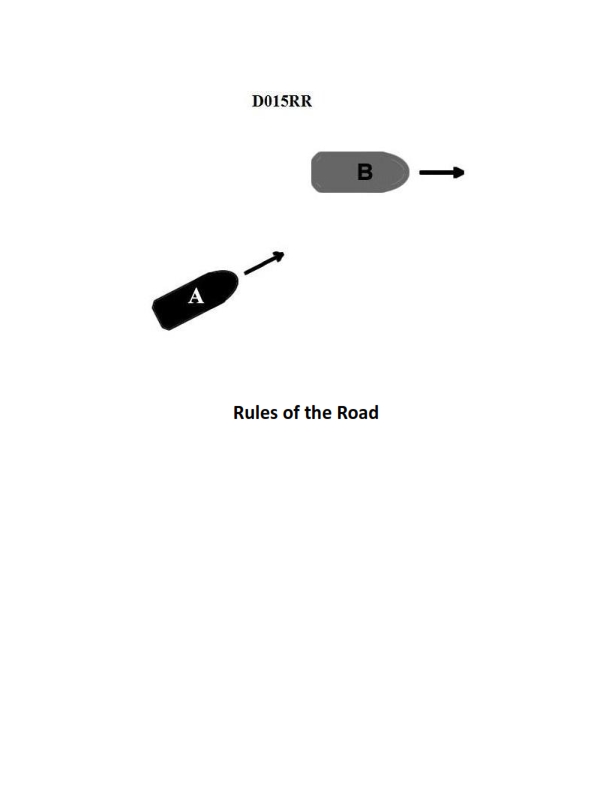
Question 193
Question: BOTH INTERNATIONAL & INLAND You are on vessel "A" and approaching vessel "B" as shown in illustration D015RR below. You are not sure whether your vessel is crossing or overtaking vessel "B". You should take which of the following actions?
A. consider it to be a crossing situation
B. consider it to be an overtaking situation
C. consider it a crossing situation if you can cross ahead safely
D. change course to make the situation definitely either crossing or overtaking
The correct answer is B) consider it to be an overtaking situation. According to the Navigation Rules (International and Inland), when you are approaching another vessel from a direction more than 22.5 degrees abaft its beam (behind the vessel), it is considered an overtaking situation, regardless of the relative positions of the two vessels. Since the illustration shows the approaching vessel coming from behind the other vessel, it should be treated as an overtaking situation. The other options are incorrect because: A) considering it a crossing situation would be incorrect in this case, as the vessels are not meeting at a right angle; C) crossing ahead safely is not an option when the situation is overtaking; and D) changing course to make it either crossing or overtaking is unnecessary, as the situation is clearly overtaking based on the relative positions of the vessels.
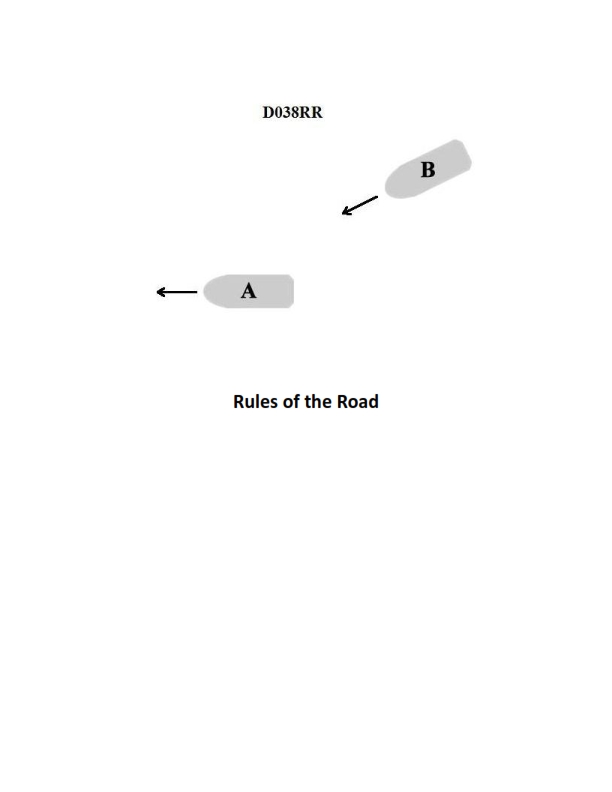
Question 194
Question: BOTH INTERNATIONAL & INLAND You are underway on vessel "B" approaching vessel "A" as shown in illustration D038RR below. You are unable to see any sidelights on vessel "A". What type of situation is this?
A. crossing situation
B. special circumstances situation
C. meeting situation
D. overtaking situation
The correct answer is D) overtaking situation. This is an overtaking situation because you are approaching vessel "A" from behind and you are unable to see any sidelights on vessel "A". According to the Navigation Rules, a vessel is in an overtaking situation when it is coming up with another vessel from a direction more than 22.5 degrees abaft its beam, meaning from behind. In this case, since you cannot see the sidelights on vessel "A", it indicates that you are approaching from behind and therefore this is an overtaking situation. The other answer choices are incorrect because a crossing situation involves vessels crossing each other's path, a meeting situation involves vessels approaching each other head-on, and a special circumstances situation would require additional information not provided in the question.
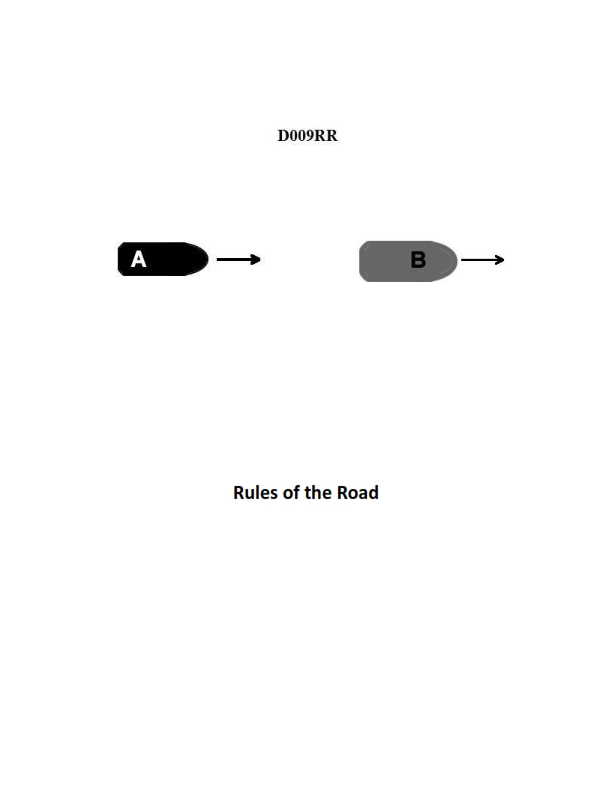
Question 195
Question: BOTH INTERNATIONAL & INLAND Vessel "A" is overtaking vessel "B" as shown in illustration D009RR below. Which vessel is the stand-on vessel?
A. Vessel "A"
B. Neither vessel
C. Vessel "B"
D. Both vessels must keep clear of the other.
The correct answer is C) Vessel "B". According to the International Regulations for Preventing Collisions at Sea (COLREGS), when a vessel is overtaking another vessel, the overtaking vessel (Vessel "A") is the give-way vessel and must keep out of the way of the vessel being overtaken (Vessel "B"), which is the stand-on vessel. This rule applies to both international and inland navigation. The other options are incorrect because: A) Vessel "A" is the give-way vessel, not the stand-on vessel. B) One of the vessels must be the stand-on vessel. D) Only Vessel "A" must keep clear, not both vessels.
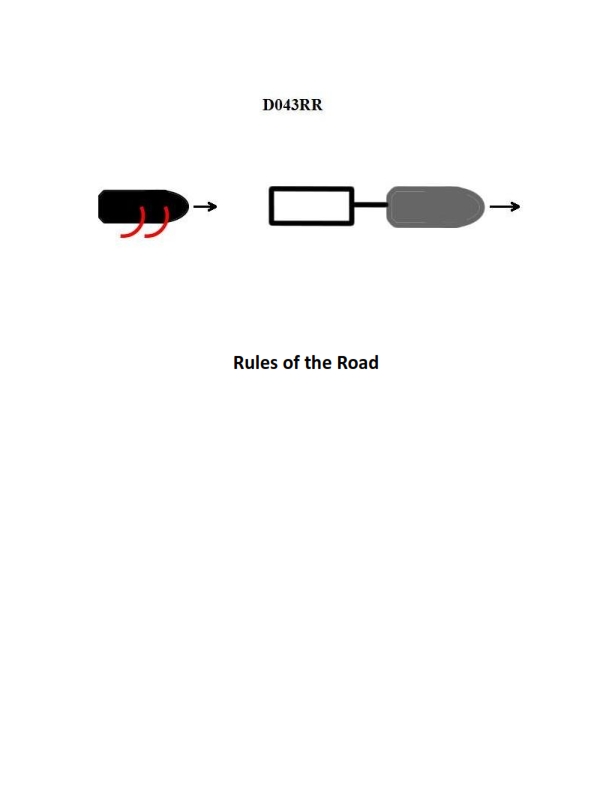
Question 196
Question: BOTH INTERNATIONAL & INLAND A sailing vessel is overtaking a tug and tow as shown in illustration D043RR below. Which statement is correct?
A. The tug is the stand-on vessel because it is being overtaken.
B. The sailing vessel is the stand-on vessel because it is overtaking.
C. The tug is the stand-on vessel because it is towing.
D. The sailing vessel is the stand-on vessel because it is under sail.
The correct answer is A) The tug is the stand-on vessel because it is being overtaken. According to the International Regulations for Preventing Collisions at Sea (COLREGS), Rule 13 on Overtaking states that the vessel being overtaken is the stand-on vessel, regardless of whether it is a sailing vessel or a vessel under power. In this case, the tug and tow is the vessel being overtaken by the sailing vessel, so the tug is the stand-on vessel and must maintain its course and speed. The sailing vessel, as the overtaking vessel, must keep out of the way of the tug. The other answer choices are incorrect because they do not properly apply the COLREGS rules on overtaking situations.
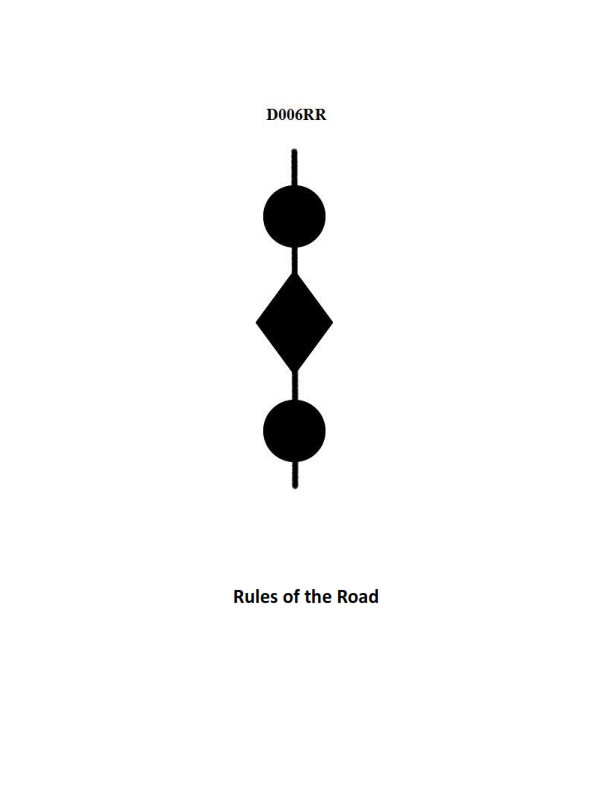
Question 197
Question: BOTH INTERNATIONAL & INLAND While underway you sight a vessel displaying the shapes shown in illustration D006RR below. What action should you take?
A. stay clear, the other vessel cannot get out of the way
B. contact the vessel on VHF radiotelephone
C. stop your vessel and sound passing signals
D. provide assistance, the other vessel is in distress
The correct answer is A) stay clear, the other vessel cannot get out of the way. The shapes displayed in illustration D006RR indicate that the other vessel is restricted in its ability to maneuver. This means the vessel is engaged in an operation that severely limits its ability to change course or speed. As the give-way vessel, you should take early and substantial action to keep well clear of the restricted vessel, as it cannot readily get out of your way. The other options are incorrect because: B) contacting the vessel on VHF is not the proper action, C) stopping and sounding passing signals is not required, and D) the vessel is not in distress, it is simply restricted in its maneuverability.
Question 198
Question: BOTH INTERNATIONAL & INLAND Vessel "A" is overtaking vessel "B" as shown in illustration D017RR below and will pass without changing course. Which light will vessel "A" observe on vessel "B"?
A. green sidelight
B. white stern light
C. yellow towing light
D. None of the above
The correct answer is B) white stern light. According to the International Regulations for Preventing Collisions at Sea (COLREGS), when a vessel is overtaking another vessel, the overtaking vessel (Vessel A) shall keep out of the way of the vessel being overtaken (Vessel B). In this situation, Vessel A will observe the white stern light of Vessel B, as the stern light indicates the direction the vessel is heading. The other answer choices are incorrect because: A) the green sidelight would not be visible from the overtaking position, C) the yellow towing light is not relevant in this scenario of a simple overtaking maneuver.
Question 200
Question: BOTH INTERNATIONAL & INLAND Vessel "A" is overtaking vessel "B" as shown in illustration D017RR below. Which of the following describes vessel "A" in this scenario?
A. stand-on vessel
B. give-way vessel
C. overtaken vessel
D. None of the above
The correct answer is B) give-way vessel. In the scenario depicted in illustration D017RR, vessel "A" is overtaking vessel "B". According to the International Regulations for Preventing Collisions at Sea (COLREGS) and the Inland Navigation Rules, the overtaking vessel (vessel "A") is the give-way vessel and must take early and substantial action to keep well clear of the vessel being overtaken (vessel "B"), which is the stand-on vessel. The other options are incorrect because: A) stand-on vessel applies to the vessel being overtaken (vessel "B"), not the overtaking vessel (vessel "A"); C) overtaken vessel also applies to vessel "B", not vessel "A"; and D) none of the above is not correct, as option B) is the proper answer.
Question 202
Question: BOTH INTERNATIONAL & INLAND Vessel "A" is overtaking vessel "B" as shown in illustration D017RR below. Vessel "B" should do which of the following?
A. may steer various courses and vessel "A" must keep clear
B. should slow down until vessel "A" has passed
C. should hold her course and speed
D. should change course to the right
The correct answer is C) should hold her course and speed. In this situation, the International and Inland Navigational Rules indicate that when a vessel "A" is overtaking vessel "B", vessel "B" should maintain its course and speed. The overtaking vessel "A" is required to keep clear and pass at a safe distance. Vessel "B" should not take any action that could interfere with the safe passage of the overtaking vessel "A". The other options are incorrect because: A) Vessel "B" does not have the right to steer various courses, as the overtaking vessel "A" must keep clear. B) Slowing down is not required, as vessel "B" should maintain its course and speed. D) Changing course to the right is not necessary, as vessel "B" should hold its course.
Question 213
Question: BOTH INTERNATIONAL & INLAND You are on vessel "A" pushing a barge ahead and meeting vessel "B" as shown in illustration D012RR below. How should the vessels pass?
A. The vessels should determine which will alter course by sounding whistle signals.
B. Vessel "A" should maintain course and vessel "B" alter course.
C. Both vessels must alter course to starboard and pass port to port.
D. Both vessels must alter course to port and pass starboard to starboard.
The correct answer is C) Both vessels must alter course to starboard and pass port to port. This is the correct answer because the International Regulations for Preventing Collisions at Sea (COLREGS) Rule 14 states that when two power-driven vessels are meeting head-on, each vessel shall alter course to starboard so that they may pass port-to-port. Since the vessels in the illustration are meeting head-on, they must both alter course to starboard to safely pass each other. The other options are incorrect because A) relying on whistle signals is not the primary method for passing head-on, B) only one vessel altering course goes against the COLREGS requirement for both vessels to take action, and D) passing starboard-to-starboard is the incorrect maneuvering for a head-on meeting situation.
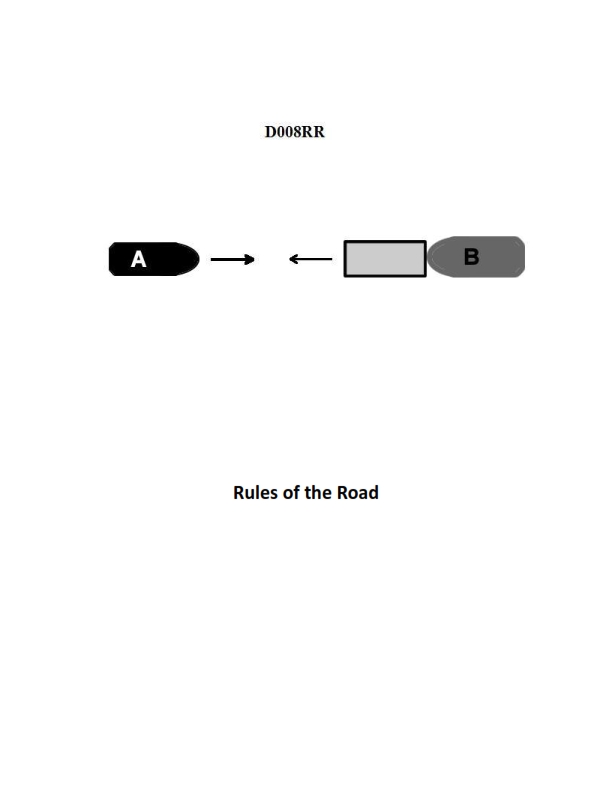
Question 223
Question: BOTH INTERNATIONAL & INLAND Vessel "A" and vessel "B" (which is pushing ahead) are meeting head-on as shown in illustration D008RR below. How must the vessels pass?
A. Vessel "A" must alter course while vessel "B" continues on its present course.
B. Both vessels should alter course to starboard and pass port to port.
C. Both vessels should alter course to port and pass starboard to starboard.
D. The vessels should determine which will alter course by exchanging whistle signals.
The correct answer is B) Both vessels should alter course to starboard and pass port to port. This is the correct answer because under the International Regulations for Preventing Collisions at Sea (COLREGS), when two power-driven vessels are meeting head-on, they must both alter course to starboard to pass port-to-port. This is the standard crossing situation in the COLREGS and applies to both international and inland waters. The other answer choices are incorrect because: A) Altering only one vessel's course is not the correct action for a head-on meeting situation. C) Passing starboard-to-starboard would be incorrect for a head-on meeting. D) Exchanging whistle signals is not necessary, as the COLREGS clearly dictate the required action for a head-on meeting.
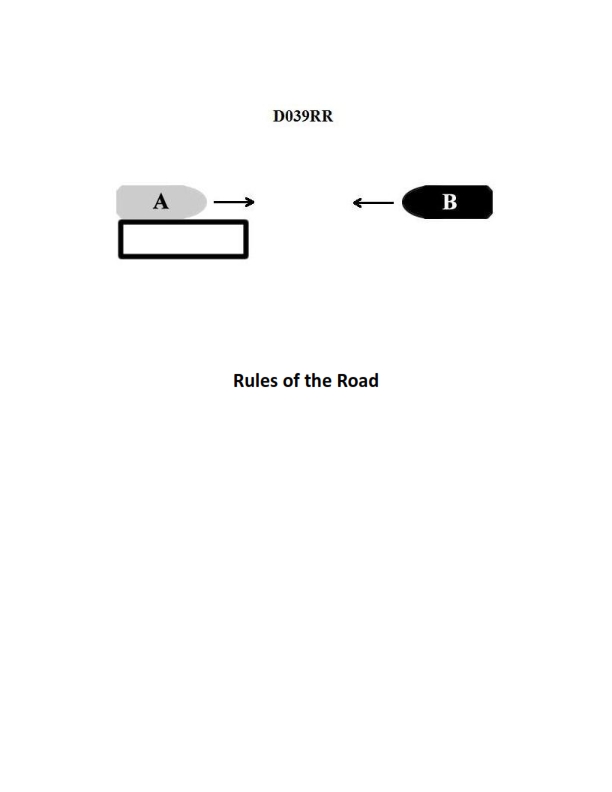
Question 228
Question: BOTH INTERNATIONAL & INLAND You are on vessel "A" towing a barge alongside and meeting power-driven vessel "B" as shown in illustration D039RR below. Which action should you take?
A. Alter course to port
B. Back down to reduce the strain on the lines
C. Alter course to starboard
D. Maintain course and speed
The correct answer is C) Alter course to starboard. According to the International Regulations for Preventing Collisions at Sea (COLREGS), Rule 14 - Head-on Situation, when two power-driven vessels are meeting on reciprocal or nearly reciprocal courses, each vessel shall alter course to starboard to pass with a safe clearance. This applies to both international and inland waterways. The other options are incorrect because: A) Altering course to port would be the wrong action in a head-on situation; B) Backing down would not be the appropriate action to take in this scenario; and D) Maintaining course and speed would go against the COLREGS requirement to alter course to starboard in a head-on encounter.
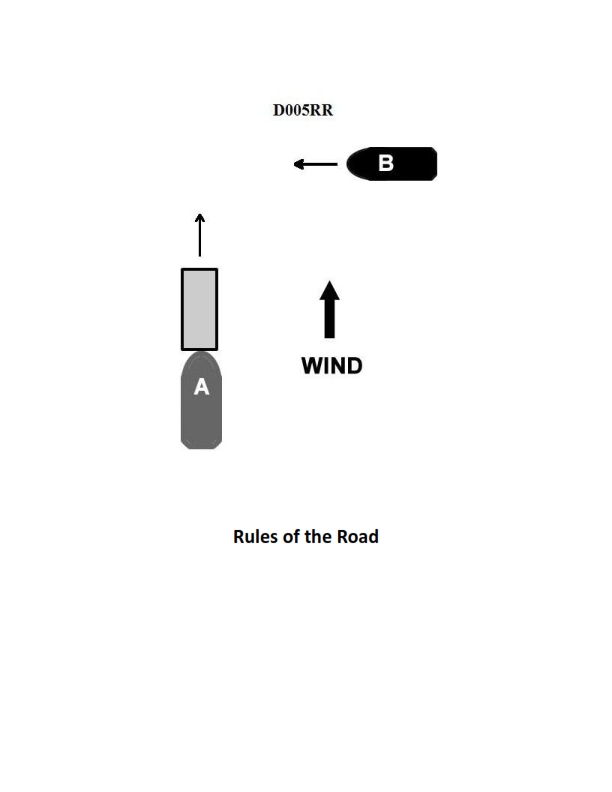
Question 241
Question: BOTH INTERNATIONAL & INLAND Vessel "A" is underway and pushing ahead when vessel "B" is sighted off the starboard bow as shown in illustration D005RR below. Which statement is TRUE?
A. Vessel "A" is the stand-on vessel because it is pushing ahead.
B. Vessel "A" is the stand-on vessel because it is to the port side of vessel "B".
C. Vessel "B" is the stand-on vessel because it is to starboard of vessel "A".
D. Neither vessel is the stand-on vessel.
The correct answer is C) Vessel "B" is the stand-on vessel because it is to starboard of vessel "A". This is correct because under the International Regulations for Preventing Collisions at Sea (COLREGS), Rule 15 states that when two power-driven vessels are crossing, the vessel that has the other on its own starboard side is the stand-on vessel. In this case, vessel "B" is to the starboard side of vessel "A", so vessel "B" is the stand-on vessel. The other answer choices are incorrect because A) vessel "A" is not the stand-on vessel simply because it is pushing ahead, and B) and D) are wrong since vessel "B" is the stand-on vessel in this crossing situation.
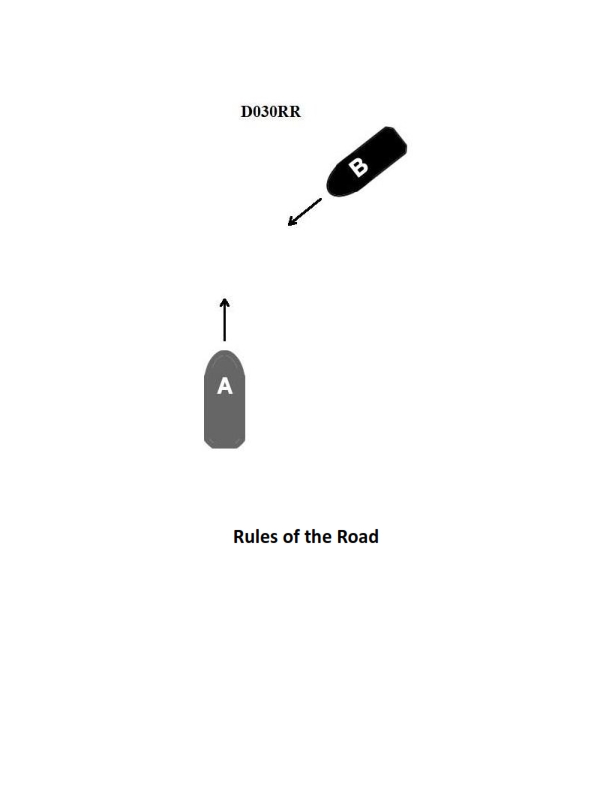
Question 244
Question: BOTH INTERNATIONAL & INLAND Vessels "A" and "B" are crossing as shown in illustration D030RR below. Which statement is TRUE?
A. Vessel "B" should pass astern of vessel "A".
B. The vessels should pass starboard to starboard.
C. Vessel "B" should alter course to the right.
D. Vessel "A" must keep clear of vessel "B".
The correct answer is D) Vessel "A" must keep clear of vessel "B". This is based on the International Regulations for Preventing Collisions at Sea (COLREGS), which govern the rules of the road for vessels at sea. In a crossing situation, the vessel on the right (starboard) side has the right of way, and the vessel on the left (port) side must keep clear. In this case, vessel "B" is on the starboard side of vessel "A", so vessel "A" must take action to avoid a collision by altering course or speed to pass behind vessel "B". The other options are incorrect because they do not properly apply the COLREGS rules for a crossing situation. Vessel "B" should not pass astern of vessel "A", the vessels should not pass starboard-to-starboard, and vessel "B" does not need to alter course to the right, as vessel "A" is the one required to keep clear.
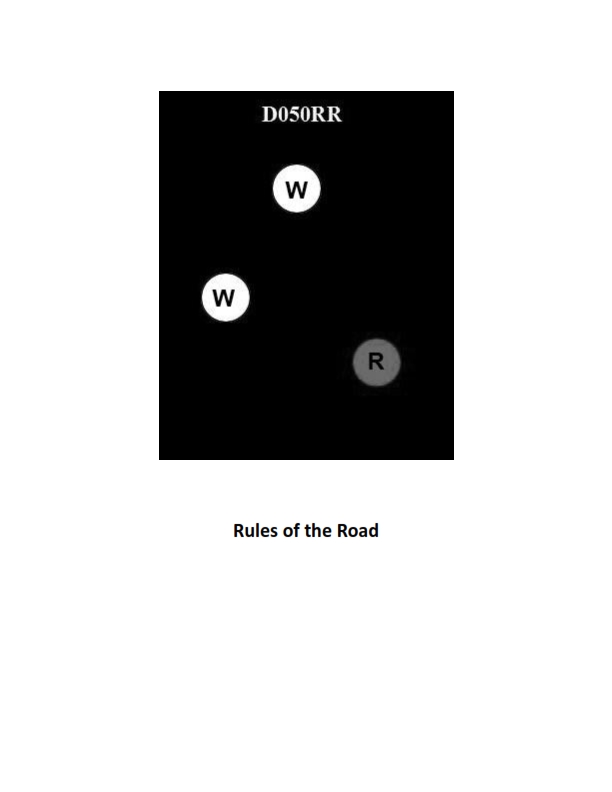
Question 248
Question: BOTH INTERNATIONAL & INLAND You see the lights shown in illustration D050RR below on your port bow. What action should you take?
A. stop engines
B. alter course to port
C. hold course and speed
D. sound the danger signal
You are correct, the answer is C) hold course and speed. This is the correct action because the lights shown in illustration D050RR represent the lights of a vessel that is overtaking you, coming up from behind on your port (left) side. According to the International and Inland Navigation Rules, the proper action for the vessel being overtaken is to hold course and speed, allowing the overtaking vessel to safely pass. The other answer choices are incorrect because stopping the engines or altering course to port would impede the safe passage of the overtaking vessel, and sounding the danger signal is not the appropriate action in this scenario.
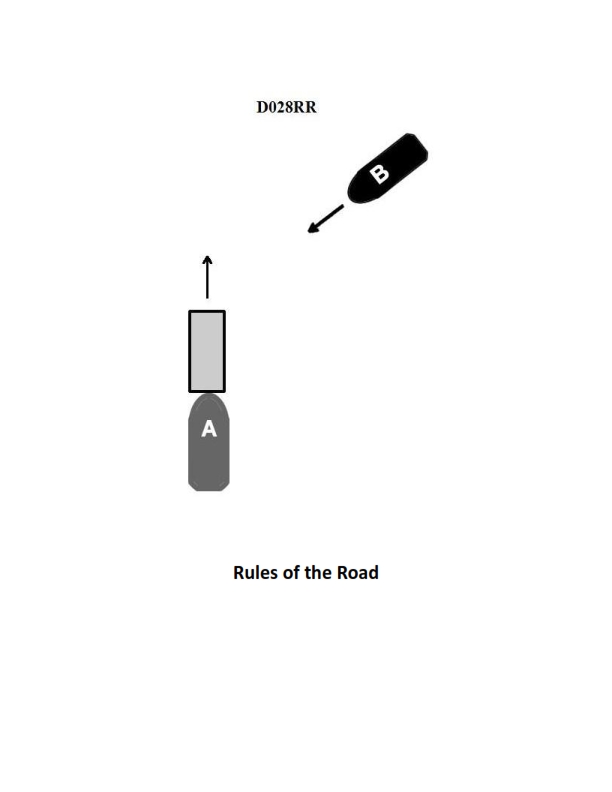
Question 253
Question: BOTH INTERNATIONAL & INLAND Vessel "A" is underway and pushing ahead when vessel "B" is sighted off the starboard bow as shown in illustration D028RR below. Which vessel is the stand-on vessel?
A. Vessel "B" is the stand-on vessel because it is to starboard of vessel "A".
B. Neither vessel is the stand-on vessel.
C. Vessel "A" is the stand-on vessel because it is to port.
D. Vessel "A" is the stand-on vessel because it is pushing ahead.
The correct answer is A) Vessel "B" is the stand-on vessel because it is to starboard of vessel "A". According to the International Regulations for Preventing Collisions at Sea (COLREGS), Rule 15, which governs crossing situations, the vessel that has the other on its starboard side (in this case, vessel "B") is the stand-on vessel and must maintain its course and speed. Vessel "A", being the give-way vessel, must take early and substantial action to avoid a collision. The other answer choices are incorrect because: B) Neither vessel is the stand-on vessel, which contradicts the COLREGS; C) Vessel "A" is not the stand-on vessel just because it is to port; and D) Vessel "A" being the pushing ahead vessel does not make it the stand-on vessel in a crossing situation.
Question 255
Question: BOTH INTERNATIONAL & INLAND In illustration D005RR below, vessel "A", which is pushing ahead, and vessel "B" are crossing. Which is the stand-on vessel?
A. Vessel "A" is the stand-on vessel because she is pushing ahead.
B. Vessel "B" is the stand-on vessel because she is to starboard of vessel "A".
C. Neither vessel is the stand-on vessel in this situation.
D. Vessel "A" is the stand-on vessel because she is to port of vessel "B".
The correct answer is B) Vessel "B" is the stand-on vessel because she is to starboard of vessel "A". According to the International and Inland Navigation Rules, when two power-driven vessels are crossing, the vessel that has the other on her own starboard side is the stand-on vessel and must maintain her course and speed. In this case, vessel "B" is to the starboard side of vessel "A", so vessel "B" is the stand-on vessel and must hold her course and speed. The other answer choices are incorrect because: A) Vessel "A" is the give-way vessel, not the stand-on vessel; C) One of the vessels must be the stand-on vessel according to the rules; and D) The relative positions of the vessels, not which one is to port, determine the stand-on vessel.
Question 271
Question: BOTH INTERNATIONAL & INLAND Vessel "A", a power-driven vessel underway, sights vessel "B" which is a vessel underway and fishing as shown in illustration D014RR below. Which statement is TRUE?
A. Vessel "A" must keep out of the way of vessel "B" because "B" is to port.
B. Vessel "A" must keep out of the way of vessel "B" because "B" is fishing.
C. In this case, both vessels are required by the Rules to keep clear of each other.
D. Vessel "B" must keep out of the way of vessel "A" because "A" is to starboard.
The correct answer is B) Vessel "A" must keep out of the way of vessel "B" because "B" is fishing. The reasoning is based on the International Regulations for Preventing Collisions at Sea (COLREGS), which state that a vessel engaged in fishing has the right-of-way over a power-driven vessel underway. This is covered in Rule 18 of the COLREGS, which outlines the responsibilities between different types of vessels. The other options are incorrect because: A) the fact that "B" is to port is irrelevant, as the fishing vessel has the right-of-way; C) both vessels do not have to keep clear of each other, as the power-driven vessel "A" must give way to the fishing vessel "B"; and D) "B" does not have to keep out of the way of "A" because "B" is the vessel engaged in fishing.
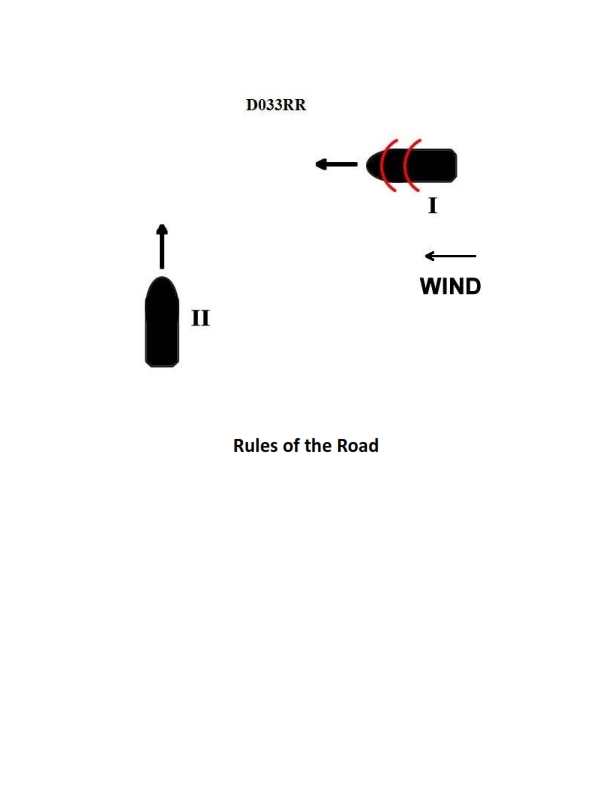
Question 272
Question: BOTH INTERNATIONAL & INLAND Vessels I and II are underway as shown in illustration D033RR below. Vessel I is a sailing vessel with the wind dead aft. Vessel II is a powerdriven vessel trawling. Which statement is TRUE?
A. Vessel II is to keep clear because the other vessel is to its starboard.
B. Both vessels are to take action to stay clear of each other.
C. Vessel I is to keep clear because the other vessel is fishing.
D. Vessel II is to keep clear because she is a power-driven vessel.
The correct answer is C) Vessel I is to keep clear because the other vessel is fishing. This is based on the International Regulations for Preventing Collisions at Sea (COLREGS), Rule 3(d) which states that a "power-driven vessel engaged in fishing shall, so far as possible, keep out of the way of a vessel not under command or a vessel restricted in her ability to maneuver." Since Vessel II is a power-driven vessel engaged in fishing (trawling), it has the right-of-way, and Vessel I, the sailing vessel, is required to keep clear. The other answer choices are incorrect because: A) Vessel II, as the power-driven fishing vessel, does not have to keep clear; B) Both vessels do not have to take action, as the sailing vessel is required to keep clear; and D) Vessel II, as the power-driven fishing vessel, does not have to keep clear.
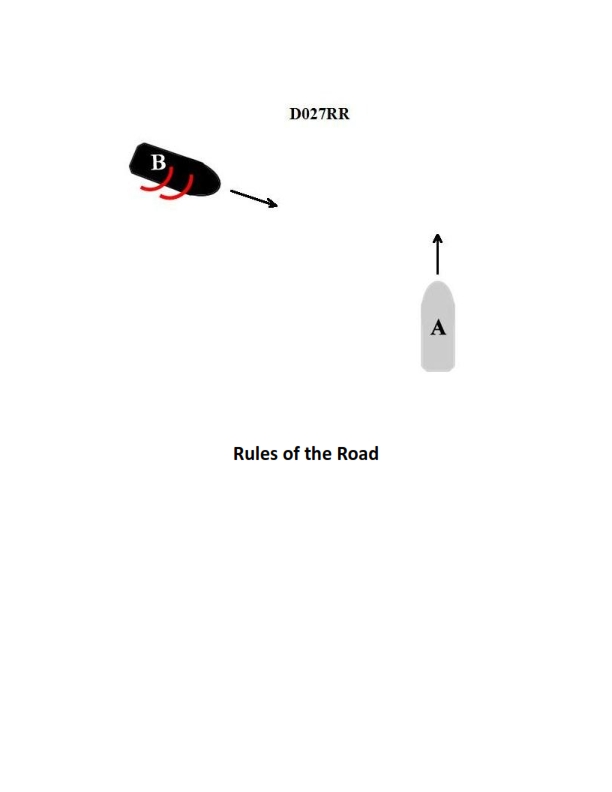
Question 273
Question: BOTH INTERNATIONAL & INLAND You are aboard vessel "A" , a power-driven vessel, on open waters and vessel "B", a sailing vessel, is sighted off your port bow as shown in illustration D027RR below. Which vessel is the stand-on vessel?
A. Vessel "A" because it is to starboard of vessel "B"
B. Vessel "B" because it is to port of vessel "A"
C. Vessel "B" because it is sailing
D. Vessel "A" because it is towing
The correct answer is C) Vessel "B" because it is sailing. According to the International Regulations for Preventing Collisions at Sea (COLREGS), a sailing vessel is the stand-on vessel when it is in a crossing situation with a power-driven vessel. This is because sailing vessels have less ability to maneuver quickly compared to power-driven vessels. Therefore, in the given scenario, vessel "B", the sailing vessel, is the stand-on vessel and must maintain its course and speed, while vessel "A", the power-driven vessel, must take early and substantial action to avoid a collision. The other options are incorrect because the relative positions of the vessels (option A) and the fact that vessel "A" is towing (option D) are not the determining factors in this crossing situation. The key factor is that vessel "B" is a sailing vessel, which makes it the stand-on vessel according to the COLREGS.
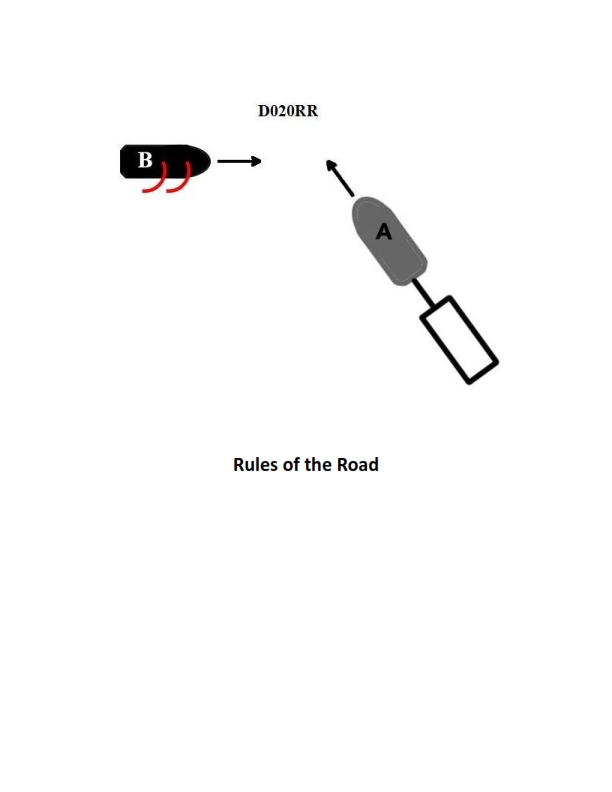
Question 275
Question: BOTH INTERNATIONAL & INLAND You are aboard vessel "A" which is towing on open waters when vessel "B", a sailing vessel, is sighted off your port bow as shown in illustration D020RR below. Which vessel is the stand-on?
A. Vessel "A" is the stand-on vessel because it is to starboard of vessel "B".
B. Vessel "B" is the stand-on vessel because it is sailing.
C. Vessel "B" is the stand-on vessel because it is to port of vessel "A".
D. Vessel "A" is the stand-on vessel because it is towing.
The correct answer is B. Vessel "B" is the stand-on vessel because it is a sailing vessel. The International Regulations for Preventing Collisions at Sea (COLREGS) state that in a crossing situation, the vessel that is not under power (the sailing vessel "B") is the stand-on vessel and must maintain its course and speed. The vessel under power (the towing vessel "A") is the give-way vessel and must take early and substantial action to avoid a collision. The other options are incorrect because the relative positions of the vessels are not the determining factor in this case - the fact that "B" is a sailing vessel makes it the stand-on vessel regardless of its position relative to "A".
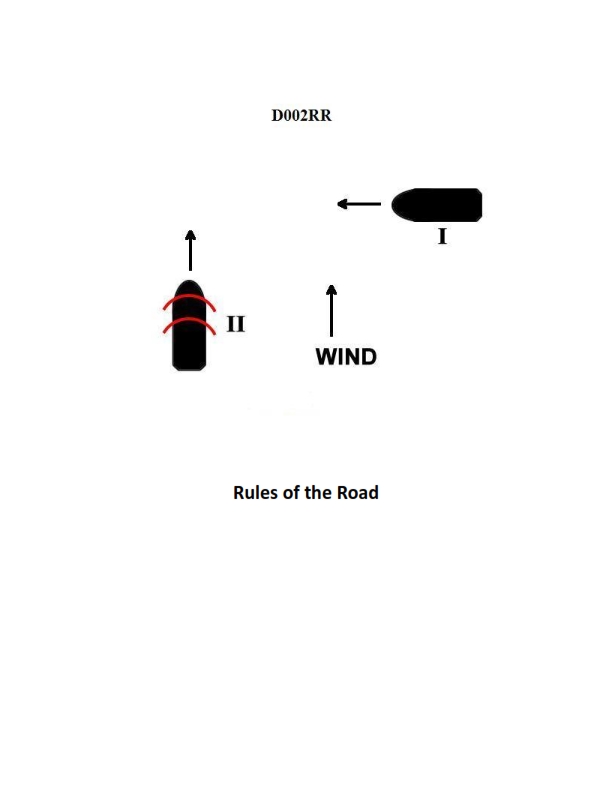
Question 276
Question: BOTH INTERNATIONAL & INLAND In illustration D002RR below, vessel I is a power-driven vessel. Vessel II is a sailing vessel with the wind dead aft. Which statement about this situation is correct?
A. Vessel I should keep out of the way of Vessel II.
B. Vessel II would normally be the stand-on vessel, but should stay out of the way in this particular situation.
C. Vessel II should keep out of the way of Vessel I.
D. The Rules of Special Circumstances applies, and neither vessel is the stand-on vessel.
The correct answer is A) Vessel I should keep out of the way of Vessel II. The reasoning is based on the International Regulations for Preventing Collisions at Sea (COLREGS), Rule 12, which states that when two sailing vessels are approaching one another, one vessel shall keep out of the way of the other. In this situation, Vessel II is a sailing vessel with the wind dead aft, while Vessel I is a power-driven vessel. Therefore, according to the COLREGS, Vessel I should keep out of the way of Vessel II. The other options are incorrect because B) Vessel II would normally be the stand-on vessel, but should stay out of the way in this particular situation is not accurate, as Vessel II is the vessel that should be kept out of the way. Options C) and D) are also incorrect, as they do not align with the COLREGS requirements for this scenario.
Question 298
Question: INLAND ONLY Two power-driven vessels are meeting in a narrow channel as shown in illustration D037RR below. Which of the following statements is TRUE?
A. If agreement is reached by radiotelephone whistle signals are optional.
B. Whistle signals must be exchanged in all situations when passing within one half mile of each other.
C. If agreement is reached by radiotelephone whistle signals must still be exchanged.
D. None of the above
The correct answer is A) If agreement is reached by radiotelephone whistle signals are optional. This is correct because under the Inland Navigation Rules, if the two power-driven vessels in a narrow channel are able to communicate and reach an agreement by radiotelephone, then the exchange of whistle signals becomes optional. The rules do not require whistle signals to be used if the vessels can coordinate their passing through verbal communication. The other answer choices are incorrect because B) and C) state that whistle signals must be exchanged, which is not the case if an agreement is reached by radiotelephone. Option D) is not correct since A) is the right answer.
Question 309
Question: INLAND ONLY You are on power-driven vessel "A" and power-driven vessel "B" desires to overtake you on the starboard side as shown in illustration D038RR below. After the vessels have exchanged one blast signals what action should you take?
A. Hold course and speed
B. Alter course to the left or right to give vessel "B" more sea room
C. Alter course to the left
D. Slow your vessel until vessel "B" has passed
The correct answer is A) Hold course and speed. According to the Inland Navigation Rules, when a vessel desires to overtake another vessel on the starboard side, the overtaking vessel (vessel "B") is required to indicate their intention by sounding one blast. The vessel being overtaken (vessel "A") should then hold its course and speed, allowing the overtaking vessel to safely pass. This is the appropriate action specified in the rules, as altering course or slowing down could create an unsafe situation. The other options are incorrect, as they would go against the established navigation rules for an overtaking maneuver.
Question 321
Question: INLAND ONLY At night, you see the lights shown in illustration D075RR below. These lights are shown by what type of vessel?
A. barge being towed astern
B. tug pushing a barge ahead
C. tug towing a barge astern
D. barge being pushed ahead
The correct answer is B) tug pushing a barge ahead. The illustration D075RR shows the navigation lights required for a tug pushing a barge ahead, as per the Inland Navigation Rules. The two red lights displayed vertically indicate the tug is pushing the barge in front of it, rather than towing the barge astern (option C) or the barge being pushed ahead without a tug (option D). The white masthead light and the two sidelights (red and green) are also consistent with the lighting configuration for a tug pushing a barge. The other options are incorrect because they do not match the lighting configuration shown in the illustration. Option A (barge being towed astern) would not have the two vertical red lights, and options C (tug towing a barge astern) and D (barge being pushed ahead) would not have the tug's masthead and sidelights visible.
Question 322
Question: INLAND ONLY You are approaching a vessel displaying the lights as shown in illustration D075RR below. What type of situation is this?
A. overtaking situation
B. crossing situation
C. meeting head-on situation
D. special circumstance situation
The correct answer is A) overtaking situation. This is an overtaking situation because the illustration D075RR shows the navigation lights of a vessel that is being overtaken from behind. The vessel displaying these lights is the overtaken vessel, and the vessel approaching from behind is the overtaking vessel. The other answer choices are incorrect because a crossing situation involves vessels crossing paths at an angle, a meeting head-on situation involves vessels approaching each other directly, and a special circumstance situation does not apply in this case.
Question 323
Question: INLAND ONLY Vessels "A" and "B" are meeting on a river as shown in illustration D041RR below and will pass 1/4 mile apart. Which is one of the lights on vessel "B" that you will see if you are on vessel "A"?
A. yellow towing light
B. red sidelight
C. special flashing light
D. All of the above
The correct answer is C) special flashing light. According to the Inland Navigation Rules, when two vessels are meeting and will pass 1/4 mile apart, the vessel being overtaken (Vessel "B") must display a special flashing light. This light helps to identify that Vessel "B" is the overtaken vessel and ensures safe passage between the two vessels. The other answer choices are incorrect because: A) the yellow towing light is only required on vessels engaged in towing operations, which is not the case here; B) the red sidelight is a standard navigation light, not a special light used in this situation; and D) not all of these lights would be visible on Vessel "B" in this meeting situation.
Question 329
Question: INLAND ONLY Vessels "A" and "B" are meeting on a river as shown in illustration D041RR below and will pass 1/4 mile apart. Which is one of the lights on vessel "B" that you will see if you are on vessel "A"?
A. yellow towing light
B. special flashing light
C. red sidelight
D. All of the above
The correct answer is B) special flashing light. When two inland vessels are meeting and will pass 1/4 mile apart, the International Regulations for Preventing Collisions at Sea (COLREGS) require the vessel on the right (in this case, vessel "B") to display a special flashing light. This flashing light alerts the other vessel ("A") that the vessels are in a meeting situation and must take appropriate action to safely pass each other. The other answer choices are incorrect because a yellow towing light is not required in a meeting situation, and red sidelights are used to indicate the port (left) side of the vessel, not for meeting lights.
Question 330
Question: INLAND ONLY You see the lights shown in illustration D085RR below while proceeding in a channel. What action should you take?
A. Proceed at full sea speed through the two sets of double red lights.
B. Stop the vessel and await the red lights to change to green.
C. Slow down and pass between the two sets of double red lights.
D. None of the above
The correct answer is C) Slow down and pass between the two sets of double red lights. This is the correct action because the illustration depicts the lights for a "Restricted Channel" according to the United States Coast Guard's Navigation Rules. The two sets of double red lights indicate that the channel is restricted, meaning vessels must proceed with caution and at a slow, safe speed when passing between the red lights. Proceeding at full speed (option A) or stopping and waiting (option B) would be improper and unsafe actions in a restricted channel situation.
Question 331
Question: INLAND ONLY While underway you sight the lights shown in illustration D081RR below with the yellow lights flashing, what action should you take?
A. wait until the vessel ahead crosses your bow
B. stop until the red lights turn green
C. pass between the two sets of vertical red lights
D. proceed leaving all the lights on your starboard side
The correct answer is C) pass between the two sets of vertical red lights. This is the correct action because the lights shown in illustration D081RR depict a dredge or other floating plant, which is restricted in its ability to maneuver. According to the Inland Navigation Rules, you should pass between the two sets of vertical red lights to safely navigate around the dredge while leaving it on your starboard side. The other answer choices are incorrect because: A) you should not wait for the dredge to cross your bow, as that would be an unsafe maneuver; B) the red lights do not indicate the need to stop, as they are simply marking the dredge's position; and D) passing the dredge on your starboard side is the proper action, not leaving all the lights on your starboard side.
Question 341
Question: INLAND ONLY You are on a power-driven vessel "I" as shown in illustration D036RR below. Vessel "II" is a power-driven vessel engaged in fishing that will pass within 1/2 a mile of your vessel. Which action should you take?
A. Sound one short blast and await response from the fishing vessel.
B. Sound one short blast, reduce speed and turn to starboard.
C. Sound the danger signal and reduce speed.
D. Hold course and speed without giving a signal.
The correct answer is A) Sound one short blast and await response from the fishing vessel. This is the correct answer because, according to the Inland Navigation Rules, when two power-driven vessels are meeting in a crossing situation, the vessel that has the other on its own starboard side must hold its course and speed. By sounding one short blast, the vessel "I" is indicating its intention to hold course and speed, and is requesting a response from the fishing vessel "II" to confirm it has understood the intention. The other options are incorrect because: B) would be the wrong action since vessel "I" should hold course and speed; C) would be unnecessary as there is no immediate danger; and D) would be improper as vessel "I" should communicate its intention to the fishing vessel.
Question 344
Question: INLAND ONLY Two power-driven vessels are meeting in the situation as shown in illustration D037RR below. What does one short blast by vessel "A" mean?
A. "I intend to pass on your starboard side"
B. "My intention is to hold course and speed"
C. "I intend to leave you on my port side"
D. "I am altering my course to starboard"
The correct answer is C) "I intend to leave you on my port side". According to the Inland Navigation Rules, one short blast from a power-driven vessel indicates that the vessel intends to pass on the other vessel's port side. In the given situation, vessel "A" is meeting vessel "B" head-on, and by sounding one short blast, vessel "A" is communicating its intention to pass vessel "B" on the port side. The other options are incorrect because: A) is for a vessel intending to pass on the starboard side, B) is for maintaining course and speed, and D) is for altering course to starboard, which is not the case here.
Question 346
Question: INLAND ONLY Vessels "A" and "B" are meeting on a river as shown in illustration D029RR below and will pass 1/4 mile apart. Which statement is TRUE?
A. The vessels should exchange two blast whistle signals and pass port to port.
B. Whistle signals must be exchanged in all situations when passing within one half mile.
C. If a passing agreement is reached by radiotelephone whistle signals are optional.
D. The vessels should pass port to port and must sound whistle signals only if either vessel changes course.
The correct answer is C) If a passing agreement is reached by radiotelephone whistle signals are optional. This is correct because under the Inland Navigation Rules, if two vessels can communicate by radiotelephone and reach a passing agreement, the vessels are not required to exchange whistle signals. As long as the passing agreement is clearly communicated and understood, the whistle signals are optional, even if the vessels will pass within 1/2 mile of each other. The other options are incorrect because they either mandate whistle signals in all situations (B), or require whistle signals regardless of a passing agreement (A, D).
Question 348
Question: INLAND ONLY Two power-driven vessels are crossing within a half a mile of each other as shown in illustration D042RR below. Vessel "A" sounds one short blast on the whistle. What should Vessel "B" sound?
A. two short blasts
B. one short blast
C. three short blasts
D. two prolonged blasts followed by two short blasts
The correct answer is B) one short blast. According to the Inland Navigation Rules, when two power-driven vessels are crossing within half a mile of each other, the vessel that has the other on its own starboard side (in this case, Vessel "B") must sound one short blast on the whistle to indicate its intention to hold course and speed. This allows the other vessel (Vessel "A") to take the appropriate action to avoid a collision. The other answer choices are incorrect because: A) two short blasts is the signal used to indicate that the vessel is altering course to starboard, C) three short blasts is the signal used to indicate that the vessel is operating astern propulsion, and D) two prolonged blasts followed by two short blasts is the signal used to indicate that the vessel is maneuvering to get underway.
Question 350
Question: INLAND ONLY Two power-driven vessels are meeting in the situation as shown in illustration D037RR below. What does one short blast from either vessel mean?
A. "I intend to hold course and speed."
B. "I intend to pass on your starboard side."
C. "I intend to leave you on my port side."
D. "I am altering my course to starboard."
The correct answer is C) "I intend to leave you on my port side." This is the correct answer because under the Inland Navigation Rules, when two power-driven vessels are meeting head-on in an "inland only" situation, one short blast from either vessel indicates that the vessel intends to pass the other vessel on its port side. This allows both vessels to safely pass each other by maintaining their respective courses. The other answer choices are incorrect because: A) does not specifically indicate the intended passing arrangement, B) would indicate passing on the starboard side, and D) would indicate altering course to starboard, which is the opposite of the intended action signaled by one short blast.
Question 352
Question: INLAND ONLY Vessels "A" and "B" are meeting on a river as shown in illustration D029RR below and will pass 1/4 mile apart. Which statement is TRUE?
A. The vessels should exchange two blast signals and pass port to port.
B. Whistle signals must be exchanged in all cases when passing within one half mile of each other.
C. If a passing agreement is reached by radiotelephone, whistle signals are optional, and the vessels should pass starboard to starboard as agreed.
D. The vessels should pass port to port and must sound whistle signals only if either vessel changes course.
The correct answer is C) If a passing agreement is reached by radiotelephone, whistle signals are optional, and the vessels should pass starboard to starboard as agreed. This is correct because under the Inland Navigation Rules, vessels are allowed to agree on a passing arrangement by radiotelephone communication. If an agreement is reached, the vessels can pass starboard to starboard as agreed, and the use of whistle signals becomes optional. The key factor is that the vessels have communicated and agreed on the passing arrangement, making the use of whistle signals unnecessary. The other options are incorrect because they do not account for the ability to agree on a passing arrangement by radio. Option A is incorrect as the vessels should pass starboard to starboard, not port to port. Option B is incorrect as whistle signals are optional if an agreement is reached. Option D is incorrect as the vessels should pass starboard to starboard, not port to port.
Question 354
Question: INLAND ONLY Two power-driven vessels, "A" and "B" , are meeting on a river as shown in illustration D041RR below and will pass about 1/4 mile apart. What action should the vessels take?
A. The vessels should exchange one blast whistle signals and pass starboard to starboard.
B. The vessels should exchange two blast whistle signals and pass starboard to starboard.
C. The vessels should pass starboard to starboard and must sound whistle signals only if either vessel changes course.
D. Both vessels should continue on course and pass without sounding any whistle signals.
The correct answer is B) The vessels should exchange two blast whistle signals and pass starboard to starboard. This is correct because the Inland Navigation Rules state that when two power-driven vessels are meeting head-on or nearly head-on in a narrow channel, they should sound two short blasts (two-blast signal) and pass starboard-to-starboard. Since the vessels in the illustration are meeting nearly head-on and will pass about 1/4 mile apart, the two-blast whistle signal and passing starboard-to-starboard is the appropriate action. The other options are incorrect because option A calls for a one-blast signal, which is not appropriate for a head-on or nearly head-on meeting situation. Options C and D do not require any whistle signals, which is incorrect for vessels meeting head-on or nearly head-on in a narrow channel.
Question 357
Question: INLAND ONLY Vessels "A" and "B" are meeting on a river as shown in illustration D029RR below and will pass about 1/4 mile apart. Which statement is TRUE?
A. Both vessels should continue on course and pass without sounding any whistle signals.
B. The vessels should pass port to port and must sound whistle signals only if either vessel changes course.
C. The vessels should exchange two blast whistle signals and pass port to port.
D. The vessels should exchange two blast whistle signals and pass starboard to starboard.
The correct answer is D) The vessels should exchange two blast whistle signals and pass starboard to starboard. This is the correct answer because under the Inland Navigation Rules, when two power-driven vessels are meeting on a river and will pass about 1/4 mile apart, they should exchange two-blast whistle signals and pass starboard-to-starboard. This is the recommended procedure for this situation, as it helps the vessels safely pass each other at a safe distance. The other options are incorrect because A) does not require any whistle signals, B) calls for passing port-to-port which is not the recommended procedure, and C) also does not have the vessels passing starboard-to-starboard as required.
Question 365
Question: INLAND ONLY Two power-driven vessels are meeting in the situation as shown in illustration D037RR below and will pass within 1/2 mile of each other. What does two short blasts from either vessel mean?
A. "I intend to leave you on my starboard side."
B. "I am altering my course to port."
C. "I am altering my course to starboard."
D. "I intend to leave you on my port side."
The correct answer is A) "I intend to leave you on my starboard side." According to the Inland Navigation Rules, two short blasts from a power-driven vessel indicate that the vessel is altering its course to starboard. In the given situation, where the two vessels are meeting and will pass within 1/2 mile of each other, this signal indicates that the vessel is intending to leave the other vessel on its starboard side, which is the correct action to take in a head-on encounter. The other options are incorrect because they do not accurately represent the meaning of the two short blast signal in an inland, head-on encounter scenario.
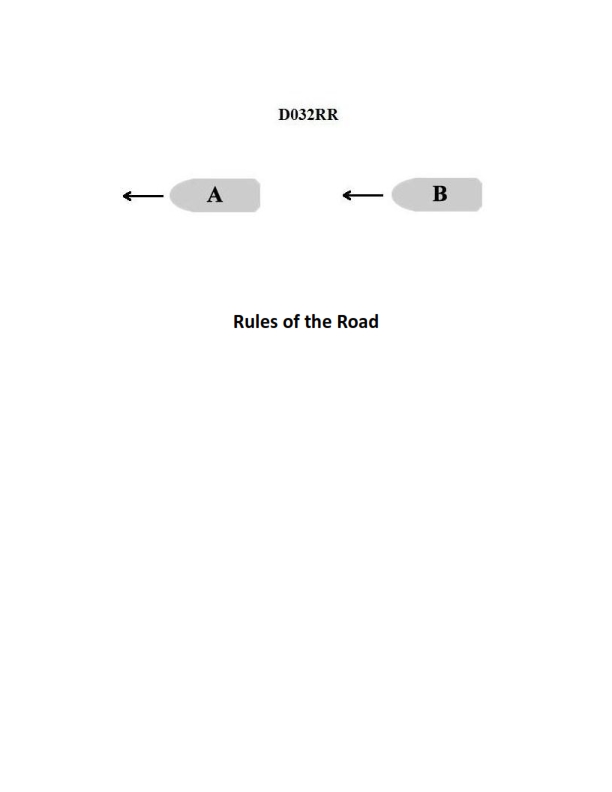
Question 368
Question: INLAND ONLY You are on power-driven vessel "A" in a narrow channel as shown in illustration D032RR below. Power-driven vessel "B" sounds two short blasts. What signal should you sound if you are in agreement?
A. sound two short blasts
B. sound two prolonged followed by two short blasts
C. not answer the whistle signals from vessel "B"
D. None of the above
The correct answer is A) sound two short blasts. According to the Inland Navigation Rules, when two power-driven vessels are meeting in a narrow channel, the vessel that has the other on its own starboard side should sound two short blasts to indicate that it intends to hold its course and speed. Since vessel "B" is sounding two short blasts, vessel "A" should respond with two short blasts to indicate agreement and that it will also hold its course and speed. The other options are incorrect because: B) is the wrong signal, C) would be improper as it is required to respond to the other vessel's signals, and D) is incorrect since A is the right answer.
Question 378
Question: INLAND ONLY Two power-driven vessels, "A" and "B" , are meeting in a narrow channel as shown in illustration D029RR below. Which statement is TRUE concerning whistle signals between the vessels?
A. Vessel "A" should sound one short blast and vessel "B" should sound two short blasts.
B. Both vessels should sound one short blast.
C. Both vessels should sound two short blasts.
D. Neither vessel should sound any signal as no course change is necessary.
The correct answer is C) Both vessels should sound two short blasts. This is correct because under the Inland Navigation Rules, when two power-driven vessels are meeting in a narrow channel, both vessels should sound two short blasts to indicate that they intend to pass port-to-port. This is the standard whistle signal for a meeting situation in a narrow channel, where a change of course and/or speed may be necessary to safely pass. The other answer choices are incorrect because option A would be the wrong signal, option B would not be sufficient, and option D would be incorrect as some whistle signal is required in this meeting situation.
Question 408
Question: INTERNATIONAL ONLY In international waters, you are on Vessel "I" in the situation as shown in illustration D036RR below. Vessel "II" sounds one short blast. Which action should you take?
A. Sound two short blasts, slow down and turn to port
B. Sound one short blast and slow down or turn to starboard.
C. Hold course and speed
D. Sound one short blast and hold course and speed.
The correct answer is C) Hold course and speed. In international waters, the International Regulations for Preventing Collisions at Sea (COLREGS) apply. According to COLREGS Rule 34(d), when one vessel is overtaking another, the vessel being overtaken should maintain its course and speed. Sounding one short blast by the overtaking vessel ("Vessel II") is a signal indicating its intention to pass. The vessel being overtaken ("Vessel I") should therefore hold its course and speed, as indicated by the correct answer choice C. The other answer choices are incorrect because they do not align with the COLREGS requirements for the overtaking situation. Sounding two short blasts (A) or one short blast (D) would not be the appropriate response, and slowing down or turning (A and B) would go against the requirement for the vessel being overtaken to hold its course and speed.
Question 409
Question: INTERNATIONAL ONLY You are on a power-driven vessel "I" as shown in illustration D036RR below. Vessel "II" is a vessel engaged in fishing. The vessels will pass within 1/2 mile of each other. Which action should you take?
A. Hold course and speed without giving a signal.
B. Sound the danger signal and slow to moderate speed.
C. Sound one short blast, turn to starboard.
D. Sound one short blast and hold course and speed.
The correct answer is C) Sound one short blast, turn to starboard. This is the correct action because under the International Regulations for Preventing Collisions at Sea (COLREGS), when two power-driven vessels are passing within 1/2 mile of each other, the vessel with the other on its starboard side (in this case, vessel "I") is the give-way vessel and must take early and substantial action to keep well clear of the other vessel. Sounding one short blast and turning to starboard is the appropriate action to indicate that vessel "I" is taking the required action to avoid a collision. The other options are incorrect because: A) Holding course and speed without giving a signal does not comply with the COLREGS; B) Sounding the danger signal and slowing to moderate speed is not the correct action for this situation; and D) Sounding one short blast and holding course and speed does not indicate the required action to avoid the other vessel.
Question 411
Question: INTERNATIONAL ONLY You are on a power-driven vessel "I" as shown in illustration D036RR below. Vessel "II" is a vessel engaged in fishing within 1/2 a mile of your vessel. Which action should you take?
A. Sound one short blast, and await a response
B. Hold course and speed without giving a signal
C. Sound two short blasts, and await a response
D. Change course or speed to avoid vessel "II"
The correct answer is D) Change course or speed to avoid vessel "II". The International Regulations for Preventing Collisions at Sea (COLREGS) require a power-driven vessel to take early and substantial action to avoid collision with a vessel engaged in fishing within 1/2 a mile, as described in the scenario. The power-driven vessel "I" must maneuver to keep well clear of the fishing vessel "II" and avoid a collision, rather than relying on the fishing vessel to take action. Options A, B, and C are incorrect because they do not involve the necessary maneuvering to avoid the collision risk.
Question 420
Question: INTERNATIONAL ONLY Vessels "A" and "B" are meeting on a river as shown in illustration D041RR below, and will pass 1/4 mile apart. Which light on vessel "B" will you see if you are on vessel "A"?
A. Flashing blue light
B. Special flashing yellow light
C. Two yellow towing lights
D. None of the above
The correct answer is D) None of the above. The reason this is the correct answer is that the scenario describes two vessels meeting on a river and passing 1/4 mile apart, which is an "International" navigation situation. In this case, the vessels would need to display the standard navigation lights required by the International Regulations for Preventing Collisions at Sea (COLREGS), not any special flashing lights. The other answer choices (flashing blue light, special flashing yellow light, two yellow towing lights) are not standard COLREGS navigation lights and would not be displayed by a vessel in this situation. Therefore, the correct answer is that you would not see any of those lights on vessel "B" if you were on vessel "A".
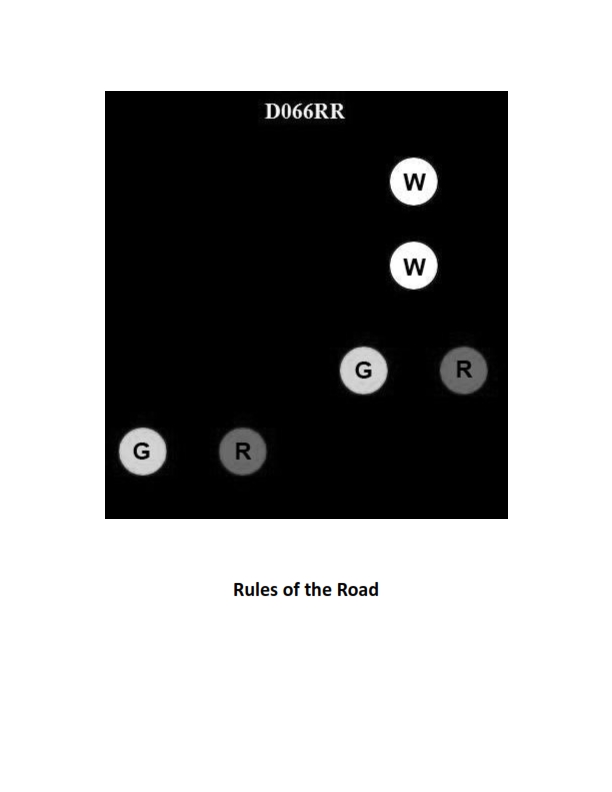
Question 423
Question: INTERNATIONAL ONLY At night you sight the lights shown in illustration D066RR below. What do the lights indicate?
A. Two vessels pair trawling
B. A vessel engaged in fishing
C. A tug with a tow alongside
D. A ship being assisted by a tug
The correct answer is C) A tug with a tow alongside. The lights shown in illustration D066RR at night indicate a tug vessel with a tow vessel alongside. This is in accordance with the International Regulations for Preventing Collisions at Sea (COLREGS), which specify the navigation lights required for different types of vessels. The other options are incorrect because: A) Two vessels pair trawling would have different light configurations, B) A vessel engaged in fishing would have different light arrangements, and D) A ship being assisted by a tug would have additional lights indicating the towing operation.
Question 424
Question: INTERNATIONAL ONLY Vessels "A" and "B" are meeting on a river as shown in illustration D041RR below and will pass 1/4 mile apart. If you are on vessel "A", in addition to the sidelight, which other light(s) will you see on vessel "B"?
A. Special flashing yellow light
B. Two yellow towing lights
C. Two white masthead lights in a vertical line
D. None of the above
The correct answer is C) Two white masthead lights in a vertical line. According to the International Regulations for Preventing Collisions at Sea (COLREGS), a vessel that is underway, but not under command, or restricted in its ability to maneuver, must display two white masthead lights in a vertical line in addition to the required sidelights. Since the vessels are passing 1/4 mile apart, this indicates they are not overtaking or crossing, and are simply meeting on the river. Therefore, the vessel "B" would display the two white masthead lights in a vertical line, in addition to the sidelights. The other options are incorrect because a special flashing yellow light is not a required navigation light, towing lights are only displayed by vessels engaged in towing operations, and there is no requirement for two white masthead lights in a horizontal line for a vessel meeting another vessel in this scenario.
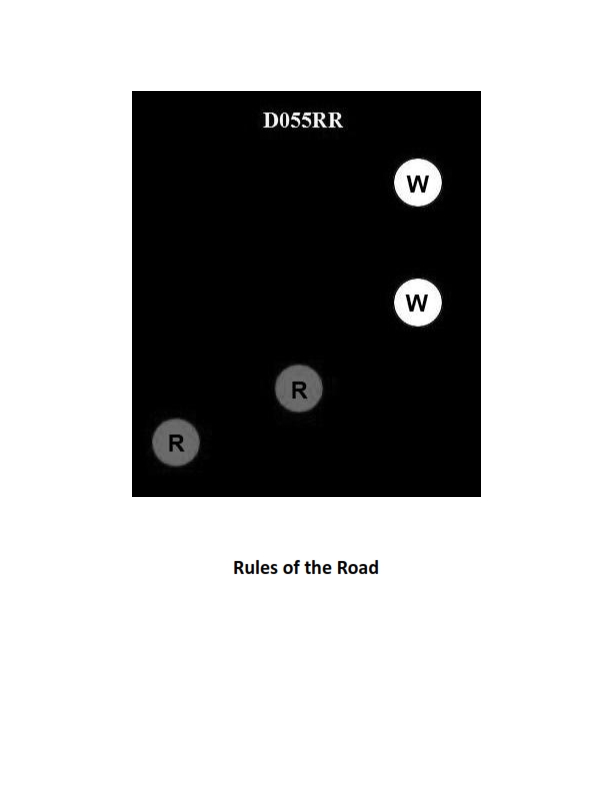
Question 426
Question: INTERNATIONAL ONLY At night, you sight the lights shown in illustration D055RR below. What do the lights indicate?
A. A tug not under command
B. A vessel fishing at anchor
C. A pipeline
D. A tug with a tow alongside
The correct answer is D) A tug with a tow alongside. The lights shown in illustration D055RR indicate a tug vessel with a tow alongside. This configuration is specified in the International Regulations for Preventing Collisions at Sea (COLREGS), which govern maritime navigation rules. Specifically, Rule 24(c) states that a power-driven vessel pushing ahead or towing alongside shall exhibit the same lights as a power-driven vessel underway, with the addition of a special flashing or all-round white light at or near the stern. The other options are incorrect because they do not match the light configuration shown in the illustration. A tug not under command would not have this specific light arrangement, and a vessel fishing at anchor or a pipeline would not be displaying these navigation lights.
Question 427
Question: INTERNATIONAL ONLY You see the lights shown in illustration D066RR below. What do these lights indicate ?
A. Vessel towing a barge alongside
B. Dredge working at anchor
C. Vessel pushing a barge ahead
D. Pilot vessel with a launch alongside
The correct answer is A) Vessel towing a barge alongside. The lights shown in illustration D066RR indicate a vessel towing a barge alongside. According to the International Regulations for Preventing Collisions at Sea (COLREGS), a vessel towing a barge alongside is required to display the same lights as a power-driven vessel, which includes the all-round white masthead light, sidelights, and a sternlight. The configuration of the lights shown in the illustration matches this requirement for a vessel towing a barge alongside. The other options are incorrect because they do not match the lighting configuration displayed in the illustration. A dredge working at anchor would typically display anchor lights rather than the full set of navigation lights shown. A vessel pushing a barge ahead would have a different lighting arrangement, and a pilot vessel with a launch alongside would also have a different set of lights.
Question 427
Question: INTERNATIONAL ONLY You see the lights shown in illustration D066RR below. What do these lights indicate?
A. Vessel towing a barge alongside
B. Dredge working at anchor
C. Vessel pushing a barge ahead
D. Pilot vessel with a launch alongside
The correct answer is A) Vessel towing a barge alongside. The light configuration shown in illustration D066RR displays the characteristic lights for a vessel engaged in towing with a barge secured alongside. This arrangement requires specific navigation lights that differ from a vessel towing astern. The masthead lights, sidelights, and towing light configuration shown are consistent with COLREGS requirements for alongside towing operations. The other options are incorrect: B) A dredge at anchor would display different lights including anchor lights and possibly obstruction lights; C) A vessel pushing ahead has a distinct light arrangement with two masthead lights in a vertical line forward; D) A pilot vessel would display the distinctive white-over-red all-round lights identifying pilot operations.
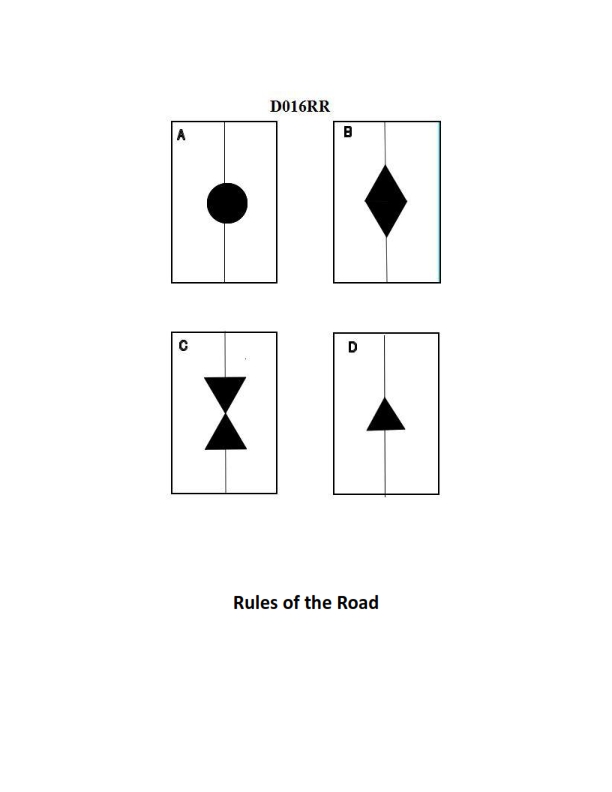
Question 430
Question: INTERNATIONAL ONLY As seen in illustration D016RR below, which additional shape must you show on the forward end of an inconspicuous partially submerged vessel or object being towed more than 200 meters in length?
A. A
B. B
C. D
D. No day shape must be shown.
The correct answer is B. As per the International Regulations for Preventing Collisions at Sea (COLREGS), for an inconspicuous partially submerged vessel or object being towed more than 200 meters in length, a diamond shape must be displayed on the forward end. This diamond shape serves as an additional day shape to improve the visibility of the towed object. The other answer choices are incorrect. Option A (a cone) is not the required shape. Option C (no shape) is incorrect as the regulations require the diamond shape to be displayed. Option D is also incorrect, as a day shape must be shown as per the regulations.
Question 444
Question: INTERNATIONAL ONLY You are on vessel "A" as shown in illustration D032RR below. Vessel "B" sounds two short blasts. What action should you take?
A. Sound two prolonged blasts followed by two short blasts
B. Sound two short blasts and maintain course and speed
C. Do not answer the whistle signal from vessel "B"
D. Sound one prolonged, one short, one prolonged and one short blasts
The correct answer is C) Do not answer the whistle signal from vessel "B". This is the correct answer because according to the International Regulations for Preventing Collisions at Sea (COLREGS), a vessel is not required to respond to a whistle signal from another vessel. The COLREGS state that the give-way vessel should take action to avoid collision, but the stand-on vessel (in this case, vessel "A") is not obligated to respond with a whistle signal. The other answer choices are incorrect because sounding any type of whistle signal in response to vessel "B" would not be the appropriate action for the stand-on vessel "A" to take in this situation.
Question 445
Question: INTERNATIONAL ONLY Two power-driven vessels are crossing within one half mile of each other as shown in illustration D042RR below. Vessel "A" sounds one short blast of the whistle. What action should vessel "B" take?
A. Sound one short blast and maintain course and speed
B. Sound the danger signal and slow to moderate speed
C. Alter course to the right or slowdown
D. Maintain course and speed
The correct answer is D) Maintain course and speed. This is the correct answer because according to the International Regulations for Preventing Collisions at Sea (COLREGS), when two power-driven vessels are crossing, the vessel that has the other on its own starboard side (Vessel "B" in this case) is the stand-on vessel and must maintain its course and speed. Vessel "A" is the give-way vessel and must take action to avoid a collision by altering course to starboard. The other options are incorrect because they would go against the COLREGS rules for a crossing situation. Sounding a signal or altering course or speed is the responsibility of the give-way vessel, not the stand-on vessel.
Question 447
Question: INTERNATIONAL ONLY Power-driven vessels "A" and "B" are meeting on a river as shown in illustration D041RR below and will pass 1/4 mile apart. Which action should the vessels take?
A. The vessels should continue on course and pass without sounding any whistle signals.
B. The vessels should exchange two blast whistle signals and pass starboard to starboard.
C. The vessels should exchange one blast whistle signals and pass starboard to starboard.
D. The vessel with the tow should initiate the whistle signals.
The correct answer is A) The vessels should continue on course and pass without sounding any whistle signals. This is because when two power-driven vessels are meeting on a river and will pass at least 1/4 mile apart, no whistle signals are required. The vessels can safely pass one another without altering course or speed. The other options are incorrect because they involve unnecessary whistle signals, which are not required in this situation according to the International Regulations for Preventing Collisions at Sea (COLREGS).
Question 450
Question: INTERNATIONAL ONLY Vessel "A" is overtaking vessel "B" on open waters as shown in illustration D017RR below and will pass without changing course. What signal should vessel "A" sound?
A. Two prolonged blasts followed by two short blasts
B. At least five short and rapid blasts
C. Two short blasts
D. No whistle signal should be sounded
The correct answer is D) No whistle signal should be sounded. According to the International Regulations for Preventing Collisions at Sea (COLREGS), when a vessel is overtaking another vessel, the overtaking vessel (Vessel A) is required to keep out of the way of the vessel being overtaken (Vessel B). In this situation, since Vessel A is overtaking Vessel B and will pass without changing course, Vessel A is not required to sound any whistle signal. The overtaking vessel should simply maintain its course and speed to safely pass the other vessel. The other options are incorrect because they describe whistle signals that are not appropriate for this overtaking situation under the COLREGS.
Question 451
Question: INTERNATIONAL ONLY Two power-driven vessels are meeting in the situation as shown in illustration D037RR below. What does one short blast from either vessel mean?
A. "I intend to hold course and speed."
B. "I am altering my course to port."
C. "I am altering my course to starboard."
D. "I intend to leave you on my port side."
The correct answer is C) "I am altering my course to starboard." According to the International Regulations for Preventing Collisions at Sea (COLREGS), when two power-driven vessels are meeting head-on, each vessel shall alter its course to starboard to pass on the port side of the other vessel. The one-short-blast signal indicates that the vessel is altering course to starboard, which is the proper action in this head-on situation. The other options are incorrect because: A) holding course and speed is not the appropriate action in a head-on situation, B) altering course to port would cause the vessels to collide, and D) leaving the other vessel on the port side goes against the COLREGS requirement to pass on the port side.
Question 453
Question: INTERNATIONAL ONLY Two power-driven vessels are meeting in the situation as shown in illustration D037RR below. What does two short blasts from either vessel mean?
A. "I am altering my course to starboard."
B. "I intend to leave you on my port side."
C. "I am operating astern propulsion."
D. "I am altering my course to port."
The correct answer is D) "I am altering my course to port." According to the International Regulations for Preventing Collisions at Sea (COLREGS), two short blasts from a power-driven vessel indicate that the vessel is altering its course to port. This signals to the other vessel that it should maintain its course and speed, as the vessel sounding the two short blasts will be the one to take avoiding action by turning to port. The other answer choices are incorrect because they do not accurately represent the meaning of two short blasts in the given situation. Altering course to starboard (A), intending to leave the other vessel on the port side (B), and operating astern propulsion (C) are not the appropriate signals for two short blasts in an international meeting situation.
Question 454
Question: INTERNATIONAL ONLY Two power-driven vessels are crossing within one half mile of each other as shown in illustration D042RR below. Vessel "A" sounds one short blast of the whistle. What does this signal mean?
A. "I intend to intend to overtake you on your port side"
B. "I am intend to leave you on my starboard side"
C. "I am altering my course to port"
D. None of the above
The correct answer is D) None of the above. The one short blast of the whistle does not have the meaning of any of the provided answer choices. According to the International Regulations for Preventing Collisions at Sea (COLREGS), a one short blast of the whistle is used to indicate "I am altering my course to starboard". It does not signal any intention to overtake or leave the other vessel on a particular side. The other answer choices do not accurately reflect the meaning of the one short blast whistle signal in the given scenario.
Question 455
Question: INTERNATIONAL ONLY Two power-driven vessels are crossing within one half mile of each other as shown in illustration D042RR below. Vessel "A" sounds one short blast of the whistle. What is vessel "B" in this situation?
A. The burdened vessel
B. The overtaking vessel
C. The give-way vessel
D. None of the above
The correct answer is D) None of the above. In the given scenario, vessel "A" sounds one short blast of the whistle, indicating that it intends to pass vessel "B" on the starboard (right) side. However, this action does not determine the relationship between the two vessels in terms of which one is the burdened or give-way vessel. The International Regulations for Preventing Collisions at Sea (COLREGS) rules determine the vessels' responsibilities based on their relative positions and courses, not on the sound signals they make. Without more information about the vessels' courses and relative positions, it is not possible to determine which vessel is the burdened or give-way vessel. Therefore, the answer "None of the above" is correct, as none of the given options accurately describe the situation.
Question 456
Question: INTERNATIONAL ONLY Two power-driven vessels are crossing within one half mile of each other as shown in illustration D042RR below. Vessel "A" sounds one short blast of the whistle. What signal should vessel "B" sound?
A. Two short blasts
B. One prolonged, one short, one prolonged and one short blasts
C. One short blast
D. None of the above
The correct answer is D) None of the above. The reason is that the given situation describes a crossing situation under the International Regulations for Preventing Collisions at Sea (COLREGS), where vessel "A" is the stand-on vessel and vessel "B" is the give-way vessel. In this case, vessel "B" is not required to sound any whistle signal. The proper action for vessel "B" is to take early and substantial action to keep well clear of vessel "A", as per Rule 16 of the COLREGS, and not to sound any whistle signals. The other answer choices are incorrect because they do not match the proper response for the given crossing situation under the COLREGS.
Question 457
Question: INTERNATIONAL ONLY Two power-driven vessels are crossing within one half mile of each other as shown in illustration D042RR below. Vessel "A" sounds one short blast of the whistle. What does this signal mean?
A. "I intend to overtake you on your starboard side"
B. "I am operating astern propulsion"
C. "I intend to leave you on my port side"
D. None of the above
The correct answer is D) None of the above. The one short blast of the whistle by Vessel "A" does not have the meanings indicated in options A, B, or C. According to the International Regulations for Preventing Collisions at Sea (COLREGS), a one-blast signal is used to indicate "I am altering my course to starboard." This signal does not communicate the vessel's intent to overtake, operate astern propulsion, or leave the other vessel on its port side. The given options do not accurately reflect the meaning of the one-blast whistle signal in the context of the international rules for vessels crossing within one-half mile of each other.
Question 458
Question: INTERNATIONAL ONLY Vessel "A" is overtaking vessel "B" on open waters as shown in illustration D017RR below and will pass without changing course. What action should Vessel "A" take?
A. Need not sound any whistle signals
B. Should sound one long blast
C. Should sound the danger signal
D. Should sound two short blasts
The correct answer is A) Need not sound any whistle signals. According to the International Regulations for Preventing Collisions at Sea (COLREGS), when a vessel is overtaking another vessel, the overtaking vessel (Vessel A) shall keep out of the way of the vessel being overtaken (Vessel B). Since Vessel A is overtaking Vessel B and will pass without changing course, Vessel A is not required to sound any whistle signals. The overtaking situation is clearly established, and no additional communication via whistle signals is necessary. The other answer choices are incorrect because: B) sounding one long blast is used to indicate a course alteration, C) the danger signal (five or more short blasts) is used to indicate doubt about the actions of another vessel, and D) two short blasts indicate the intent to overtake on the starboard side, which is not the case here.
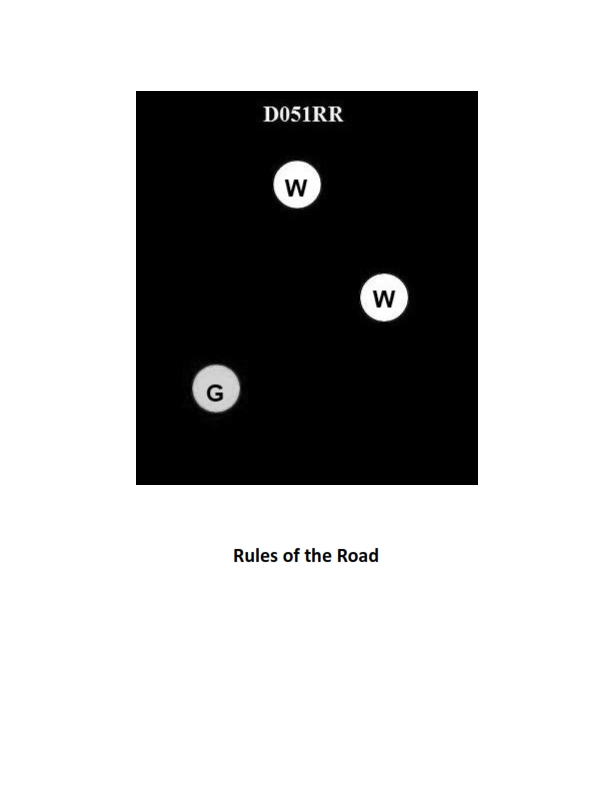
Question 487
Question: BOTH INTERNATIONAL & INLAND You are on a vessel heading due south and see the lights shown in illustration D051RR below, one point on the port bow. What direction could this vessel be heading?
A. NW
B. SE
C. SW
D. NE
The correct answer is A) NW. The lights shown in illustration D051RR represent the navigation lights of a vessel heading in a northwesterly direction. According to the International and Inland Rules of the Road, when viewing these navigation lights from one point on the port bow (i.e., 1 point off the port bow), the vessel must be heading in a northwesterly direction. The other options are incorrect because a vessel with these navigation lights would not be heading in a southeasterly (B), southwesterly (C), or northeasterly (D) direction when viewed from one point on the port bow.
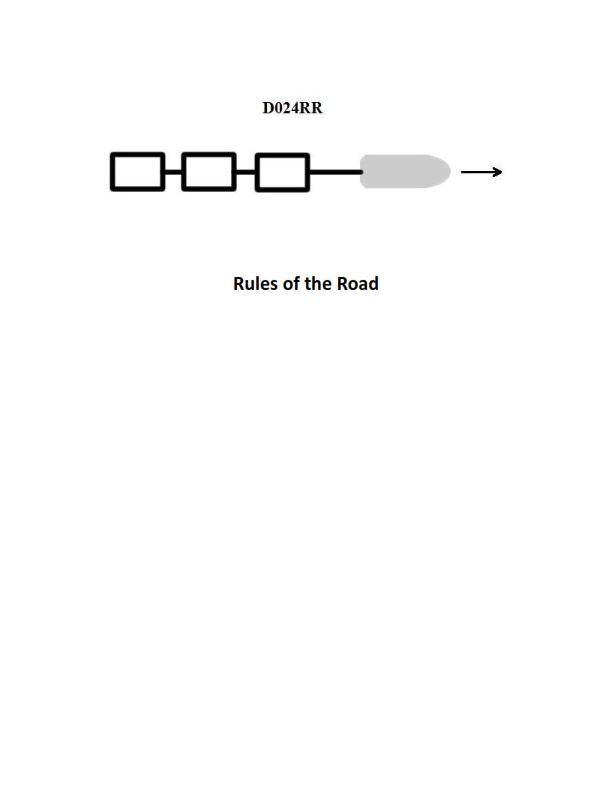
Question 494
Question: BOTH INTERNATIONAL & INLAND The tow shown in illustration D024RR below is greater than 200 meters in length and severely restricts the tow vessel's ability to deviate from her course. Which shape(s) would be displayed by day from the vessel(s)?
A. ball-diamond-ball on the towing vessel
B. diamond on the towing vessel
C. diamond on the barges
D. All of the above
The correct answer is D) All of the above. According to the International and Inland Navigation Rules, when a tow exceeds 200 meters in length and severely restricts the towing vessel's ability to deviate from its course, the towing vessel must display a ball-diamond-ball shape, and each of the barges or other vessels being towed must display a diamond shape. The other options are incorrect because they do not fully address the requirements for a tow of this length and restriction. Option A is partially correct, but it only addresses the shape displayed by the towing vessel. Option B is incorrect, as it only mentions the diamond shape on the towing vessel. Option C is also incorrect, as it only addresses the barges, not the towing vessel.
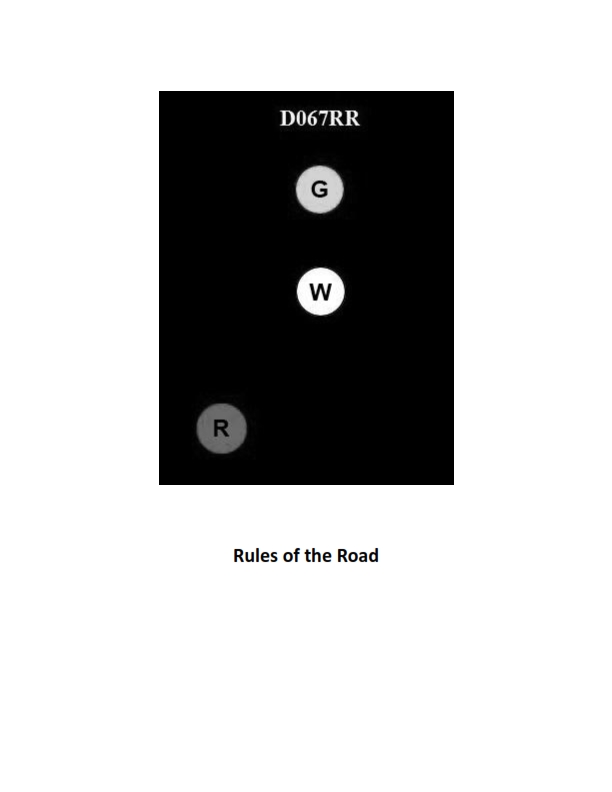
Question 495
Question: BOTH INTERNATIONAL & INLAND Which is TRUE for a fishing vessel displaying the lights shown in illustration D067RR below?
A. the vessel is anchored
B. the vessel is fishing by trawling
C. it is tending a small fishing boat
D. it is underway but not fishing
The correct answer is B) the vessel is fishing by trawling. The lights shown in illustration D067RR depict the required navigation lights for a fishing vessel engaged in trawling, as specified in the International Regulations for Preventing Collisions at Sea (COLREGS) and the Inland Navigation Rules. These rules require fishing vessels engaged in trawling to display two all-round green lights in a vertical line, indicating that they are trawling and not simply underway. The other options are incorrect because option A) the vessel is anchored would require different lights, option C) it is tending a small fishing boat would require additional lights for the small boat, and option D) it is underway but not fishing would not display the characteristic green trawling lights.
Question 496
Question: BOTH INTERNATIONAL & INLAND You are on a 30-meter trawler. Which identification shape shown in illustration D016RR below must you show while trawling?
A. A
B. B
C. C
D. None of these day signals are correct.
The correct answer is C. According to the International Regulations for Preventing Collisions at Sea (COLREGS), when a vessel is engaged in trawling, it must display the shape of a "cone apex downwards" (option C) during the day. This shape indicates that the vessel is restricted in its ability to maneuver and that other vessels should keep clear. The other options, A and B, represent different shapes that do not accurately depict a vessel engaged in trawling operations.
Question 500
Question: BOTH INTERNATIONAL & INLAND Vessel "A" is overtaking vessel "B" as shown in illustration D017RR below. Which color light will vessel "A" observe on vessel "B"?
A. Flashing red
B. Green
C. Yellow over yellow
D. White
The correct answer is D) White. When vessel "A" is overtaking vessel "B" in both international and inland navigation rules, vessel "B" will display a white stern light. This is in accordance with the International Regulations for Preventing Collisions at Sea (COLREGS) and the United States Inland Navigation Rules. The other answer choices are incorrect because: A) Flashing red is the light displayed by the vessel being overtaken, not the overtaking vessel. B) Green is the sidelight displayed by the vessel being overtaken. C) Yellow over yellow is the light configuration for a towing vessel, not an overtaking situation.
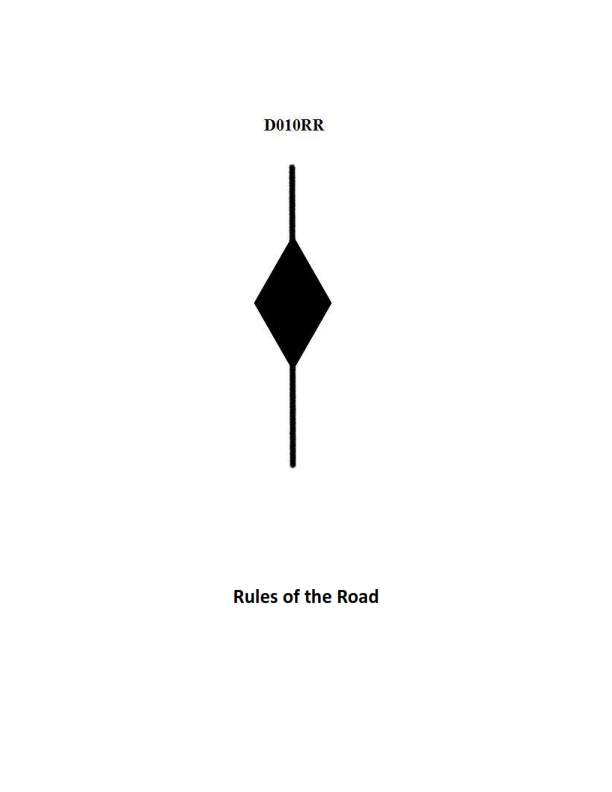
Question 509
Question: BOTH INTERNATIONAL & INLAND A vessel displaying the shape shown in illustration D010RR below is which of the following?
A. has a tow that exceeds 200 meters in length
B. is not under command
C. is at anchor
D. has a tow that is carrying dangerous cargo
The correct answer is A) has a tow that exceeds 200 meters in length. The shape shown in illustration D010RR is the "not under command" signal, which indicates that a vessel is unable to maneuver as required by the rules and is therefore not under command. Per the international and inland navigation rules, a vessel displaying this signal is required to indicate that it has a tow exceeding 200 meters in length. The other answer choices are incorrect because they do not accurately represent the meaning of the "not under command" signal.
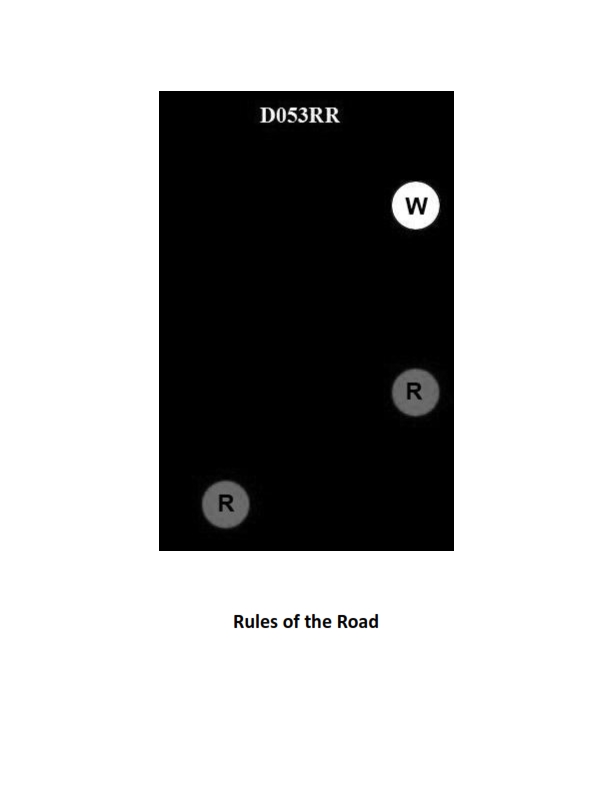
Question 511
Question: BOTH INTERNATIONAL & INLAND A vessel is displaying ONLY the lights shown in illustration D053RR below. What type of vessel is this?
A. vessel under sail
B. vessel engaged in fishing
C. vessel engaged on pilotage duty underway
D. power-driven vessel underway, making way
The correct answer is C) vessel engaged on pilotage duty underway. The lighting configuration shown in illustration D053RR, with only the red and green sidelights and white masthead light, indicates a power-driven vessel underway and engaged in pilotage duty. As per the navigation rules, a vessel on pilotage duty is not required to display the stern light or the range of lights typically seen on a standard power-driven vessel underway. The absence of the additional lights rules out the other options, such as a vessel under sail or a fishing vessel.
Question 517
Question: BOTH INTERNATIONAL & INLAND The tow shown in illustration D024RR below is less than 200 meters in length and severely restricted in her ability to deviate from her course. Which shape(s) would be displayed by day from the vessel(s)?
A. diamond on the last barge
B. diamond on the towing vessel
C. ball-diamond-ball on the towing vessel
D. All of the above
The correct answer is C) ball-diamond-ball on the towing vessel. This is because the tow shown is less than 200 meters in length and severely restricted in its ability to deviate from its course, which means it is considered a "Vessel Restricted in its Ability to Maneuver" under both the International and Inland Navigation Rules. The appropriate day shape for such a vessel is a ball, diamond, ball displayed from the towing vessel. The other options are incorrect because a diamond shape is not the appropriate day shape for the tow or towing vessel in this scenario. The ball-diamond-ball configuration on the towing vessel properly indicates that the tow is restricted in its maneuverability.
Question 518
Question: BOTH INTERNATIONAL & INLAND You are on a vessel engaged in fishing, other than trawling, and have gear extending more than 150 meters horizontally from the vessel. Which of the shapes shown in illustration D016RR below must you show in the direction of the outlying gear?
A. A
B. B
C. C
D. D
The correct answer is D. The reason D is the correct answer is that when fishing gear extends more than 150 meters horizontally from the vessel, the International and Inland Navigation Rules require displaying two all-round red lights in a vertical line to indicate the presence of the outlying gear. This is specified in Rule 26(c) of the Navigation Rules. The other answer choices (A, B, and C) represent different shapes or lights that are not the appropriate signal for a vessel with outlying fishing gear extending more than 150 meters. The two vertical red lights in choice D specifically denote the presence of the extended fishing gear as per the Navigation Rules.
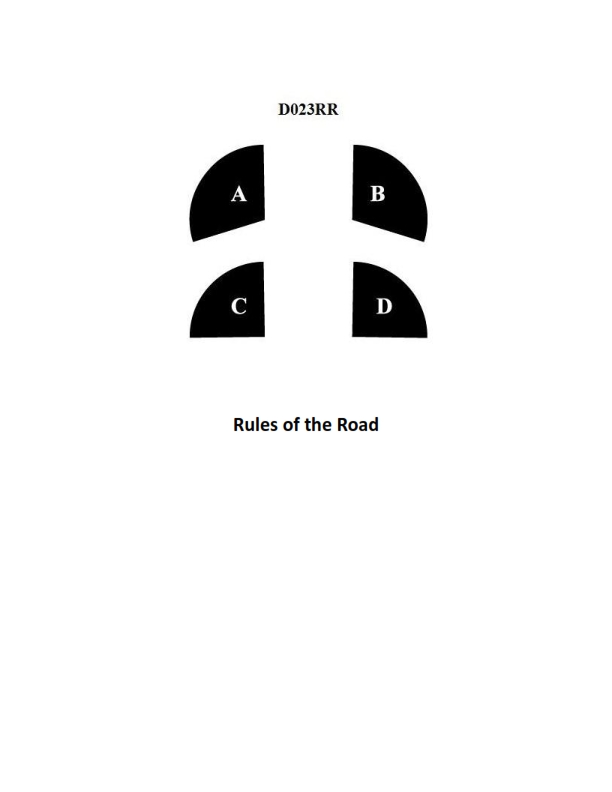
Question 527
Question: BOTH INTERNATIONAL & INLAND In illustration D023RR below which represents the arc of visibility of a red sidelight?
A. A
B. B
C. C
D. D
The correct answer is A. The arc of visibility of a red sidelight, both for International and Inland Navigation Rules, is represented by section A in the illustration D023RR. The red sidelight must be visible from right ahead to 22.5 degrees abaft the beam on its respective side of the vessel, which corresponds to section A in the diagram. The other options are incorrect because they do not accurately depict the arc of visibility for a red sidelight. Options B, C, and D represent different sections of the overall navigation light configuration, but not specifically the red sidelight.
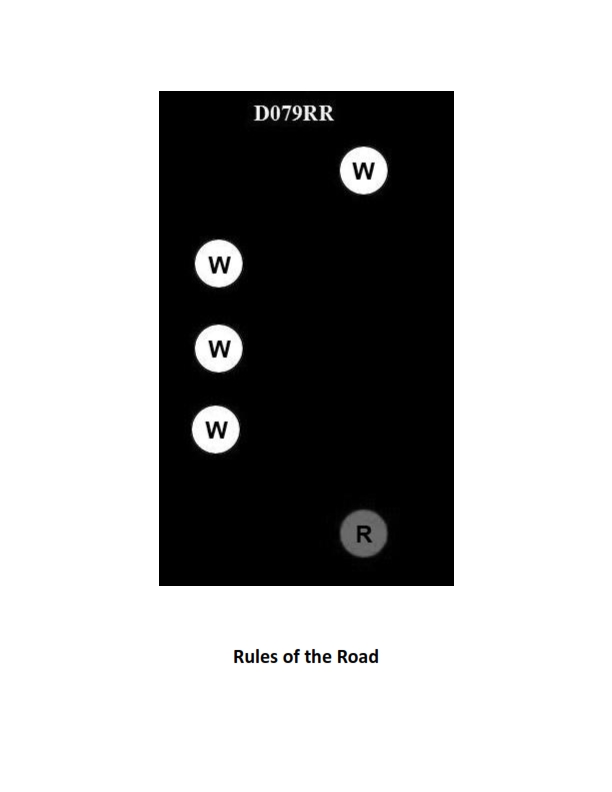
Question 536
Question: BOTH INTERNATIONAL & INLAND Which vessel would display the lights shown in illustration D079RR below?
A. law enforcement vessel
B. vessel constrained by her draft
C. vessel towing astern
D. vessel not under command
The correct answer is C) vessel towing astern. The lights shown in illustration D079RR depict the required navigation lights for a vessel towing astern. According to the International and Inland Navigation Rules, a vessel engaged in towing another vessel must display a yellow towing light in a vertical line above the sternlight(s) of the vessel being towed. The other answer choices are incorrect because: A) a law enforcement vessel would display different lights, B) a vessel constrained by draft would display different lights, and D) a vessel not under command would display different lights.
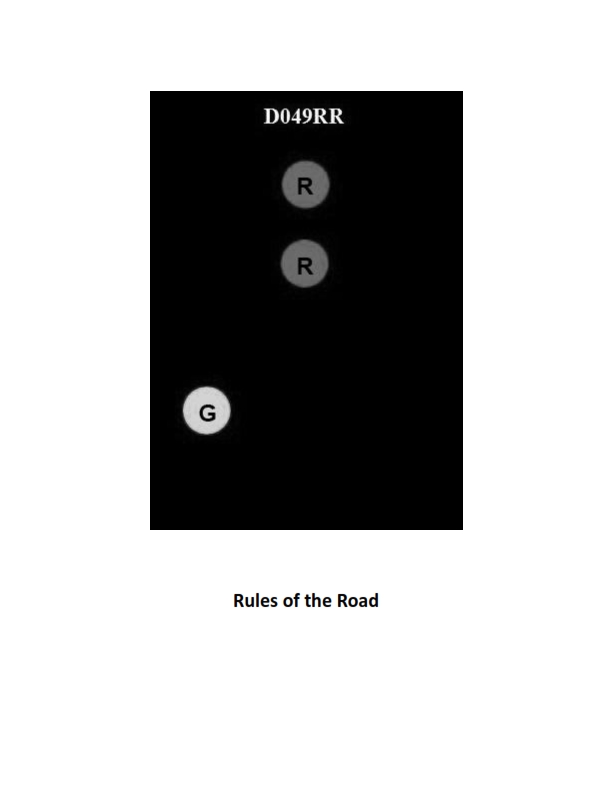
Question 537
Question: BOTH INTERNATIONAL & INLAND Which vessel is required to exhibit the lights shown in illustration D049RR below?
A. not under command
B. engaged in fishing
C. restricted in her ability to maneuver
D. on pilotage duty
The correct answer is A) not under command. The lights shown in illustration D049RR are the required navigation lights for a vessel that is not under command. This means the vessel is unable to maneuver as required by the Rules of the Road and must exhibit these distinctive lights to alert other vessels in the area of its limited ability to maneuver. The other answer choices are incorrect because the lights in the illustration do not match the navigation light requirements for vessels engaged in fishing (B), restricted in their ability to maneuver (C), or on pilotage duty (D). Those vessel types have different navigation light configurations specified in the International and Inland Navigation Rules.
Question 553
Question: BOTH INTERNATIONAL & INLAND You are on a vessel heading due south and see the lights shown in illustration D051RR below one point on the port bow. What direction could this vessel be heading in?
A. NW
B. NE
C. SE
D. SW
The correct answer is A) NW. According to the International Regulations for Preventing Collisions at Sea (COLREGS), when you see the lights shown in illustration D051RR one point on the port bow, the other vessel must be heading in a northwesterly (NW) direction. This is because the configuration of the lights indicates the other vessel is traveling in a direction approximately 11.25 degrees to the right of your vessel's heading, which is northwest. The other answer choices are incorrect because a vessel showing these lights could not be heading northeast (NE), southeast (SE), or southwest (SW) in relation to your vessel's southbound course.
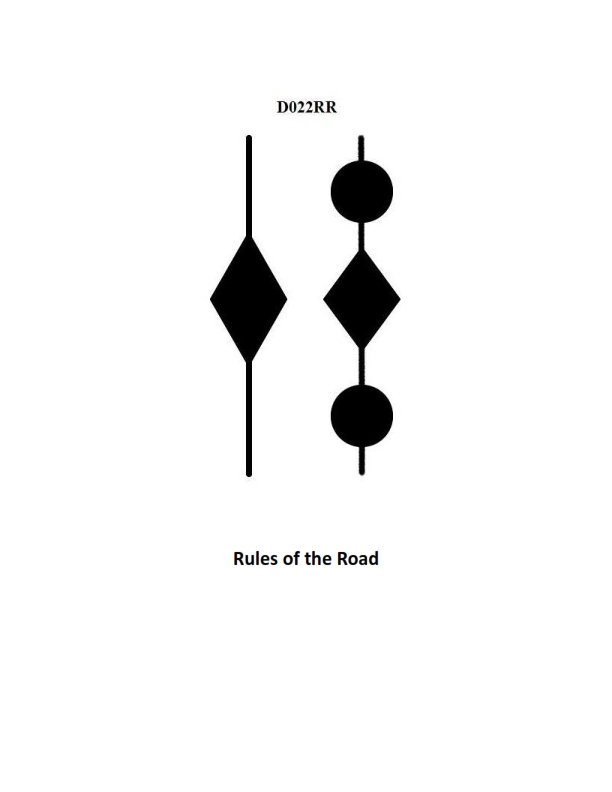
Question 560
Question: BOTH INTERNATIONAL & INLAND Which vessel is indicated by the day signal shown in illustration D022RR?
A. A dredge indicating the side with the obstruction
B. A tug with a tow exceeding 200 meters which limits her ability to maneuver
C. A fishing vessel with gear extending more than 150 meters horizontally
D. A vessel engaged in underwater operations with a diver down
The correct answer is B) A tug with a tow exceeding 200 meters which limits her ability to maneuver. The day signal shown in illustration D022RR is an all-round red light, which indicates a vessel "not under command" or a vessel "with restricted ability to maneuver" as per the International Rules of the Road. For a tug with a tow exceeding 200 meters, this signal would be appropriate, as the length of the tow would limit the tug's ability to maneuver. The other options are incorrect because they do not match the specific meaning of the day signal depicted in the illustration. A dredge, a fishing vessel, or a vessel engaged in underwater operations would not display this particular signal.
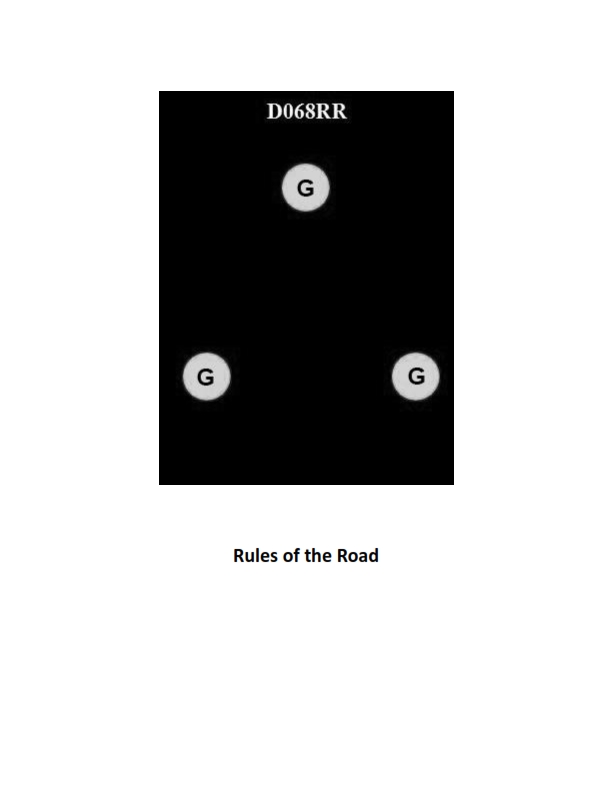
Question 568
Question: BOTH INTERNATIONAL & INLAND The lights shown in illustration D068RR mean that another vessel should NOT pass within what distance?
A. 1000 meters
B. 1250 meters
C. 1500 meters
D. 2000 meters
The correct answer is A) 1000 meters. The lights shown in illustration D068RR represent a vessel restricted in its ability to maneuver. According to the International Regulations for Preventing Collisions at Sea (COLREGS), a vessel restricted in its ability to maneuver should display these lights to indicate that other vessels should not pass within 1000 meters. The other answer choices are incorrect because they do not match the COLREGS requirement for this type of vessel.
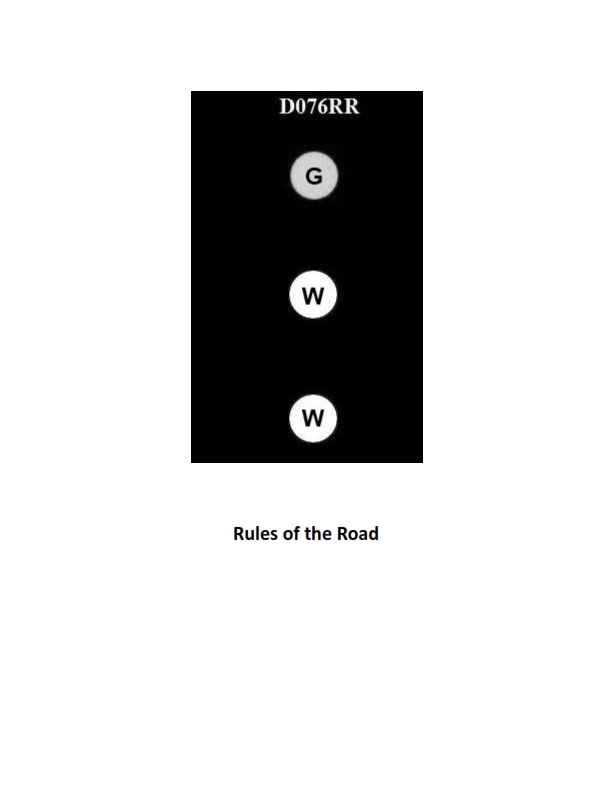
Question 578
Question: BOTH INTERNATIONAL & INLAND At night, the lights shown in illustration D076RR would indicate a vessel engaged in which of the operations?
A. laying submarine cable
B. trawling
C. towing astern
D. dredging
The correct answer is B) trawling. The lights shown in illustration D076RR, which are two all-round lights in a vertical line, indicate a vessel engaged in trawling operations. According to the navigation rules, vessels engaged in trawling, whether fishing with trawls or dragging for any purpose, must display two all-round lights in a vertical line where they can best be seen. This helps other vessels identify the trawling operation and navigate safely around the area. The other options are incorrect because the specified light configuration does not match the requirements for vessels engaged in laying submarine cable, towing astern, or dredging operations, which have different light requirements.
Question 587
Question: BOTH INTERNATIONAL & INLAND Which of the shapes shown in illustration D016RR below would be used to indicate a vessel with a tow exceeding 200 meters in length?
A. A
B. B
C. C
D. D
The correct answer is B. The shape shown in illustration D016RR that would be used to indicate a vessel with a tow exceeding 200 meters in length is the square shape (B). This is in accordance with the International Regulations for Preventing Collisions at Sea (COLREGS), which require vessels with a tow exceeding 200 meters in length to display this square shape. The other shapes shown (A, C, and D) are not used to indicate a vessel with a tow exceeding 200 meters. They have different meanings, such as indicating a vessel constrained by its draft (A) or a vessel not under command (C and D).
Question 594
Question: BOTH INTERNATIONAL & INLAND You are on vessel "A", as shown in illustration D032RR below and hear vessel "B" sound a signal indicating his intention to overtake you. You feel it is not safe for vessel "B" to overtake you at the present time. What action should you take?
A. Sound five or more short and rapid blasts
B. Sound three blasts of the whistle
C. Sound two short blasts
D. Not answer the whistle signal from vessel "B"
A) Sound five or more short and rapid blasts is the correct answer. The reasoning is that according to the International Regulations for Preventing Collisions at Sea (COLREGS), Rule 34(d), when a vessel is being overtaken, the vessel being overtaken should sound five or more short and rapid blasts on the whistle to indicate that it is unsafe for the overtaking vessel to proceed. This signals to the overtaking vessel that the maneuver is not safe at the current time. The other options are incorrect because they do not match the appropriate signal specified in the COLREGS for this situation.
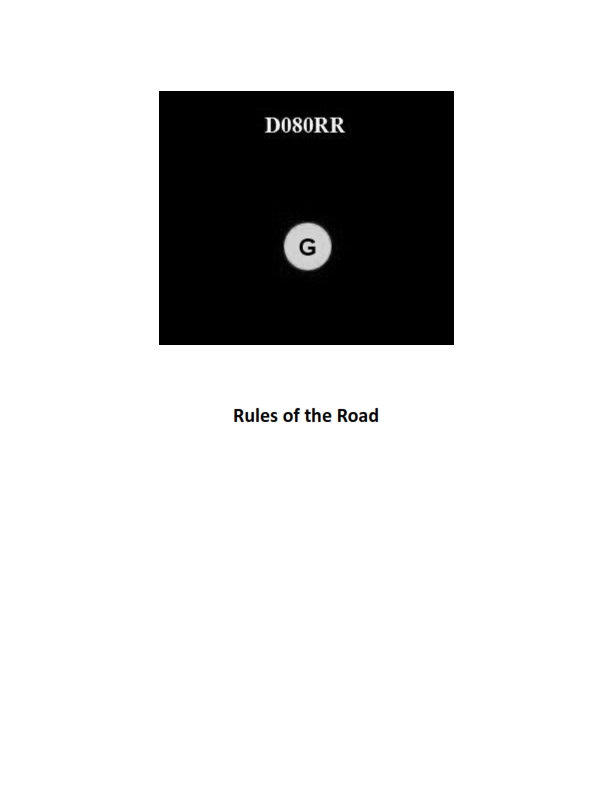
Question 595
Question: BOTH INTERNATIONAL & INLAND You see ONLY the light shown in illustration D080RR below. Which vessel are you observing?
A. not under command
B. engaged in fishing
C. towing
D. under oars
The correct answer is D) under oars. The illustration D080RR shows a single red light, which according to the International Regulations for Preventing Collisions at Sea (COLREGS) indicates a vessel under oars. This is because a vessel under oars does not have the ability to maneuver as freely as a powered vessel, so the red light helps other vessels identify and avoid it. The other answer choices are incorrect because they represent different types of vessels with different light configurations. A vessel not under command would display different lights, a fishing vessel would have additional green and/or white lights, and a towing vessel would have a different arrangement of lights.
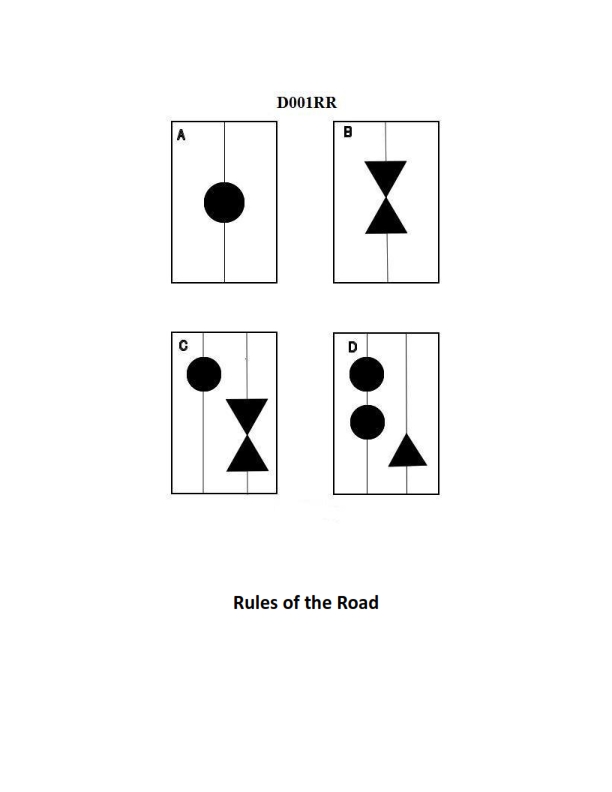
Question 598
Question: BOTH INTERNATIONAL & INLAND A vessel fishing should display which of the shapes shown in illustration D001RR below?
A. A
B. B
C. C
D. D
The correct answer is B. According to the International and Inland Navigation Rules (COLREGS), a vessel engaged in fishing, regardless of whether it is operating in international or inland waters, should display the shape depicted in illustration D001RR as option B - a black cone apex downward. The other options (A, C, and D) do not correctly represent the shape required for a fishing vessel under the COLREGS. Options A, C, and D depict different shapes that are used to indicate the status of other types of vessels, such as a vessel not under command or a vessel restricted in its ability to maneuver.
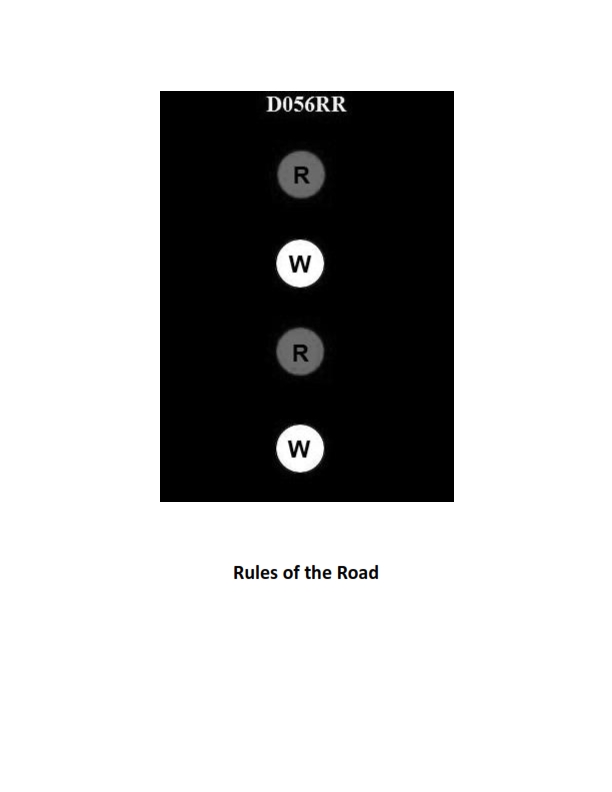
Question 599
Question: BOTH INTERNATIONAL & INLAND Which of the following describes a vessel exhibiting the lights shown in illustration D056RR below?
A. underway and laying submarine cable
B. at anchor and dredging
C. underway and carrying dangerous cargo
D. towing a barge alongside
The correct answer is A) underway and laying submarine cable. This is correct because the illustration D056RR depicts the navigation lights required for a vessel that is underway and engaged in the laying of submarine cable. The lights shown - all-round white lights at the masthead and stern - are the required lights for this type of vessel operation, as specified in the International and Inland Navigation Rules. The other answer choices do not accurately describe the lighting configuration shown in the illustration. Vessels at anchor, carrying dangerous cargo, or towing a barge would have different navigation light requirements that do not match the illustration.
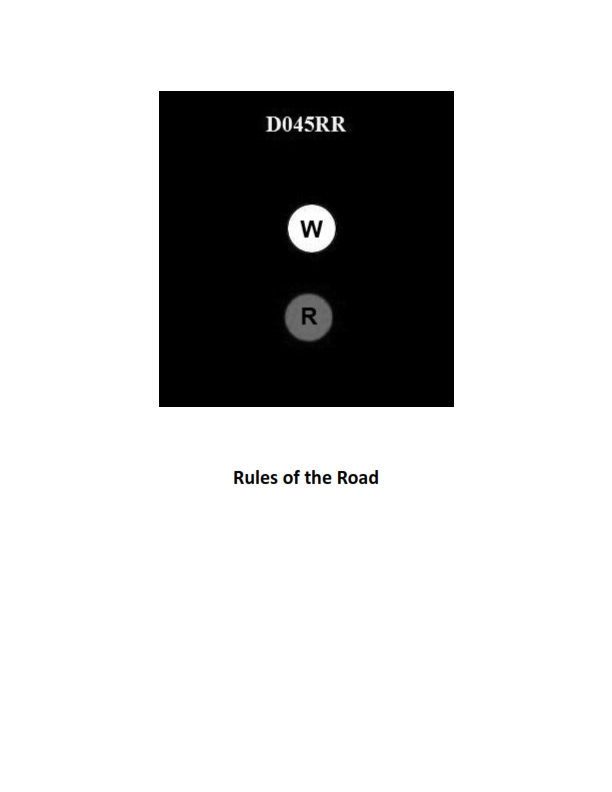
Question 602
Question: BOTH INTERNATIONAL & INLAND A vessel is displaying ONLY the lights shown in illustration D045RR below. What type of vessel could this be?
A. vessel engaged in dredging at anchor with an obstruction on one side
B. vessel aground less than 50 meters
C. pilot vessel less than 50 meters, underway and NOT engaged on pilotage duty
D. vessel engaged in fishing
The correct answer is C) pilot vessel less than 50 meters, underway and NOT engaged on pilotage duty. This is correct because the lights shown in illustration D045RR depict the navigation lights required for a power-driven vessel less than 50 meters in length that is underway, but not engaged in pilotage duty. The display of these specific lights, without any other lights, indicates the vessel is a pilot vessel that is not actively engaged in pilotage operations. The other answer choices are incorrect because they do not match the lighting configuration shown in the illustration. A vessel engaged in dredging, aground, or fishing would display different navigation light configurations.
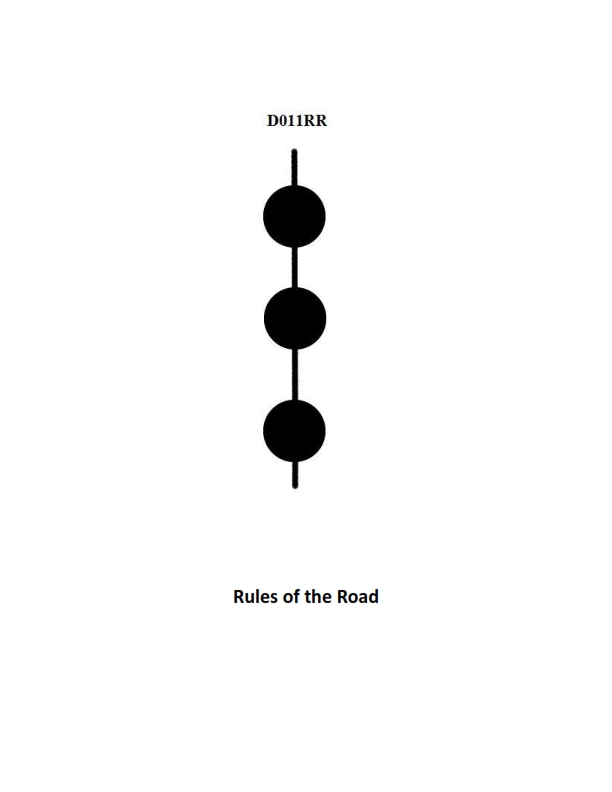
Question 604
Question: BOTH INTERNATIONAL & INLAND Which of the following describes a vessel displaying the shapes shown in illustration D011RR below?
A. towing
B. conducting underwater operations
C. aground
D. drifting
The correct answer is C) aground. The illustration D011RR shows the shapes of a vessel displaying two black balls stacked vertically. According to the International and Inland Navigation Rules, this configuration of shapes indicates that the vessel is aground. When a vessel is aground, it must display these two black balls to signal its status to other vessels in the area. The other options are incorrect because they do not match the shapes displayed in the illustration. A vessel that is towing would display different shapes, underwater operations would not require this specific configuration, and a drifting vessel would not display these particular shapes.
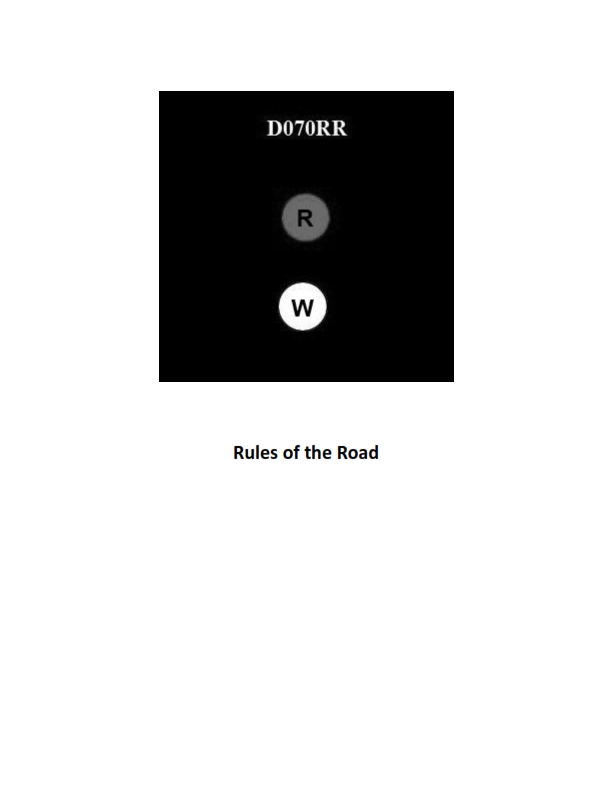
Question 606
Question: BOTH INTERNATIONAL & INLAND Which type of vessel is required to display the lights shown in illustration D070RR below?
A. motorboat
B. fishing vessel
C. sailboat
D. pilot boat
The correct answer is B) fishing vessel. The lights shown in illustration D070RR are the required navigation lights for fishing vessels under both the International and Inland Navigation Rules. Fishing vessels are required to display these lights to indicate their presence and activity to other vessels, which helps prevent collisions at sea. The other answer choices are incorrect because motorboats, sailboats, and pilot boats have different navigation light requirements that do not match the illustration.
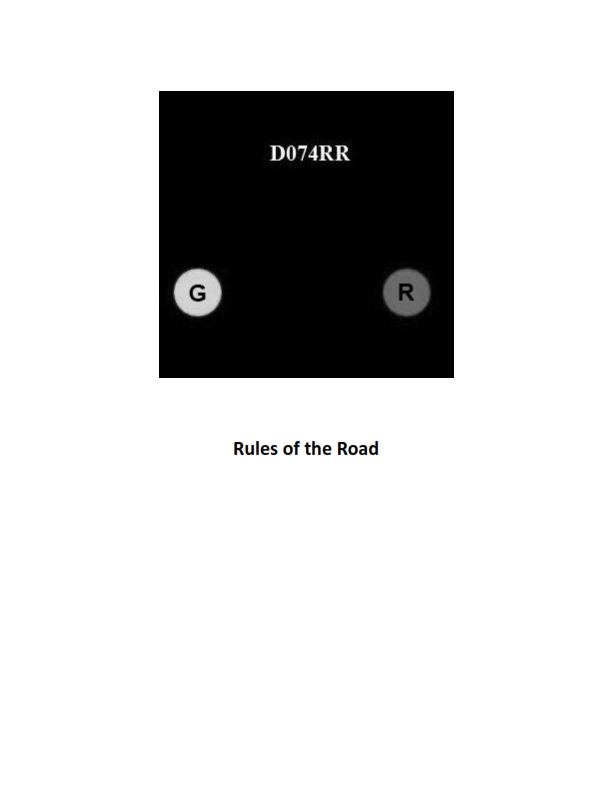
Question 608
Question: BOTH INTERNATIONAL & INLAND At night, you see the display of lights shown in illustration D074RR below. These lights indicate which vessel?
A. a sailing vessel
B. a 12-meter fishing vessel
C. an 8-meter power-driven vessel
D. a vessel not under command
The correct answer is A) a sailing vessel. The display of lights shown in illustration D074RR indicates the navigation lights required for a sailing vessel at night, according to the International and Inland Navigation Rules. Specifically, this configuration of a red light on the port (left) side, a green light on the starboard (right) side, and a white masthead light visible all-around, is the standard lighting arrangement for a sailing vessel underway at night. The other answer choices are incorrect because they do not match the navigation light display shown in the illustration, which is specifically indicative of a sailing vessel.
Question 617
Question: BOTH INTERNATIONAL & INLAND You are on a vessel heading due north and see the lights shown in illustration D051RR below, one point on your port bow. What direction could this vessel be heading in?
A. SE
B. NE
C. SW
D. NW
The correct answer is A) SE. The illustration D051RR shows the navigation lights for a vessel heading in a southeasterly direction. According to the International Regulations for Preventing Collisions at Sea (COLREGS), when you see these navigation lights one point on your port bow, it indicates that the other vessel is heading in a southeasterly direction. The other answer choices are incorrect because they do not match the orientation of the navigation lights shown in the illustration. For example, if the vessel was heading northeast, you would see the red and green sidelights more directly on your port and starboard sides, respectively.
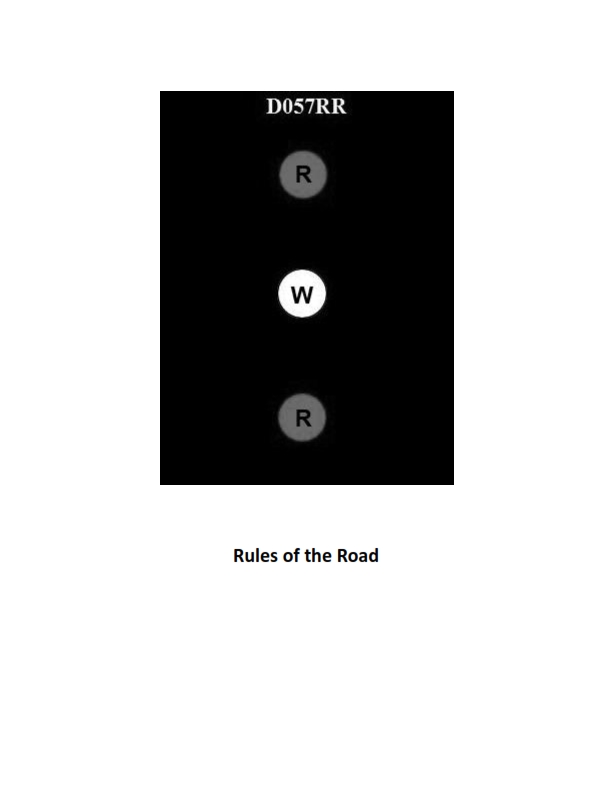
Question 622
Question: BOTH INTERNATIONAL & INLAND Which of the following describes a vessel displaying the lights shown in illustration D057RR below?
A. a pilot vessel underway and making way on pilotage duty
B. a vessel towing and making way
C. a vessel restricted in her ability to maneuver and not making way
D. a vessel engaged in fishing and not making way
The correct answer is C) a vessel restricted in her ability to maneuver and not making way. This is correct because the lights shown in illustration D057RR depict the lights required for a vessel restricted in her ability to maneuver, as per the International Regulations for Preventing Collisions at Sea (COLREGS). These vessels are required to display three all-round lights in a vertical line, with the highest and lowest being red and the middle one being white, which is exactly what is shown in the illustration. The other options are incorrect because they do not match the light configuration shown. A pilot vessel would display different lights, a towing vessel would have different light arrangements, and a fishing vessel would not display the vertical three-light pattern.
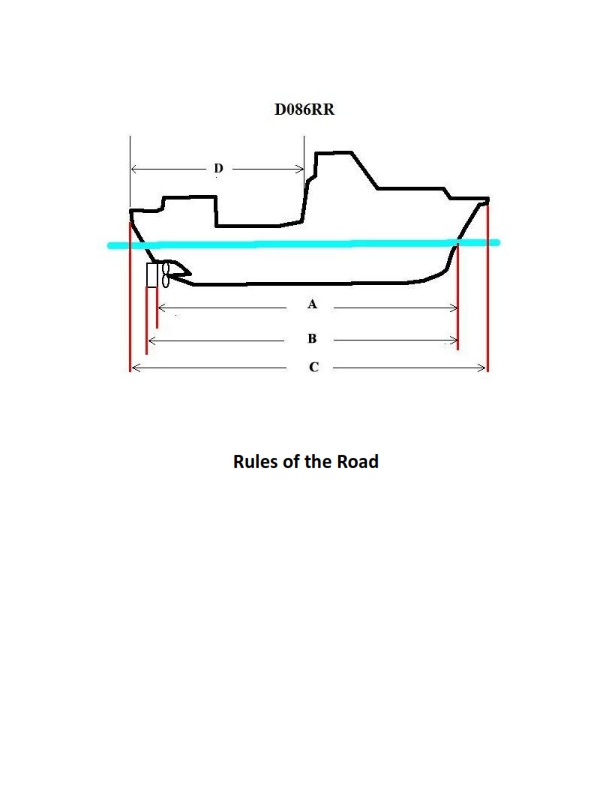
Question 623
Question: BOTH INTERNATIONAL & INLAND Which of the following in illustration D086RR below represents the length of a vessel as defined by the Rules?
A. A
B. B
C. C
D. D
The correct answer is C. According to the Rules, the length of a vessel is defined as the length overall (LOA), which represents the horizontal distance between the foremost part of the stem and the aftermost part of the stern. In the illustration D086RR, the length of the vessel is represented by the measurement indicated by C. The other options are incorrect because A represents the beam of the vessel, B represents the height of the vessel, and D represents the draft of the vessel, which are not the same as the length of the vessel as defined by the Rules.
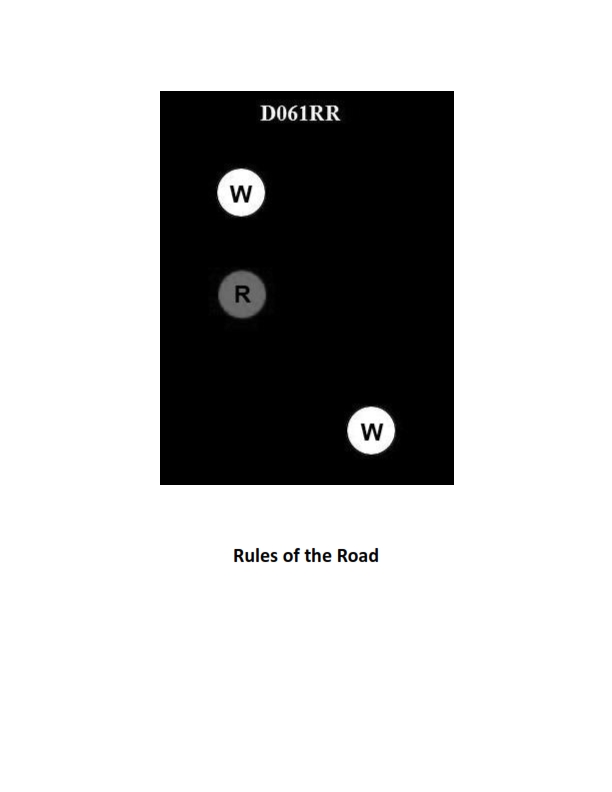
Question 629
Question: BOTH INTERNATIONAL & INLAND A vessel is displaying ONLY the lights shown in illustration D061RR below. Which vessel is this?
A. a fishing vessel aground
B. fishing and hauling her nets
C. a pilot vessel at anchor
D. fishing
The correct answer is C) a pilot vessel at anchor. The reason this is the correct answer is that the lights shown in illustration D061RR depict the lights required for a vessel at anchor, as per the International Regulations for Preventing Collisions at Sea (COLREGS) and the Inland Navigation Rules. A pilot vessel at anchor would be required to display these lights, which include an all-around white light at the masthead to indicate the vessel is at anchor. The other answer choices are incorrect because a fishing vessel aground (A) would not be displaying anchor lights, a fishing vessel hauling her nets (B) would have different light requirements, and a fishing vessel (D) would not be displaying anchor lights unless it was at anchor.
Question 631
Question: BOTH INTERNATIONAL & INLAND Which vessel would exhibit the lights shown in illustration D056RR below?
A. a vessel fishing at anchor
B. a vessel dredging while underway
C. a vessel transferring dangerous cargo at a berth
D. a vessel restricted in her ability to maneuver, underway but not making way
The correct answer is B) a vessel dredging while underway. The lights shown in illustration D056RR represent the required navigation lights for a vessel engaged in dredging or underwater operations while underway. This is specified in the International Regulations for Preventing Collisions at Sea (COLREGS) and the Inland Navigation Rules. The other answer choices do not match the light configuration shown in the illustration. A vessel fishing at anchor would exhibit different lights, a vessel transferring dangerous cargo would have additional signals, and a vessel restricted in maneuverability would have a different arrangement of navigation lights.
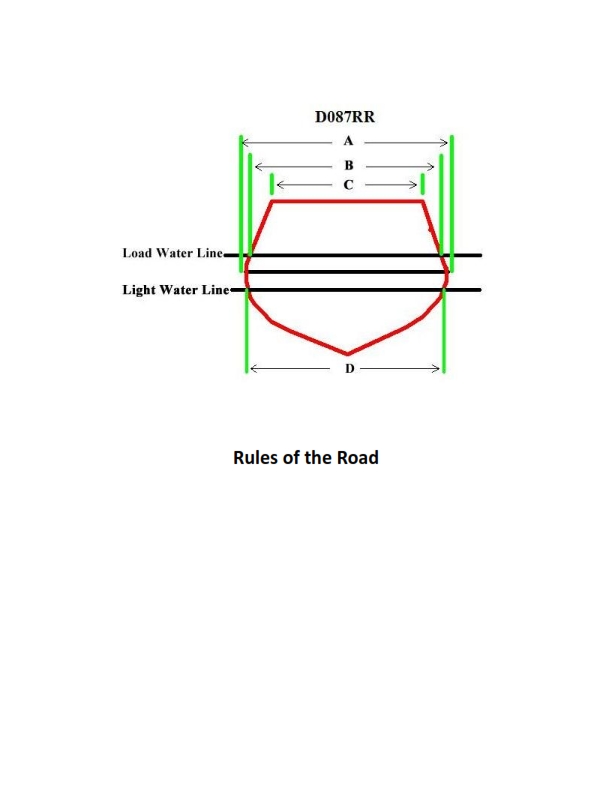
Question 638
Question: BOTH INTERNATIONAL & INLAND In illustration D087RR below, which represents the breadth as defined in the Rules?
A. A
B. B
C. C
D. D
The correct answer is A. In the illustration D087RR, the breadth as defined in the Rules is represented by the line labeled "A". The breadth refers to the width of the vessel, and this is the appropriate dimension indicated in the diagram. The other options (B, C, and D) represent different dimensions or aspects of the vessel, but they do not specifically depict the breadth as required by the question. Therefore, option A is the correct answer based on the information provided in the illustration.
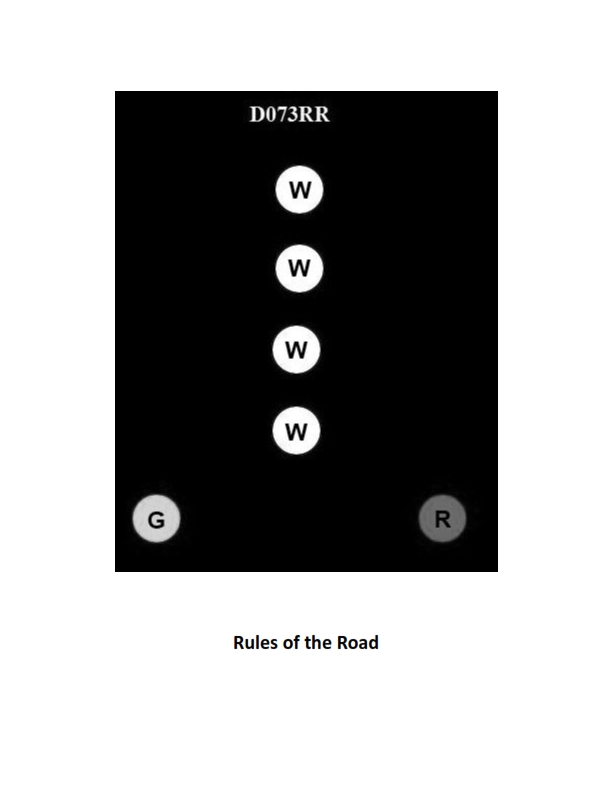
Question 644
Question: BOTH INTERNATIONAL & INLAND What do the lights displayed in illustration D073RR indicate?
A. vessel towing astern
B. vessel laying submarine cable
C. fishing vessel trolling
D. vessel dredging
The correct answer is A) vessel towing astern. The lights displayed in illustration D073RR indicate that the vessel is towing another vessel astern (behind it). This is in accordance with the International Regulations for Preventing Collisions at Sea (COLREGS) and the Inland Navigation Rules, which require vessels engaged in towing to display specific light configurations to signal their status to other vessels. The other options are incorrect because they do not match the light configuration shown in the illustration. Vessels laying submarine cable, fishing vessels trolling, and dredging vessels have different light arrangements to indicate their activities.
Question 646
Question: BOTH INTERNATIONAL & INLAND Two power-driven vessels are crossing as shown in illustration D042RR below. Vessel "A" sounds one short blast on the whistle. You are on vessel "B" and doubt that sufficient action is being taken by vessel "A" . What action should you take?
A. Sound at least five short and rapid blasts
B. Maintain course and speed
C. Alter course to the right or slow down
D. Sound one short blast and maintain course and speed
The correct answer is A) Sound at least five short and rapid blasts. According to the International Regulations for Preventing Collisions at Sea (COLREGS), when a power-driven vessel doubts the actions of another vessel, it should sound at least five short and rapid blasts on the whistle. This indicates uncertainty about the other vessel's actions and prompts the other vessel to take appropriate action to avoid a collision. The other options are incorrect because: B) Maintaining course and speed is not the appropriate action when doubt exists about the other vessel's intentions; C) Altering course or slowing down without clearly signaling the doubt could lead to confusion; and D) Sounding only one short blast may not effectively communicate the need for the other vessel to take action.
Question 650
Question: BOTH INTERNATIONAL & INLAND You are on a vessel heading due north and see the lights shown in illustration D051RR below one point on your port bow. This vessel could be heading in what direction?
A. SW
B. NW
C. NE
D. SE
The correct answer is D) SE. The lights shown in illustration D051RR indicate that the other vessel is heading in a south-easterly (SE) direction. According to the International and Inland Navigation Rules, the side lights (red and green) on a vessel are visible from right ahead to 22.5 degrees abaft the beam (behind the beam) on their respective sides. Seeing the lights one point on your port bow means the other vessel is heading in a south-easterly direction relative to your own vessel. The other options are incorrect because a vessel heading in a south-westerly (SW), north-westerly (NW), or north-easterly (NE) direction would not have its side lights visible one point on your port bow.
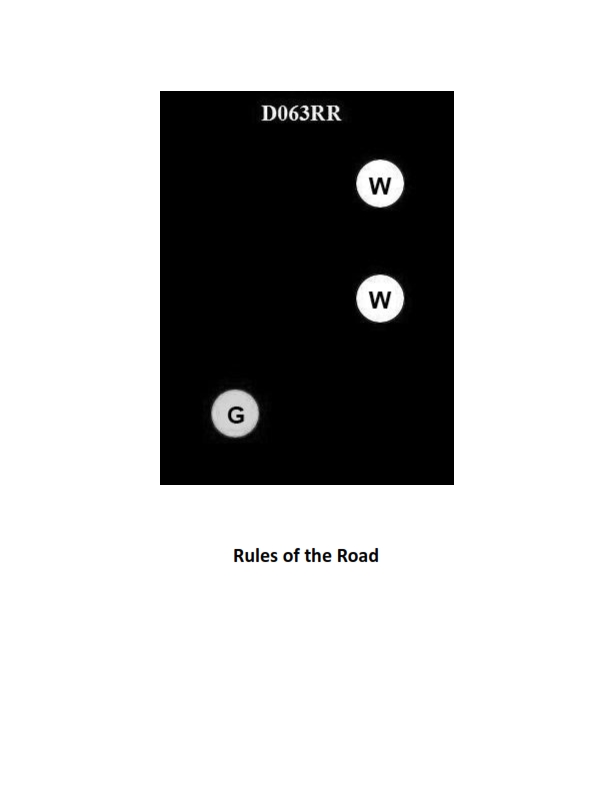
Question 662
Question: BOTH INTERNATIONAL & INLAND A vessel displaying the lights shown in illustration D063RR below is which of the following?
A. not under command
B. underway and more than 50 meters in length
C. fishing
D. towing astern
The correct answer is D) towing astern. The lights shown in illustration D063RR depict the navigation lights required for a vessel that is towing another vessel astern. The two all-round white lights, one at the stern and one near the towing vessel's masthead, are the distinctive signals that identify a vessel engaged in towing operations. The other answer choices are incorrect because: A) a vessel "not under command" would display different navigation lights, B) a vessel "underway and more than 50 meters in length" would display a different configuration of navigation lights, and C) a "fishing" vessel would have a different set of navigation lights.
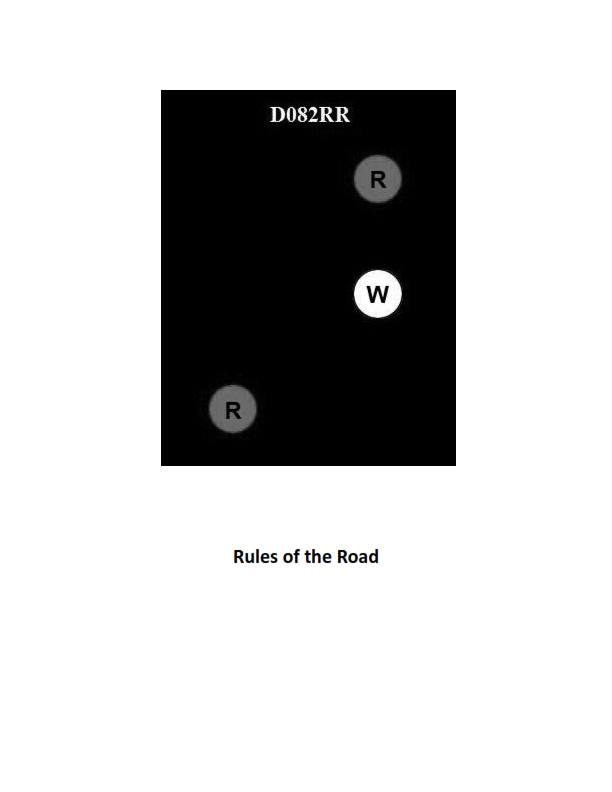
Question 668
Question: BOTH INTERNATIONAL & INLAND A vessel is exhibiting the lights shown in illustration D082RR below. Which can you conclude about the vessel?
A. it is a fishing vessel
B. it is a pilot boat on duty
C. it is a sailing vessel
D. it is a trawling vessel
The correct answer is A) it is a fishing vessel. The lights shown in illustration D082RR indicate that the vessel is exhibiting the required navigation lights for a fishing vessel. According to the International Regulations for Preventing Collisions at Sea (COLREGS) and the Inland Navigation Rules, a fishing vessel underway must display a masthead light, sidelights, and a stern light, which is the configuration shown in the illustration. The other answer choices are incorrect because a pilot boat on duty would not exhibit these specific lights, a sailing vessel would have different light configurations, and a trawling vessel is a type of fishing vessel, so the correct answer is that the vessel is a fishing vessel.
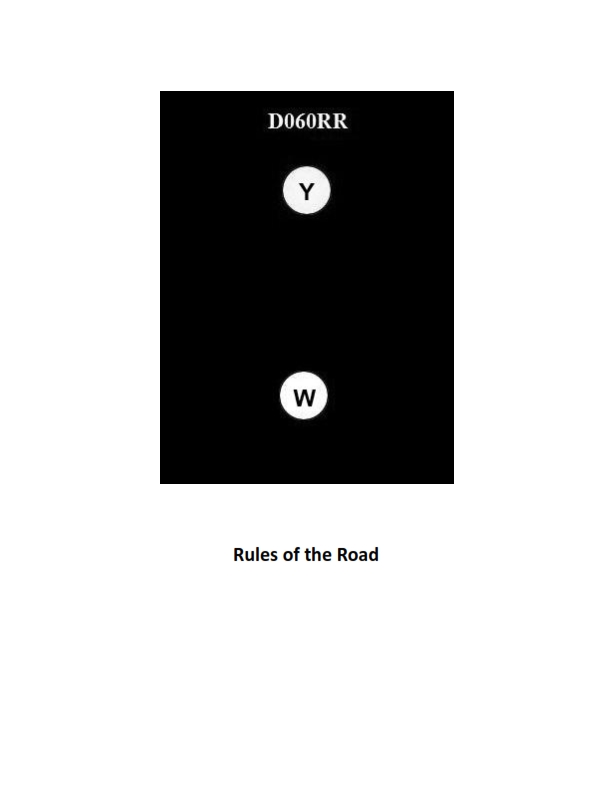
Question 672
Question: BOTH INTERNATIONAL & INLAND Which vessel shall display the lights shown in illustration D060RR below?
A. a vessel towing
B. a fishing vessel
C. a vessel that is broken down
D. a vessel being towed
The correct answer is A) a vessel towing. The lights shown in illustration D060RR are the required lights for a vessel that is towing another vessel or object. According to the International and Inland Navigation Rules, a vessel engaged in towing another vessel or object must display the masthead lights, sidelights, and sternlight prescribed for the vessel being towed. This configuration of lights helps to visually indicate the presence and nature of the towing operation to other vessels in the area. The other answer choices are incorrect because the lights in the illustration are not the appropriate configurations for a fishing vessel, a vessel that is broken down, or a vessel being towed.
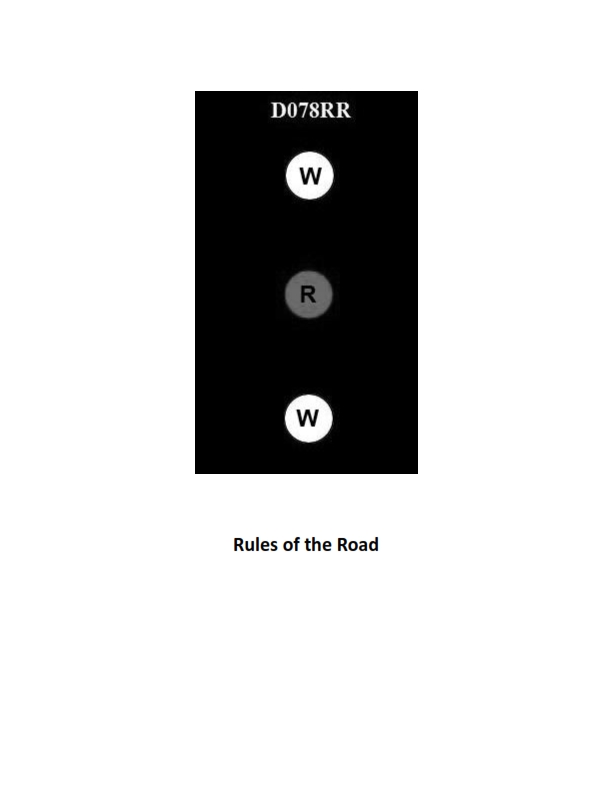
Question 681
Question: BOTH INTERNATIONAL & INLAND At night, you see the lights shown in illustration D078RR below. These lights would indicate which vessel?
A. not under command
B. on pilotage duty and underway
C. restricted in her ability to maneuver
D. engaged in fishing and making way
The correct answer is B) on pilotage duty and underway. The lights shown in illustration D078RR indicate that the vessel is on pilotage duty and underway. According to the International Regulations for Preventing Collisions at Sea (COLREGS), a vessel engaged in pilotage duty must display two all-round red lights in a vertical line at the fore part of the vessel. This configuration of lights identifies the vessel as being on pilotage duty and underway. The other answer choices are incorrect because the lights do not match the descriptions for a vessel not under command (A), a vessel restricted in its ability to maneuver (C), or a fishing vessel making way (D).
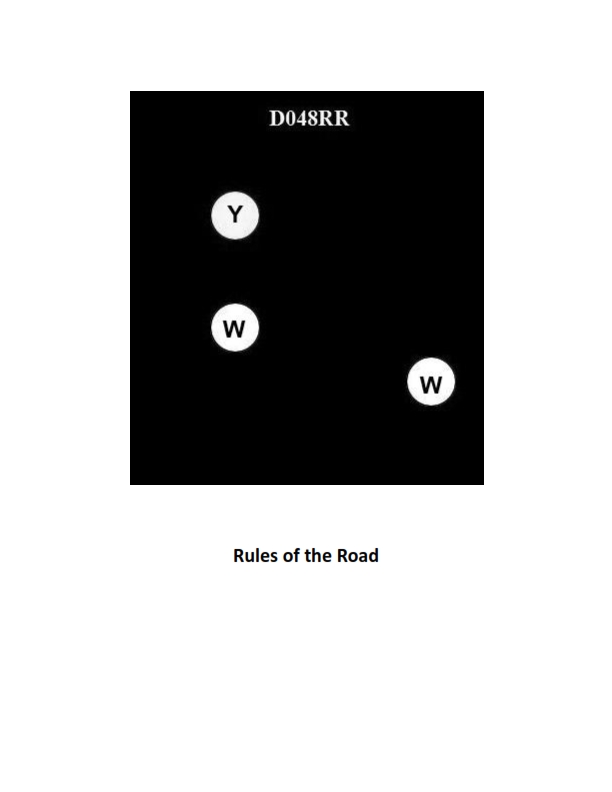
Question 682
Question: BOTH INTERNATIONAL & INLAND The display of lights shown in illustration D048RR below could represent which vessel?
A. a submarine on the surface
B. a tug and a barge being towed astern
C. a vessel not under command
D. a sailing vessel
The correct answer is B) a tug and a barge being towed astern. The display of lights shown in illustration D048RR represents the lighting configuration for a towing vessel (the tug) and a vessel being towed (the barge) when operating at night. This arrangement of lights is required by the International Regulations for Preventing Collisions at Sea (COLREGS) and the Inland Navigation Rules to indicate the presence and relative position of the towing vessel and the towed vessel. The other answer choices are incorrect because a submarine on the surface (A) would have a different lighting arrangement, a vessel not under command (C) would display different signals, and a sailing vessel (D) would have a different configuration of masthead, sidelights, and stern lights.
Question 690
Question: BOTH INTERNATIONAL & INLAND The vessel whose lights are shown in illustration D082RR below is navigating in a narrow channel. Which statement about this vessel is TRUE?
A. It shall not impede the passage of any other vessel navigating within the channel or fairway.
B. It shows two balls
C. It may anchor in the channel or fairway
D. It is the stand-on vessel
The correct answer is A) It shall not impede the passage of any other vessel navigating within the channel or fairway. This is correct because under both the International and Inland Navigation Rules, a vessel navigating in a narrow channel or fairway must not impede the passage of any other vessel that can safely navigate only within that channel or fairway. The vessel shown in the illustration is the "burdened" vessel and must take early and substantial action to keep out of the way of other vessels. The other answer choices are incorrect. Choice B is wrong because the vessel does not show two balls. Choice C is incorrect because vessels are generally prohibited from anchoring in narrow channels or fairways. Choice D is wrong because the vessel shown is the "burdened" vessel, not the "stand-on" vessel.
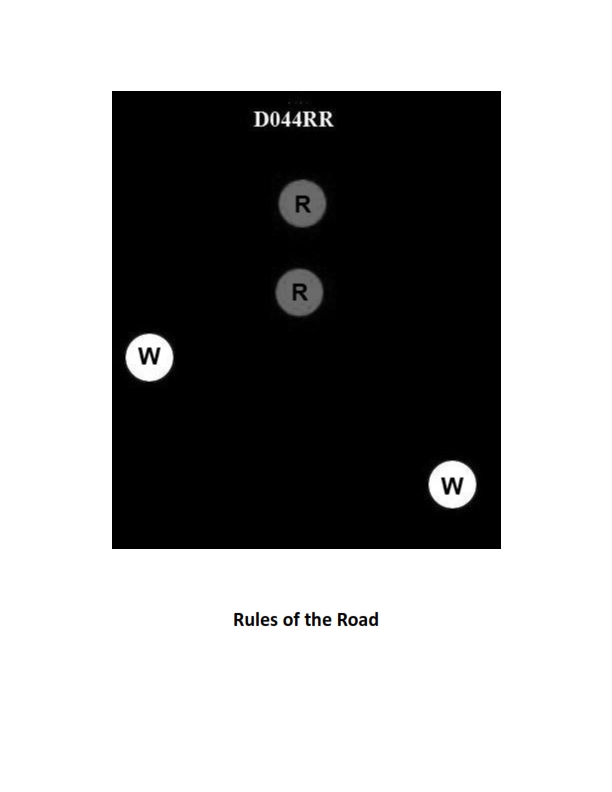
Question 692
Question: BOTH INTERNATIONAL & INLAND The lights displayed in illustration D044RR below would be shown by a vessel described by which of the following?
A. aground
B. not under command and is making way
C. not under command and is dead in the water
D. laying or picking up navigation marks
The correct answer is A) aground. The lights displayed in the illustration D044RR are the all-round red lights, which indicate that the vessel is aground. According to the International Regulations for Preventing Collisions at Sea (COLREGS), a vessel that is aground must display the same lights as a vessel not under command, which includes the all-round red lights shown in the illustration. The other answer choices are incorrect because they do not accurately describe the lighting configuration shown in the illustration. A vessel not under command and making way would display different lights, a vessel not under command and dead in the water would also display different lights, and a vessel laying or picking up navigation marks would not display the all-round red lights.
Question 698
Question: BOTH INTERNATIONAL & INLAND You see the display of lights shown in illustration D071RR below. What do these lights indicate?
A. a vessel dredging
B. a vessel approaching head-on
C. a vessel fishing with nets extending more than 150 meters
D. a vessel trawling
The correct answer is B) a vessel approaching head-on. The display of lights shown in illustration D071RR indicates that the vessel is approaching head-on, as per the International and Inland Navigation Rules. The two all-round white lights displayed vertically signify that the vessel is underway and meeting another vessel head-on, requiring both vessels to take early and substantial action to avoid a collision. The other options are incorrect because they do not match the light configuration shown in the illustration. A vessel dredging would display different lights, a vessel fishing with nets extending more than 150 meters would display different lights, and a vessel trawling would also display a different set of lights.
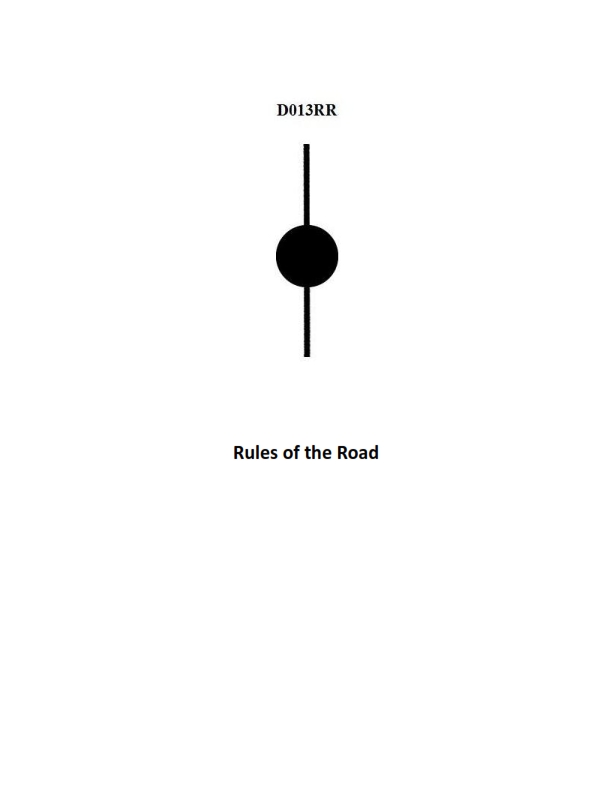
Question 704
Question: BOTH INTERNATIONAL & INLAND A vessel displaying the shape shown in illustration D013RR below is doing which of the following?
A. being towed
B. anchored
C. fishing
D. towing
The correct answer is A) being towed. The shape shown in illustration D013RR depicts the combination of two shapes - a diamond shape over a ball shape. This combination of shapes is the appropriate signal to display when a vessel is being towed, as per the International Regulations for Preventing Collisions at Sea (COLREGS) and the Inland Navigation Rules. The other answer choices are incorrect because a vessel displaying this signal is not anchored (B), fishing (C), or towing another vessel (D). The diamond over ball shape is specifically used to indicate that the vessel is being towed by another vessel.
Question 706
Question: BOTH INTERNATIONAL & INLAND You see ONLY the light shown in illustration D080RR below. This could be what type of vessel?
A. under oars
B. not under command
C. towing
D. engaged in fishing
The correct answer is A) under oars. The illustration D080RR shows a single all-round red light, which is the appropriate light configuration for a vessel under oars according to the International Regulations for Preventing Collisions at Sea (COLREGS) and the Inland Navigation Rules. The other answer choices are incorrect because: B) not under command would require a different light configuration, C) towing would require additional lights, and D) engaged in fishing would require different light signals to indicate that status.
Question 711
Question: BOTH INTERNATIONAL & INLAND Which of the shapes shown in illustration D016RR below must you show when at anchor?
A. A
B. B
C. C
D. D
The correct answer is A. According to the International and Inland Navigation Rules, vessels at anchor must display a single all-round white light, which corresponds to shape A in the illustration. This light is required to be visible all around the horizon for a distance of at least 2 miles. The other shapes in the illustration (B, C, and D) are not the appropriate signals for a vessel at anchor. Shape B represents a vessel underway, shape C represents a vessel restricted in its ability to maneuver, and shape D represents a vessel constrained by its draft.
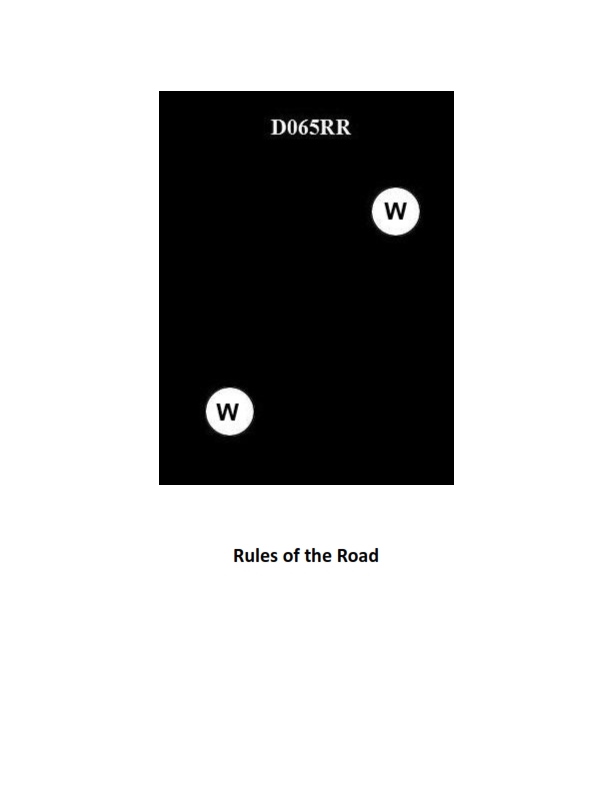
Question 713
Question: BOTH INTERNATIONAL & INLAND At night a vessel displaying the lights shown in illustration D065RR is doing which of the following?
A. drifting
B. anchored
C. being towed
D. fishing
The correct answer is A) drifting. The lights shown in illustration D065RR depict the navigation lights required for a vessel that is drifting at night. The illustration shows an all-around white light, which indicates the vessel is not underway and not anchored. If the vessel was anchored, it would display an anchor light instead. If the vessel was being towed, it would display towing lights. And if the vessel was fishing, it would display the required fishing vessel lights, which are different from the illustration. Therefore, based on the navigation lights depicted, the vessel is drifting at night.
Question 719
Question: BOTH INTERNATIONAL & INLAND Vessel "A" is overtaking vessel "B" as shown in illustration D017RR below. Vessel "B" is an air-cushion vessel operating in the non-displacement mode. In addition to a steady white light which other light will vessel "A" observe on vessel "B"?
A. Flashing red light
B. Steady green light
C. Flashing yellow light
D. Flashing white light
The correct answer is C) Flashing yellow light. According to the International Regulations for Preventing Collisions at Sea (COLREGS), an air-cushion vessel operating in the non-displacement mode is required to exhibit, in addition to the steady white light, a flashing yellow light. This flashing yellow light helps identify the vessel as an air-cushion vessel not operating in the normal displacement mode, which is important information for the overtaking vessel "A" to have. The other answer choices are incorrect because a flashing red light is used for vessels not under command, a steady green light is used for the sidelights of a vessel, and a flashing white light is not a required light for an air-cushion vessel operating in the non-displacement mode.
Question 722
Question: BOTH INTERNATIONAL & INLAND What type of vessel displays the lights as shown in illustration D082RR?
A. anchored
B. fishing
C. sailing
D. a pilot boat
The correct answer is A) anchored. The illustration D082RR depicts the lights required for a vessel that is anchored, as specified in the International and Inland Navigation Rules. An anchored vessel must display an all-round white light at or near the top of the vessel's forward structure. This is the configuration shown in the illustration, indicating that the vessel is anchored. The other answer choices are incorrect because the lighting pattern does not match the requirements for fishing vessels, sailing vessels, or pilot boats, which have different light configurations as per the navigation rules.
Question 723
Question: BOTH INTERNATIONAL & INLAND In illustration D023RR below "B" represents the arc of visibility of which of the following?
A. stern light
B. red sidelight
C. green sidelight
D. yellow flashing light
The correct answer is C) green sidelight. In the illustration D023RR, the arc of visibility represented by "B" corresponds to the green sidelight, which is required to be visible from the bow to 112.5 degrees abaft the beam (side) on the starboard side of the vessel, as per the International Regulations for Preventing Collisions at Sea (COLREGS). The other options are incorrect because the stern light (A) has a different arc of visibility, the red sidelight (B) is on the port side, and the yellow flashing light (D) is not a standard navigation light required by the COLREGS.
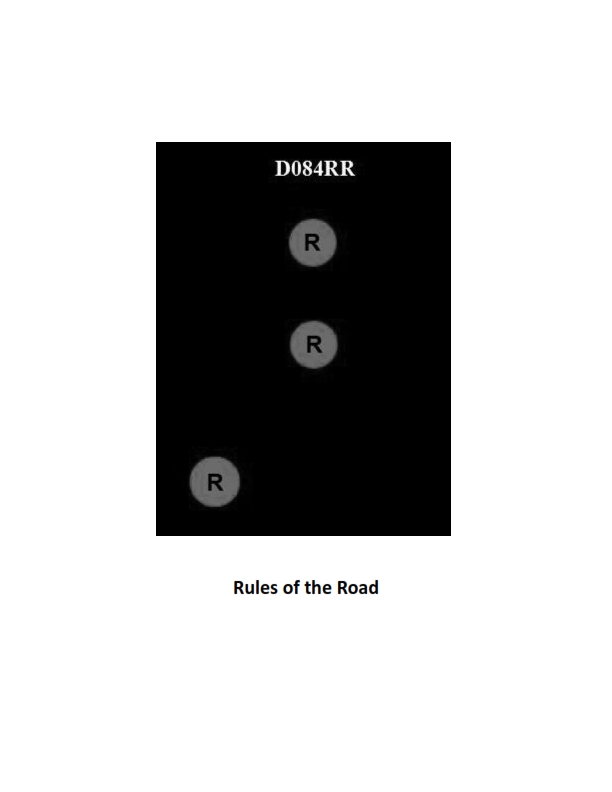
Question 724
Question: BOTH INTERNATIONAL & INLAND Which of the following describes a vessel exhibiting the lights shown in illustration D084RR below?
A. towing
B. dredging
C. showing improper lights
D. not under command
The correct answer is D) not under command. The illustration D084RR shows a vessel exhibiting a red light over a white light, which indicates that the vessel is "not under command" as per the International Regulations for Preventing Collisions at Sea (COLREGS). A vessel not under command is one that, through some exceptional circumstance, is unable to maneuver as required by the rules and is therefore unable to keep out of the way of another vessel. The other answer choices are incorrect because a towing vessel would exhibit different lights, a dredging vessel would exhibit different lights, and a vessel showing improper lights would not be exhibiting the specific lights shown in the illustration.
Question 725
Question: BOTH INTERNATIONAL & INLAND In illustration D023RR below item "C" shows the arc of visibility of which of the following?
A. red sidelight
B. green sidelight
C. yellow flashing light
D. None of the above
The correct answer is D) None of the above. In illustration D023RR, item "C" shows the arc of visibility of the all-round white light, not the sidelights or any yellow flashing light. The sidelights (red and green) have their own separate arcs of visibility, which are not depicted in this particular illustration. Therefore, none of the answer choices accurately describe what item "C" represents in this diagram.
Question 727
Question: BOTH INTERNATIONAL & INLAND A 49 meter seagoing tug has a tow greater than 200 meters as shown in illustration D024RR below and is severely restricted in her ability to deviate from her course. Which lights would be displayed from the towing vessel?
A. Three white masthead lights, red-white-red all-round lights, sidelights and two towing lights
B. Three white masthead lights, red-white-red all-round lights, sidelights, stern light and a towing light
C. Three white masthead lights, two all-round red lights, sidelights, stern light and a towing light
D. None of the above
The correct answer is A) Three white masthead lights, red-white-red all-round lights, sidelights and two towing lights. This is correct because the International Regulations for Preventing Collisions at Sea (COLREGS) require a seagoing tug with a tow greater than 200 meters to display three white masthead lights, red-white-red all-round lights, sidelights, and two towing lights. This is specified in Rule 24(b) of the COLREGS, which covers the lighting requirements for a vessel engaged in towing another vessel. The other options are incorrect because they do not fully comply with the COLREGS requirements for a tug with a tow greater than 200 meters. For example, option B is missing the two towing lights, and options C and D do not include all the required lights.
Question 728
Question: BOTH INTERNATIONAL & INLAND In illustration D023RR below which item shows the arc of visibility of a green sidelight?
A. A
B. B
C. C
D. D
The correct answer is B. In illustration D023RR, item B shows the arc of visibility of a green sidelight. According to the International Regulations for Preventing Collisions at Sea (COLREGS), the arc of visibility for a green sidelight is from dead ahead to 112.5 degrees abaft the beam on the starboard side of the vessel. The other options are incorrect because: A shows the arc of visibility for a white masthead light, C shows the arc of visibility for a red sidelight, and D shows the arc of visibility for a white stern light.
Question 729
Question: BOTH INTERNATIONAL & INLAND In illustration D023RR below item "B" shows the arc of visibility of which of the following lights?
A. red sidelight
B. white masthead light
C. stern light
D. green sidelight
The correct answer is D) green sidelight. In illustration D023RR, the arc of visibility shown by item "B" corresponds to the green sidelight, which is required to be visible from dead ahead to 112.5 degrees abaft the beam on the starboard side of the vessel, as per the navigation rules. The other options are incorrect because the red sidelight (A) has a different arc of visibility, the white masthead light (B) is not a sidelight, and the stern light (C) has a different placement and arc of visibility compared to the green sidelight shown in the illustration.
Question 736
Question: BOTH INTERNATIONAL & INLAND In illustration D023RR below item "A" represents the arc of visibility of which of the following lights?
A. stern light
B. white masthead light
C. red sidelight
D. green sidelight
The correct answer is C) red sidelight. In the illustration D023RR, the arc of visibility labeled "A" represents the arc of visibility of the red sidelight, which is required to be visible from right ahead to 112.5 degrees abaft the beam on the respective side of the vessel, both under the International and Inland Navigation Rules. The other options are incorrect because the stern light and white masthead light have different arc of visibility requirements, and the green sidelight would have a different placement and arc of visibility on the opposite side of the vessel.
Question 737
Question: BOTH INTERNATIONAL & INLAND In illustration D023RR below item "D" represents the arc of visibility of which of the following lights?
A. green sidelight
B. stern light
C. white masthead light
D. None of the above
The correct answer is D) None of the above. The illustration D023RR does not depict the arc of visibility of any of the lights mentioned in the answer choices (green sidelight, stern light, or white masthead light). The arc labeled "D" in the illustration represents the arc of visibility of a red sidelight, not the lights listed in the answer choices. Therefore, none of the answer options correctly identify the light represented by the "D" label in the illustration.
Question 746
Question: BOTH INTERNATIONAL & INLAND You see a vessel displaying ONLY the lights shown in illustration D045RR below. This vessel could be which of the following?
A. power-driven vessel underway
B. pilot vessel on pilotage duty
C. vessel engaged in launching or recovering aircraft
D. vessel engaged in fishing at anchor
The correct answer is A) power-driven vessel underway. This is because the lighting configuration shown in illustration D045RR corresponds to the navigation lights required for a power-driven vessel underway, as per the International Regulations for Preventing Collisions at Sea (COLREGS) and the Inland Navigation Rules. The other options are incorrect because the lighting shown does not match the requirements for a pilot vessel, a vessel engaged in launching/recovering aircraft, or a vessel engaged in fishing at anchor, which have different navigation light configurations.
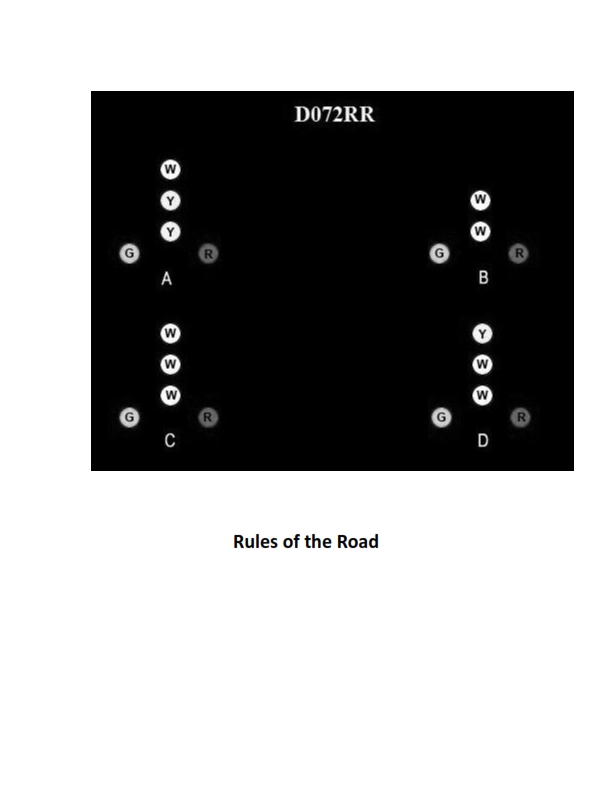
Question 747
Question: BOTH INTERNATIONAL & INLAND Which display of lights shown in illustration D072RR below indicates a 65-meter tug towing a barge astern, length of tow 120 meters?
A. A
B. B
C. C
D. D
The correct answer is C. The display of lights shown in illustration D072RR for a 65-meter tug towing a barge astern, with a length of tow of 120 meters, indicates the configuration for a power-driven vessel towing another vessel astern. This is in accordance with the International Regulations for Preventing Collisions at Sea (COLREGS) and the Inland Navigation Rules. The other options do not accurately represent the lighting configuration for this scenario. For example, option A would be for a vessel not engaged in towing, while options B and D would be for different towing configurations or vessel sizes.
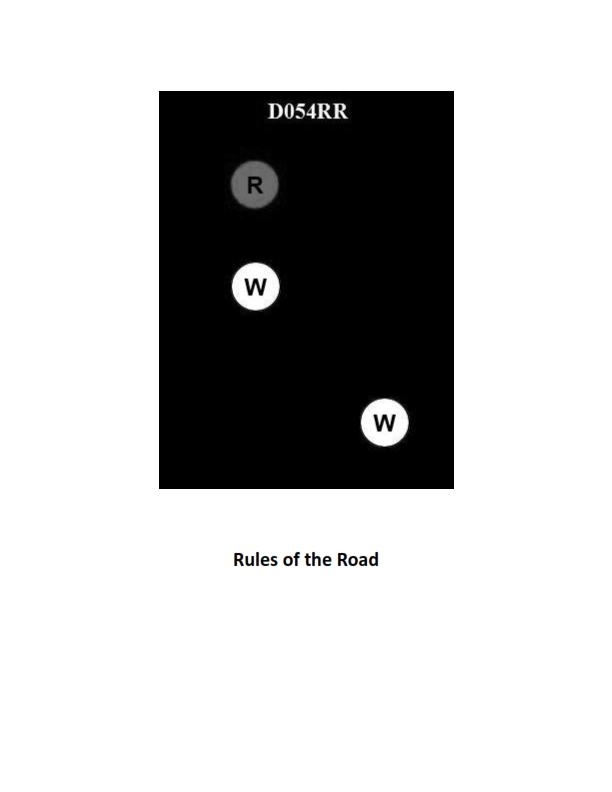
Question 748
Question: BOTH INTERNATIONAL & INLAND You see the display of lights shown in illustration D054RR below, this could be which of the following?
A. fishing vessel at anchor
B. pilot vessel with a motor launch alongside
C. fishing vessel adrift and fishing with handlines
D. fishing vessel with outlying gear more than 150 meters
The correct answer is D) fishing vessel with outlying gear more than 150 meters. This is correct because the display of lights shown in illustration D054RR indicates a fishing vessel with outlying gear extending more than 150 meters from the vessel. The International Regulations for Preventing Collisions at Sea (COLREGS) require fishing vessels with gear extending more than 150 meters to display the lights shown in the illustration to indicate the presence of the extended gear. The other options are incorrect because they do not match the specific lighting configuration depicted in the illustration. A fishing vessel at anchor (A), a pilot vessel with a motor launch alongside (B), and a fishing vessel adrift and fishing with handlines (C) would have different light displays.
Question 751
Question: BOTH INTERNATIONAL & INLAND Vessel "A" is overtaking vessel "B" as shown in illustration D017RR below, and will pass without changing course. Vessel "B" is an air-cushion vessel operating in the non-displacement mode. Which light will vessel "A" observe from vessel "B"?
A. Green light
B. flashing red light
C. flashing yellow light
D. flashing white light
The correct answer is C) flashing yellow light. According to the International Regulations for Preventing Collisions at Sea (COLREGS), an air-cushion vessel operating in the non-displacement mode is required to exhibit a flashing yellow light when overtaken by another vessel. This is specified in Rule 18(f) of the COLREGS. The other answer choices are incorrect because a green light is not a recognized signal for an air-cushion vessel, a flashing red light would indicate a vessel not under command, and a flashing white light is not the proper signal for an overtaking situation involving an air-cushion vessel.
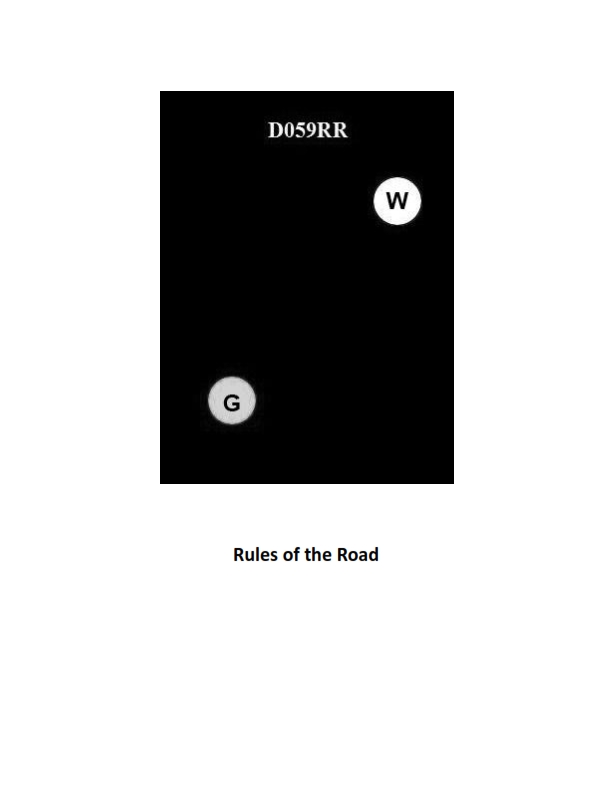
Question 753
Question: BOTH INTERNATIONAL & INLAND You are on watch and sight a vessel showing only the lights in illustration D059RR below. What type of vessel do these lights represent?
A. vessel engage in trawling
B. power-driven vessel
C. sailing vessel
D. mineclearance vessel
The correct answer is B) power-driven vessel. The lights shown in illustration D059RR represent the navigation lights required for a power-driven vessel under both the International and Inland Rules of the Road. Power-driven vessels must display a masthead light forward, sidelights, and a stern light. This lighting configuration allows other vessels to identify the type and direction of travel of the power-driven vessel. The other answer choices are incorrect because: A) trawling vessels have additional lights to indicate they are engaged in fishing, C) sailing vessels have different sidelight configurations, and D) mineclearance vessels do not have this standard power-driven vessel lighting arrangement.
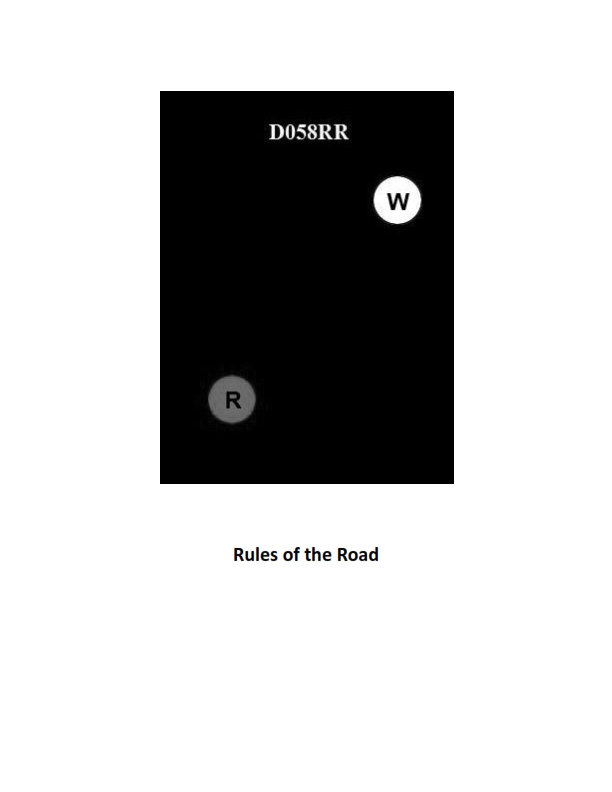
Question 756
Question: BOTH INTERNATIONAL & INLAND The lights shown in illustration D058RR below represent which of the following?
A. a power-driven vessel of less than 50 meters in length
B. a sailboat
C. a fishing vessel at anchor
D. a vessel being towed
The correct answer is A) a power-driven vessel of less than 50 meters in length. The lights shown in illustration D058RR represent the navigation lights required for a power-driven vessel less than 50 meters in length, as per the International Regulations for Preventing Collisions at Sea (COLREGS) and the Inland Navigation Rules. These lights include a masthead light, sidelights, and a stern light, which is the standard configuration for this type of vessel in both international and inland waters. The other options are incorrect because the lighting configuration does not match the requirements for a sailboat, a fishing vessel at anchor, or a vessel being towed.
Question 760
Question: BOTH INTERNATIONAL & INLAND You are on a vessel and see ahead the lights shown in illustration D059RR below. These lights indicate which of the following?
A. vessel crossing from your port
B. vessel meeting head-on
C. vessel crossing from your starboard
D. vessel being overtaken
The correct answer is A) vessel crossing from your port. The lights shown in illustration D059RR indicate that the vessel ahead is a power-driven vessel crossing from your port side. According to the International Regulations for Preventing Collisions at Sea (COLREGS), when two power-driven vessels are crossing, the vessel that has the other on its own port side shall keep out of the way and avoid crossing ahead of the other vessel. The other answer choices are incorrect because: B) a head-on situation would be indicated by two white masthead lights in a vertical line, C) a vessel crossing from your starboard side would have its green sidelight visible, and D) an overtaking situation would be indicated by the overtaken vessel's stern light.
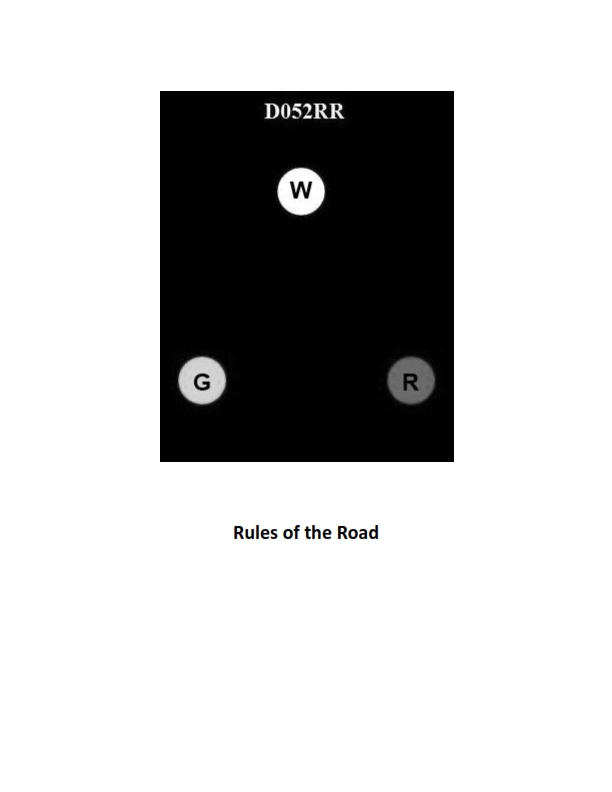
Question 761
Question: BOTH INTERNATIONAL & INLAND At night, a vessel displaying the lights shown in illustration D052RR below. Which of the following describes this vessel?
A. transferring dangerous cargo
B. aground
C. underway
D. at anchor
The correct answer is C) underway. The lights displayed in illustration D052RR indicate that the vessel is underway at night. The illustration shows a vessel displaying the required navigation lights for a power-driven vessel underway - a masthead light forward, sidelights (red and green), and a stern light. This lighting configuration is specifically required by the International Regulations for Preventing Collisions at Sea (COLREGS) and the Inland Navigation Rules for a power-driven vessel underway at night. The other answer choices are incorrect because the lights do not match the requirements for a vessel transferring dangerous cargo (A), aground (B), or at anchor (D).
Question 762
Question: BOTH INTERNATIONAL & INLAND At night, a vessel displaying the lights shown in illustration D052RR below is doing which of the following?
A. underway
B. pushing ahead
C. towing a submerged object
D. engaged in dredging
The correct answer is A) underway. The lights displayed in illustration D052RR indicate that the vessel is underway at night. The illustration shows a vessel displaying a masthead light, sidelights, and a stern light - which is the standard lighting configuration for a vessel underway as per the International Regulations for Preventing Collisions at Sea (COLREGS). The other answer choices are incorrect because: B) pushing ahead and C) towing a submerged object would require different lighting configurations, while D) engaged in dredging would typically display different signals to indicate the restricted nature of the vessel's operations.
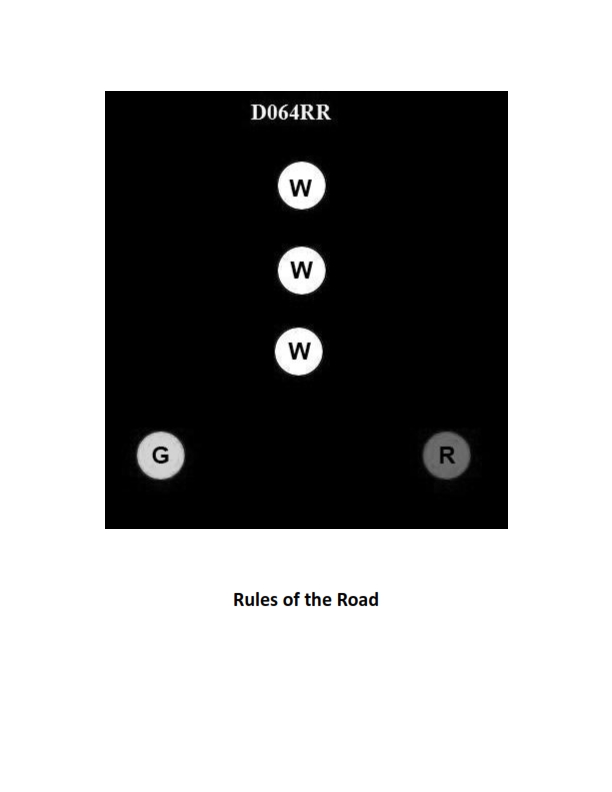
Question 763
Question: BOTH INTERNATIONAL & INLAND You see the display of lights shown in illustration D064RR below. These lights could indicate which of the following?
A. 60-meter tug pushing a barge ahead
B. tug unable to maneuver as required by the Rules
C. 40-meter tug with tow exceeding 200 meters
D. range marking a channel beneath a drawbridge
The correct answer is C) 40-meter tug with tow exceeding 200 meters. The display of lights shown in illustration D064RR indicates a towing vessel over 20 meters in length with a tow exceeding 200 meters. Per the International and Inland Navigation Rules, this configuration of lights is required for a 40-meter tug with a tow longer than 200 meters. The other options do not match this specific lighting configuration.
Question 764
Question: BOTH INTERNATIONAL & INLAND At night, a vessel displaying the lights shown in illustration D052RR below represents which of the following?
A. a vessel dredging
B. a vessel underway
C. a vessel aground
D. a vessel at anchor
The correct answer is B) a vessel underway. The lights displayed in illustration D052RR, which consist of a masthead light, sidelights, and a stern light, represent the lighting configuration required for a power-driven vessel underway at night under both the International and Inland Navigation Rules. The other answer choices are incorrect because the lighting configuration does not match the requirements for a vessel dredging (A), a vessel aground (C), or a vessel at anchor (D), which have different light display requirements.
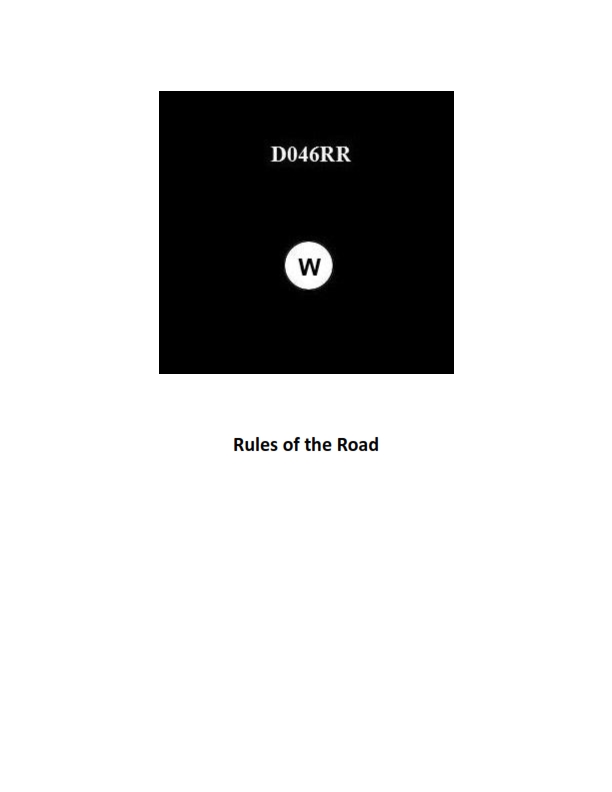
Question 765
Question: BOTH INTERNATIONAL & INLAND At night, you see a vessel displaying the light shown in illustration D046RR below. Which vessel would exhibit this light?
A. a pilot boat making way
B. sailing
C. fishing and anchored
D. fishing and making way
The correct answer is B) sailing. The light shown in illustration D046RR is the combination of a masthead light, sidelights, and a sternlight, which is the lighting configuration required for a sailing vessel at night under both the International and Inland Navigation Rules. This lighting arrangement allows other vessels to identify the sailing vessel's direction of travel and navigation status. The other answer choices are incorrect because: A) a pilot boat would typically display different lights, C) a fishing vessel at anchor would display an all-around white anchor light, and D) a fishing vessel underway would display different sidelights and possibly additional fishing vessel lights.
Question 770
Question: BOTH INTERNATIONAL & INLAND The tow shown in illustration D024RR below is made up of inconspicuous, partly submerged vessels and is 150 meters in length. The towed vessels are less than 25 meters in breadth and less than 100 meters in length. Which lights would be displayed from the towed vessels?
A. One all round white light at or near each end of each vessel towed
B. Sidelights and stern light on each vessel towed
C. One all round white light at the forward end of each vessel towed
D. One all round white light at each end and one all round white light at the extremities of its breadth of each vessel towed
The correct answer is A) One all round white light at or near each end of each vessel towed. This is correct based on the International Regulations for Preventing Collisions at Sea (COLREGS), Rule 24(e), which states that "a vessel being towed shall exhibit the lights prescribed in Rule 23(a)(i) and (a)(ii)." Rule 23(a)(i) and (a)(ii) require that vessels less than 50 meters in length display one all-round white light at or near the stern of the vessel. The other answer choices are incorrect because they do not fully comply with the COLREGS requirements for the lighting of towed vessels that are less than 25 meters in breadth and less than 100 meters in length, as described in the question.
Question 772
Question: BOTH INTERNATIONAL & INLAND Which of the shapes shown in illustration D016RR below would you show on the after end of an inconspicuous partially submerged vessel or object being towed over 200 meters in length?
A. A
B. B
C. C
D. D
The correct answer is B. The shape shown in illustration D016RR that would be displayed on the after end of an inconspicuous partially submerged vessel or object being towed over 200 meters in length is a diamond shape (B). This is because the International Regulations for Preventing Collisions at Sea (COLREGS) require that a diamond shape be displayed on the after end of any vessel or object being towed that is 200 meters or more in length. This helps to make the towed object more visible to other vessels and prevent collisions. The other options (A, C, and D) are incorrect as they do not meet the COLREGS requirement for the appropriate shape to be displayed on a towed object over 200 meters in length.
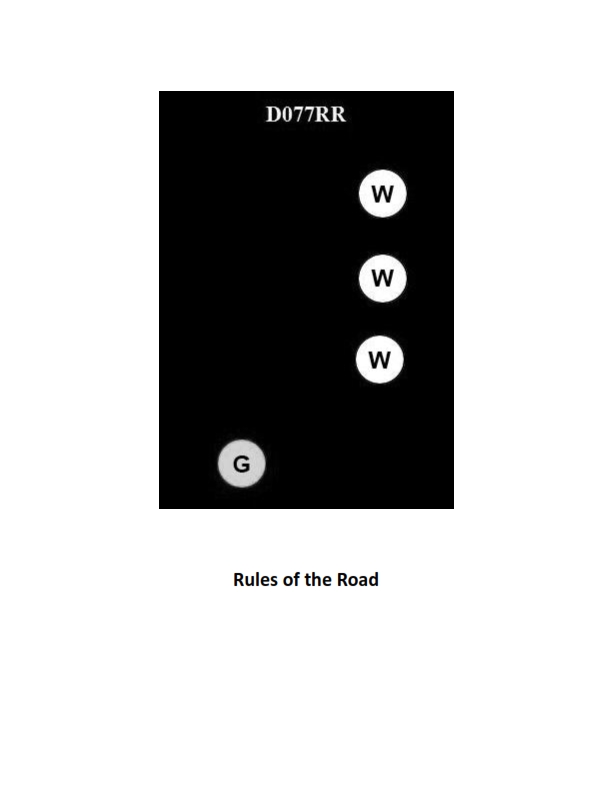
Question 773
Question: BOTH INTERNATIONAL & INLAND You see the lights shown in illustration D077RR below. This could be which of the following?
A. A vessel pushing barges ahead
B. A pipeline
C. A stationary dredge
D. A vessel towing barges astern
The correct answer is D) A vessel towing barges astern. The lights shown in illustration D077RR depict the navigation lights required for a vessel towing barges astern. This configuration includes a white masthead light, a yellow towing light, and a red and green sidelight. According to the International and Inland Navigation Rules, this lighting arrangement is specifically required for a vessel towing barges from the stern. The other answer choices are incorrect because the displayed lights do not match the requirements for a vessel pushing barges ahead (A), a pipeline (B), or a stationary dredge (C).
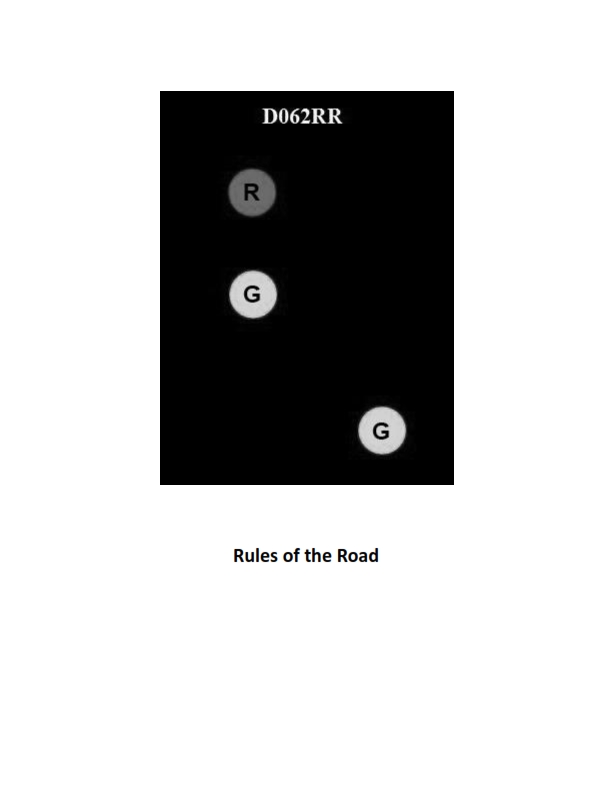
Question 783
Question: BOTH INTERNATIONAL & INLAND A vessel underway at night is displaying the lights shown in illustration D062RR below. What do these lights indicate?
A. engaged in fishing
B. mine sweeping
C. a pilot boat
D. under sail
The correct answer is D) under sail. The lights displayed in the illustration D062RR indicate that the vessel is under sail at night. According to the International Regulations for Preventing Collisions at Sea (COLREGS), a vessel under sail is required to display a combination of sidelights (red and green) and a stern light (white) when underway at night. This lighting configuration, as shown in the illustration, is the proper signal for a sailing vessel operating in both international and inland waters. The other answer choices are incorrect because they do not match the lighting requirements for a vessel under sail. A fishing vessel, a mine sweeper, and a pilot boat would have different light configurations that do not match the one shown in the illustration.
Question 793
Question: BOTH INTERNATIONAL & INLAND Which of the shapes shown in illustration D016RR below would you show on the after end of an inconspicuous partially submerged vessel or object being towed less than 200 meters in length?
A. A
B. B
C. C
D. No day-shape would be shown.
The correct answer is B. According to the International Regulations for Preventing Collisions at Sea (COLREGS), an inconspicuous partially submerged vessel or object being towed less than 200 meters in length is required to display a diamond shape on the after end. This is specified in Rule 24(c) of the COLREGS. The other answer choices are incorrect because: A) A diamond shape is the correct shape, not a single ball. C) A diamond shape, not a double cone, is the required day-shape. D) A day-shape must be displayed, not no shape at all.
Question 796
Question: BOTH INTERNATIONAL & INLAND Which vessel would display the shape shown in illustration D010RR below?
A. a vessel towing
B. a vessel broken down
C. a fishing vessel
D. a vessel at anchor
The correct answer is A) a vessel towing. The shape shown in illustration D010RR is the shape that a vessel engaged in towing must display, as per the International Regulations for Preventing Collisions at Sea (COLREGS) and the Inland Navigation Rules. This shape, consisting of two black shapes placed vertically, indicates that the vessel is towing another vessel astern or alongside. The other answer choices do not match this specific shape requirement for towing vessels.
Question 797
Question: BOTH INTERNATIONAL & INLAND Which is TRUE of a tug boat displaying the shape shown in illustration D010RR below?
A. has a tow that exceeds 200 meters in length
B. is at anchor
C. has a tow that is carrying dangerous cargo
D. is not under command
The correct answer is A) has a tow that exceeds 200 meters in length. The shape shown in illustration D010RR represents the day signal for a vessel that is towing another vessel or object where the length of the tow, measured from the stern of the towing vessel to the after end of the tow, exceeds 200 meters. This signal is required by both the International and Inland Rules of the Road to indicate the extended length of the tow. The other answer choices are incorrect because B) a vessel at anchor would display different day shapes, C) a vessel carrying dangerous cargo would display a different set of signals, and D) a vessel not under command would display a different shape.
Question 799
Question: BOTH INTERNATIONAL & INLAND The vessel showing the shape in illustration D022RR below is which of the following?
A. A trawler shooting nets in the direction indicated
B. A tug with a tow exceeding 200 meters unable to deviate from course
C. A vessel engaged in mine clearance operations
D. A fishing vessel with gear extending more than 150 meters horizontally
The correct answer is B) A tug with a tow exceeding 200 meters unable to deviate from course. This is correct because the shape shown in illustration D022RR represents a vessel restricted in its ability to maneuver, which is the case for a tug with a long tow that cannot easily change direction. The regulations for Inland and International Navigation Rules require this shape to be displayed in such situations to alert other vessels to the limited maneuverability of the tug and tow. The other options are incorrect because they do not match the specific navigational constraints indicated by the shape in the illustration. A trawler, fishing vessel, or mine clearance vessel would not be required to display this particular shape.
Question 800
Question: BOTH INTERNATIONAL & INLAND The tug shown in illustration D024RR below is greater than 50 meters and severely restricted in her ability to deviate from her course. Which lights would be displayed from the towing vessel?
A. Three white masthead lights, red-white-red all round lights, sidelights and two towing lights
B. Two white masthead lights, red-white-red all round lights, sidelights, stern light and a towing light
C. Three white masthead lights, two all round red lights, sidelights, stern light and a towing light
D. None of the above
The correct answer is D) None of the above. The tug shown in illustration D024RR is described as being greater than 50 meters and severely restricted in its ability to deviate from its course. Under both the International and Inland Navigation Rules, a towing vessel of this size and maneuverability would be required to display a different set of navigation lights than the options provided. The other answer choices do not accurately reflect the specific lighting requirements for a towing vessel of this size and restriction. The correct lighting configuration would need to be determined by referencing the applicable navigation rules and regulations.
Question 805
Question: BOTH INTERNATIONAL & INLAND You see the display of lights shown in illustration D064RR below. This could indicate which of the following?
A. dredge working at anchor
B. dredge restricted in its ability to maneuver
C. 65-meter tug towing astern, length of tow 150 meters
D. 55-meter tug towing astern, length of tow exceeds 200 meters
The correct answer is C) 65-meter tug towing astern, length of tow 150 meters. This is the correct answer because the display of lights shown in illustration D064RR, which includes two all-round white lights and two all-round red lights, is the required lighting configuration for a vessel 65 meters or more in length engaged in towing astern, where the length of the tow exceeds 150 meters but does not exceed 200 meters. The other answer choices are incorrect because they do not match the lighting configuration described in the illustration. Option A refers to a dredge at anchor, Option B refers to a dredge restricted in its ability to maneuver, and Option D refers to a tug towing astern with a tow length exceeding 200 meters, all of which have different lighting requirements.
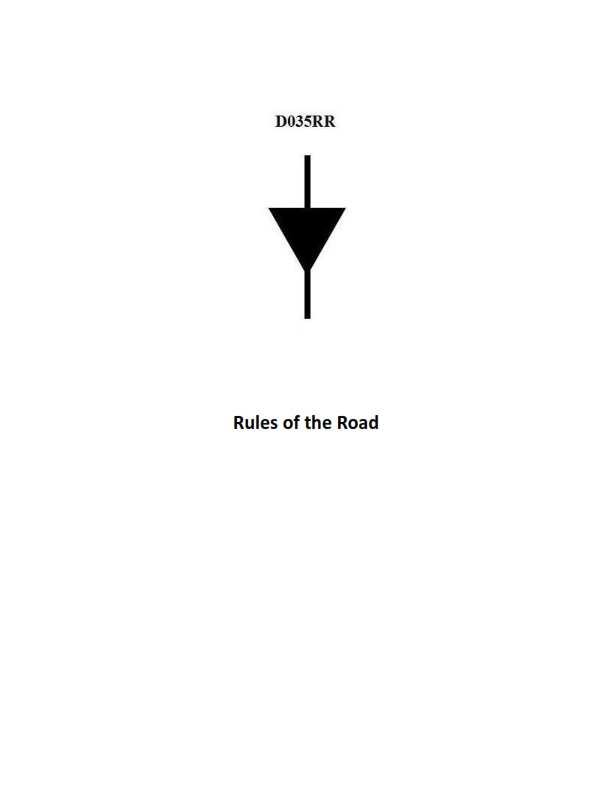
Question 817
Question: BOTH INTERNATIONAL & INLAND A sailing vessel is displaying the shape shown in illustration D035RR. What does this shape indicate?
A. the vessel is fishing as well as sailing
B. the vessel is being propelled by power as well as sail
C. the sailboat is on a starboard tack
D. the vessel is close-hauled and has difficulty maneuvering
The correct answer is B) the vessel is being propelled by power as well as sail. The shape shown in illustration D035RR indicates that the sailing vessel is being propelled by both power and sail. This is specified in the International and Inland Navigation Rules, which require a sailing vessel using auxiliary power to display this shape when the propulsion power is being used. The other options are incorrect because A) the shape does not indicate the vessel is fishing, C) the shape does not indicate the vessel is on a starboard tack, and D) the shape does not indicate the vessel is close-hauled or having difficulty maneuvering, but rather that it is using both power and sail for propulsion.
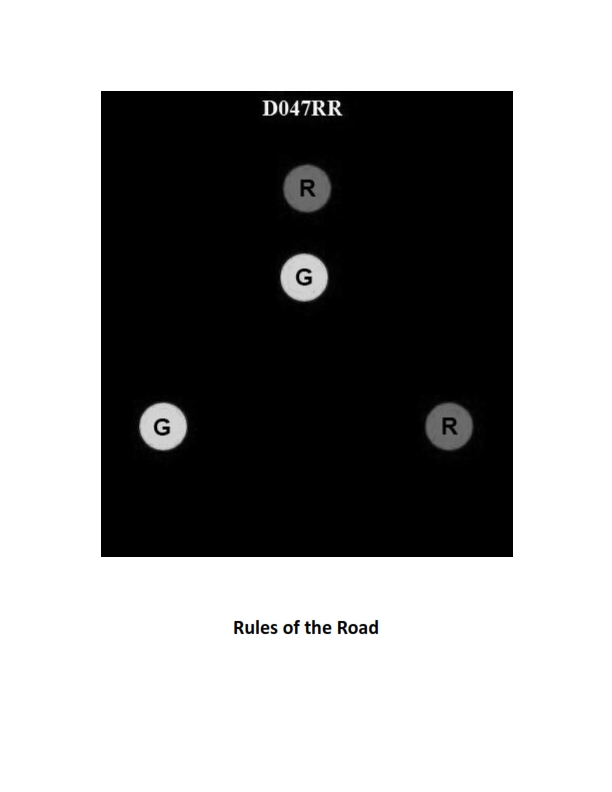
Question 822
Question: BOTH INTERNATIONAL & INLAND You are underway at night and you sight the lights shown in illustration D047RR below. You know these lights indicate which of the following?
A. sailing vessel
B. dredge at work
C. trawler dragging nets
D. fishing vessel engaged in fishing
The correct answer is A) sailing vessel. The lights shown in illustration D047RR indicate the navigation lights of a sailing vessel underway at night. According to the International and Inland Navigation Rules, a sailing vessel underway at night must display the following lights: a white light at the stern, a red light on the port (left) side, and a green light on the starboard (right) side. These are the three lights shown in the illustration, which is the proper configuration for a sailing vessel. The other answer choices (B, C, and D) do not match the lighting configuration displayed in the illustration, and therefore are incorrect.
Question 823
Question: BOTH INTERNATIONAL & INLAND You see ONLY the light shown in illustration D080RR below. Which type of vessel are you observing?
A. vessel on pilotage duty
B. law enforcement vessel
C. sailing vessel
D. vessel engaged in fishing
The correct answer is C) sailing vessel. The illustration D080RR shows a red sidelight, which indicates that the vessel is a sailing vessel. According to the International and Inland Navigation Rules, sailing vessels must display a red sidelight on the port (left) side of the vessel when underway. This allows other vessels to identify the sailing vessel and take the appropriate action to avoid a collision. The other answer choices are incorrect because a vessel on pilotage duty (A) would display different navigation lights, a law enforcement vessel (B) would typically display flashing blue or red lights, and a vessel engaged in fishing (D) would display different navigation lights specific to fishing vessels.
Question 825
Question: BOTH INTERNATIONAL & INLAND You are on a sailing vessel. While under sail you decide to use your engine to assist in propulsion. Which of the shapes shown in illustration D016RR below would you exhibit?
A. B
B. C
C. D
D. None of these day signals are correct.
The correct answer is D) None of these day signals are correct. When operating a sailing vessel under power, the appropriate day signal to exhibit is not one of the options shown in the illustration. Instead, the vessel should display the shape of a black diamond according to the International and Inland Navigation Rules. This indicates that the vessel is no longer under sail alone and is using mechanical propulsion, which changes its maneuvering characteristics. The options provided in the illustration do not accurately represent the correct day signal required in this scenario.
Question 828
Question: BOTH INTERNATIONAL & INLAND At night, if you see a vessel ahead displaying the lights shown in illustration D070RR below, what action should you take?
A. stay clear as the vessel is fishing
B. change course to the right as the vessel is crossing your bow
C. stay clear as the vessel is transferring dangerous cargo
D. provide assistance as the vessel is in distress
The correct answer is A) stay clear as the vessel is fishing. The lighting configuration shown in illustration D070RR represents the navigation lights required for a vessel engaged in fishing at night, as per the International Regulations for Preventing Collisions at Sea (COLREGS). This indicates that the vessel ahead is actively fishing and you should stay clear to avoid interfering with its operations. The other options are incorrect because B) the vessel is not crossing your bow, C) the vessel is not transferring dangerous cargo, and D) the vessel is not in distress, but rather is engaged in lawful fishing activities.
Question 829
Question: BOTH INTERNATIONAL & INLAND You are on a 30-meter fishing vessel. Which of the shapes shown in illustration D016RR below must you show while engaged in fishing?
A. A
B. B
C. C
D. D
The correct answer is C. While engaged in fishing on a 30-meter fishing vessel in both international and inland waters, you must show the shape depicted in illustration D016RR, which is a cone shape. This is because the International Regulations for Preventing Collisions at Sea (COLREGS) and the Inland Navigation Rules require fishing vessels to display a cone shape pointed downwards while engaged in fishing, to indicate their activity and status to other vessels in the area. The other shapes shown in the illustration do not apply to fishing vessels specifically.
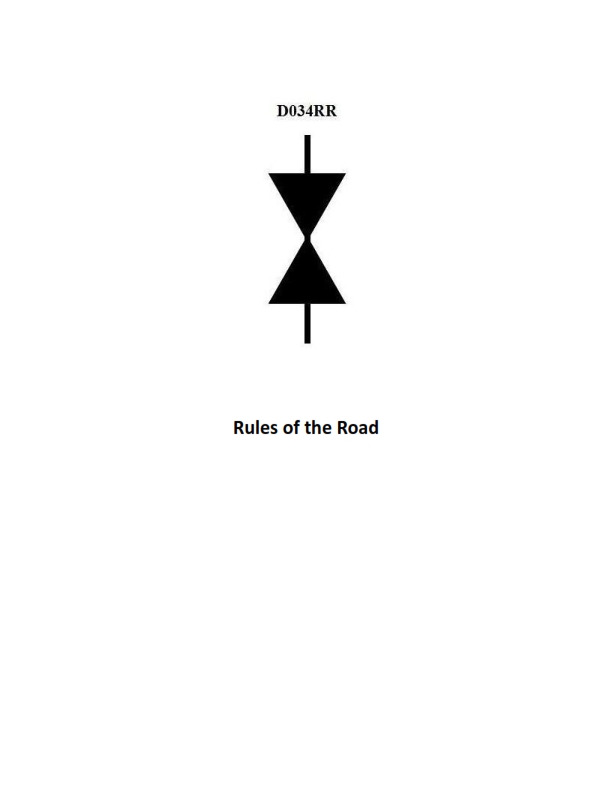
Question 833
Question: BOTH INTERNATIONAL & INLAND Which of the following describes a vessel showing the shape in illustration D034RR below?
A. has a tow which exceeds 200 meters in length
B. is not under command
C. is engaged in surveying or underwater work
D. is fishing
The correct answer is D) is fishing. The shape in illustration D034RR depicts the navigational shape for a vessel engaged in fishing. According to both the International and Inland Navigation Rules, vessels engaged in fishing must display this diamond shape to indicate their status and activity to other vessels in the vicinity. The other answer choices are incorrect because they do not match the navigational shape shown in the illustration. A vessel with a tow exceeding 200 meters, a vessel not under command, or a vessel engaged in surveying or underwater work would display different navigational shapes to communicate their status to other vessels.
Question 834
Question: BOTH INTERNATIONAL & INLAND You sight a vessel displaying the shape shown in illustration D034RR below. What does this shape indicate about the vessel?
A. the vessel is fishing
B. the vessel is anchored
C. the vessel is towing
D. the vessel is being towed
The correct answer is A) the vessel is fishing. The shape shown in illustration D034RR indicates that the vessel is engaged in fishing operations. This shape is a diamond shape, which under both the International and Inland Navigation Rules, is the shape that a vessel engaged in fishing must display when underway. The other answer choices do not match the meaning of this specific navigational shape.
Question 836
Question: BOTH INTERNATIONAL & INLAND Which shape(s) would be displayed by the vessel engaged in the operation indicated by the lights shown in illustration D082RR below?
A. a cylinder
B. two cones with apexes together
C. a ball, a diamond and another ball
D. a diamond
The correct answer is B) two cones with apexes together. The lights shown in illustration D082RR indicate that the vessel is engaged in towing operations. According to the International and Inland Navigation Rules, a vessel engaged in towing another vessel must display two masthead lights in a vertical line and two all-round red lights in a vertical line. These lights, coupled with the shape displayed, signal to other vessels that the towing operation is taking place. The shape that must be displayed is two cones with their apexes together, as this shape is the recognized shape for a vessel engaged in towing under the International and Inland Navigation Rules.
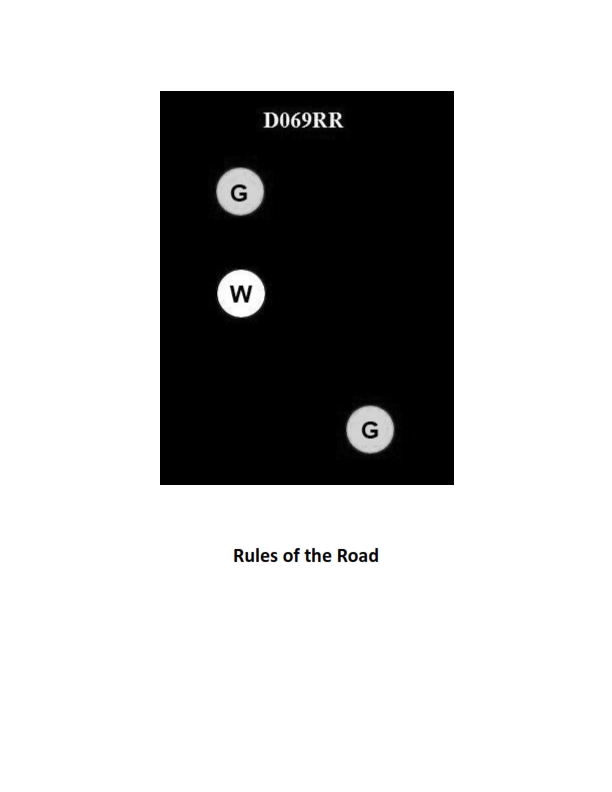
Question 845
Question: BOTH INTERNATIONAL & INLAND Which vessel that is underway at night is required to display the lights shown in illustration D069RR below?
A. engaged in trawling
B. a pilot boat
C. minesweeping
D. under sail
The correct answer is A) engaged in trawling. The illustration D069RR shows the required navigation lights for a vessel engaged in trawling, which includes two all-around green lights in a vertical line. This lighting configuration is specified in the International Regulations for Preventing Collisions at Sea (COLREGS) and the Inland Navigation Rules for vessels underway at night. The other answer choices are incorrect because pilot boats, minesweepers, and sailboats have different navigation light requirements that do not match the illustration.
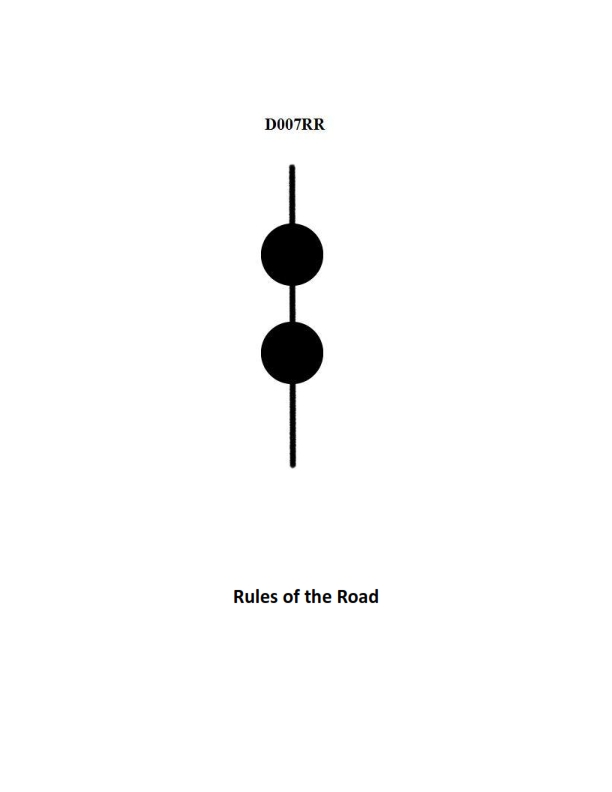
Question 849
Question: BOTH INTERNATIONAL & INLAND Which vessel is required to display the shapes shown in illustration D007RR below?
A. a minesweeper
B. a broken down vessel
C. vessels transferring dangerous cargo
D. a fishing vessel
The correct answer is B) a broken down vessel. The shapes shown in illustration D007RR are the shapes required to be displayed by a vessel that is not under command, which is the international and inland navigation term for a vessel that is unable to maneuver as required by the rules due to some exceptional circumstance, such as being disabled or broken down. The other answer choices are incorrect because minesweepers, vessels transferring dangerous cargo, and fishing vessels have different shape requirements that are not depicted in the given illustration.
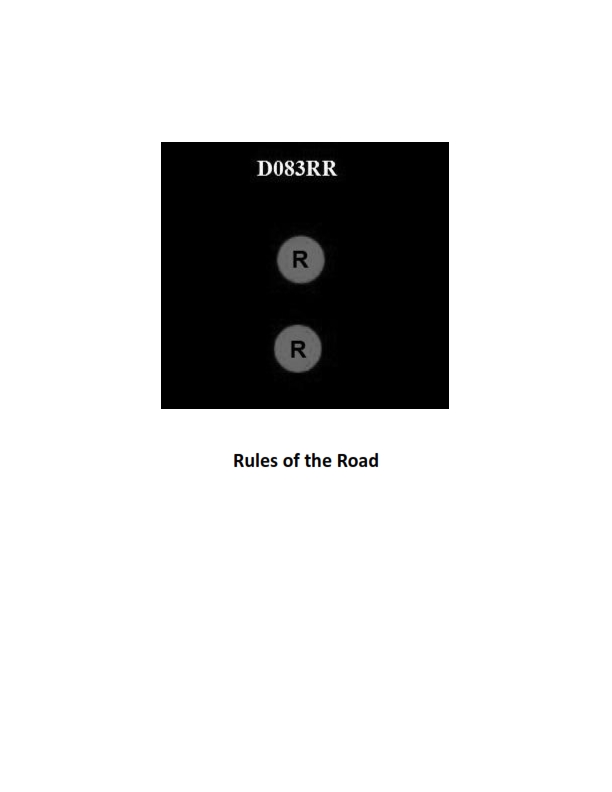
Question 854
Question: BOTH INTERNATIONAL & INLAND Which of the following describes a vessel exhibiting the lights shown in illustration D083RR below?
A. fishing
B. not under command
C. towing
D. being towed
The correct answer is B) not under command. The lights shown in illustration D083RR depict the lights required for a vessel that is not under command, meaning the vessel is unable to maneuver as required by the International Regulations for Preventing Collisions at Sea (COLREGS). This includes vessels that are disabled, anchored, or aground. The all-round red light and the two all-round white lights are the characteristic lights for a vessel not under command. The other answer choices are incorrect because they do not accurately describe the lighting configuration shown in the illustration. A fishing vessel would exhibit different lights, a towing vessel would have different lighting, and a vessel being towed would also have a different lighting arrangement.
Question 859
Question: BOTH INTERNATIONAL & INLAND You see a vessel displaying the day signal shown in illustration D006RR below. The vessel may be which of the following?
A. fishing with trawls
B. aground
C. not under command
D. laying submarine cable
The correct answer is D) laying submarine cable. The day signal shown in illustration D006RR depicts two black balls or shapes displayed vertically on the vessel. This signal indicates that the vessel is "engaged in laying, servicing or picking up a submarine cable", as per the International Rules of the Road and the Inland Navigation Rules. The other answer choices are incorrect because they do not match the specific day signal being displayed. A vessel fishing with trawls would display different signals, a vessel aground would not display this signal, and a vessel not under command would display a different set of shapes.
Question 865
Question: BOTH INTERNATIONAL & INLAND While underway, you see a vessel displaying the shapes shown in illustration D006RR below. Which action should you take?
A. Stay clear, the other vessel is maneuvering with difficulty
B. Stop your vessel and sound passing signals
C. Maintain course and speed
D. Provide assistance, the other vessel is in distress
The correct answer is A) Stay clear, the other vessel is maneuvering with difficulty. The shapes shown in illustration D006RR indicate that the other vessel is restricted in its ability to maneuver, such as a vessel engaged in dredging, diving operations, or other work limiting its maneuverability. In this situation, the proper action is to stay clear of the restricted vessel, as it may not be able to take evasive action or give way to other vessels. The other answer choices are incorrect because stopping and sounding passing signals (B) is not the appropriate action, maintaining course and speed (C) could lead to a collision, and the vessel is not necessarily in distress (D) - it is simply restricted in its ability to maneuver.
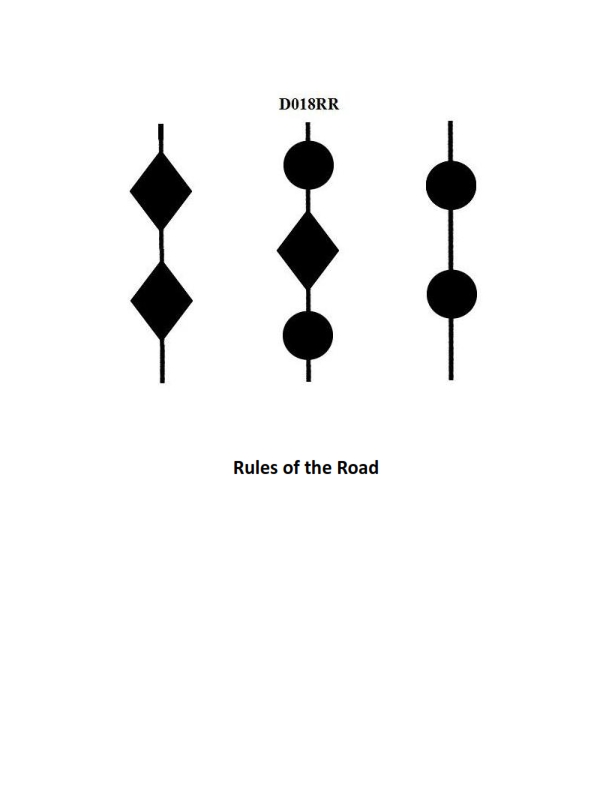
Question 867
Question: BOTH INTERNATIONAL & INLAND Which of the following describes a vessel exhibiting the shapes shown in illustration D018RR below?
A. dredging with an existing obstruction
B. carrying dangerous cargo
C. not under command making way
D. towing astern with a tow greater than 200 meters in length
The correct answer is A) dredging with an existing obstruction. The shapes shown in illustration D018RR depict the signals required for a vessel engaged in dredging or underwater operations with an obstruction present. According to the International and Inland Navigation Rules, vessels engaged in these activities must display two black balls or shapes vertically to indicate their restricted ability to maneuver. This distinguishes them from other vessels not under command or towing, which have different signaling requirements. The other options are incorrect because they do not accurately describe the signaling requirements for the situation depicted in the illustration.
Question 869
Question: BOTH INTERNATIONAL & INLAND Which display of lights shown in illustration D072RR below indicates a dredge underway and not dredging?
A. A
B. B
C. C
D. D
The correct answer is B. The display of lights shown in illustration D072RR that indicates a dredge underway and not dredging is B. This is because the International and Inland Navigation Rules (Rule 27) state that a vessel engaged in dredging or underwater operations shall display the lights and shapes prescribed for a vessel constrained by her draft, which is a different set of lights than those shown in option B. The other options (A, C, and D) do not correctly depict the lighting configuration for a dredge underway and not dredging, as they either show the lights for a vessel constrained by her draft or a vessel engaged in dredging operations.
Question 874
Question: BOTH INTERNATIONAL & INLAND A vessel which displays the day signal shown in illustration D006RR below may be engaged in which task?
A. fishing with trawling gear
B. submarine cable laying
C. mineclearance
D. pilotage duty
The correct answer is B) submarine cable laying. The day signal shown in illustration D006RR indicates that the vessel is engaged in a task that restricts its ability to maneuver, which is characteristic of a vessel involved in submarine cable laying operations. The International Regulations for Preventing Collisions at Sea (COLREGS) and the Inland Navigation Rules both require vessels restricted in their ability to maneuver, such as those engaged in submarine cable laying, to display this particular day signal. The other options are incorrect because fishing with trawling gear (A), mineclearance (C), and pilotage duty (D) are not activities that would typically require a vessel to display the day signal shown in the illustration.
Question 883
Question: BOTH INTERNATIONAL & INLAND Two power-driven vessels are crossing as shown in illustration D042RR below. Vessel "A" sounds two short blasts on the whistle. You are on vessel "B" and are in doubt that sufficient action is being taken by vessel "A" to avoid collision. What action should you take?
A. Maintain course and speed
B. Sound five or more short and rapid blasts
C. Alter course to the left and increase speed
D. None of the above
The correct answer is B) Sound five or more short and rapid blasts. The reasoning behind this is that when the give-way vessel (vessel "A") is not taking appropriate action to avoid a collision, the stand-on vessel (vessel "B") should sound the danger signal of five or more short and rapid blasts on the whistle. This is in accordance with the International Regulations for Preventing Collisions at Sea (COLREGS), which govern navigational rules for vessels at sea. The other options are incorrect because: A) Maintaining course and speed would not be the appropriate action when the give-way vessel is not maneuvering to avoid a collision. C) Altering course to the left and increasing speed could potentially put the vessels on a collision course. D) There is a specific action required by the COLREGS in this situation, so "none of the above" is not the correct answer.
Question 885
Question: BOTH INTERNATIONAL & INLAND You are on vessel "A" as shown in illustration D032RR below, and hear vessel "B" sound a signal indicating her intention to overtake you. You feel it is not safe for vessel "B" to overtake you at the present time. What action should you take?
A. Sound three blasts of the whistle
B. Not answer the whistle signal from vessel "B"
C. Sound five or more short rapid blasts
D. Sound two short blasts
The correct answer is C) Sound five or more short rapid blasts. This is the correct action because according to the International Regulations for Preventing Collisions at Sea (COLREGS), when a vessel is overtaking another vessel, the overtaking vessel must indicate its intention to do so by sounding the appropriate whistle signal. If the vessel being overtaken (vessel A) feels it is not safe for the overtaking vessel (vessel B) to proceed, vessel A should sound five or more short rapid blasts on the whistle to indicate that it is unsafe to overtake at the present time. The other options are incorrect because option A would be the wrong signal, option B would be ignoring the overtaking vessel's signal, and option D would be the wrong number of blasts.
Question 887
Question: BOTH INTERNATIONAL & INLAND You are on a 15-meter vessel "A" in a narrow channel as shown in illustration D032RR below. Vessel "B", a large tanker which can safely navigate only within the channel, sounds five short and rapid blasts. What action should you take?
A. Maintain course and speed
B. Not impede the passage of vessel "B"
C. Not answer the whistle signal from vessel "B"
D. Sound one prolonged followed by two short blasts
The correct answer is B) Not impede the passage of vessel "B". This is the correct answer because the International Regulations for Preventing Collisions at Sea (COLREGS) state that a vessel that is less maneuverable, such as the large tanker "B", has the right-of-way in a narrow channel. As the stand-on vessel, you should take action to not impede the passage of the larger, less maneuverable vessel "B" by maintaining course and speed. The other answer choices are incorrect because: A) Maintaining course and speed would impede the passage of the larger vessel, which is not allowed. C) Not answering the whistle signal would be improper communication. D) Sounding a whistle signal is not the appropriate action in this situation.
Question 890
Question: BOTH INTERNATIONAL & INLAND Two power-driven vessels are crossing as shown in illustration D042RR below. Vessel "A" sounds three short blasts on the whistle. What is the meaning of this signal?
A. Vessel "A" is backing engines
B. Vessel "A" intends to hold course and speed
C. Vessel "A" is sounding the danger signal
D. Vessel "A" proposes to cross ahead of the other vessel
The correct answer is A) Vessel "A" is backing engines. The International Regulations for Preventing Collisions at Sea (COLREGS) state that a vessel backing engines is required to sound three short blasts on the whistle. This signal indicates that the vessel is going astern, which can help inform the other vessel of its maneuvering intentions. The other options are incorrect because B) holding course and speed would not require a whistle signal, C) the danger signal is five or more short blasts, and D) crossing ahead of the other vessel would typically be signaled with one prolonged blast followed by two short blasts.
Question 982
Question: BOTH INTERNATIONAL & INLAND Vessels "A" and "B" are meeting in a narrow channel as shown in illustration D029RR below but are not in sight of one another due to restricted visibility. Which statement is TRUE concerning whistle signals between the vessels?
A. Both vessels should sound two short blasts.
B. Vessel "A" should sound one short blast and vessel "B" should sound two short blasts.
C. Both vessels should sound one short blast.
D. None of the above statements is TRUE.
The correct answer is D) None of the above statements is TRUE. The reason this is the correct answer is that in a narrow channel with restricted visibility, as described in the scenario, the appropriate whistle signals are not one short blast, two short blasts, or any combination thereof. Instead, the International Regulations for Preventing Collisions at Sea (COLREGS) Rule 34(e) states that in this situation, both vessels should sound the danger signal, which is five or more short and rapid blasts on the whistle. This alerts the other vessel to the restricted visibility and potential danger of the situation, prompting both vessels to take appropriate action to avoid a collision.