Question 14
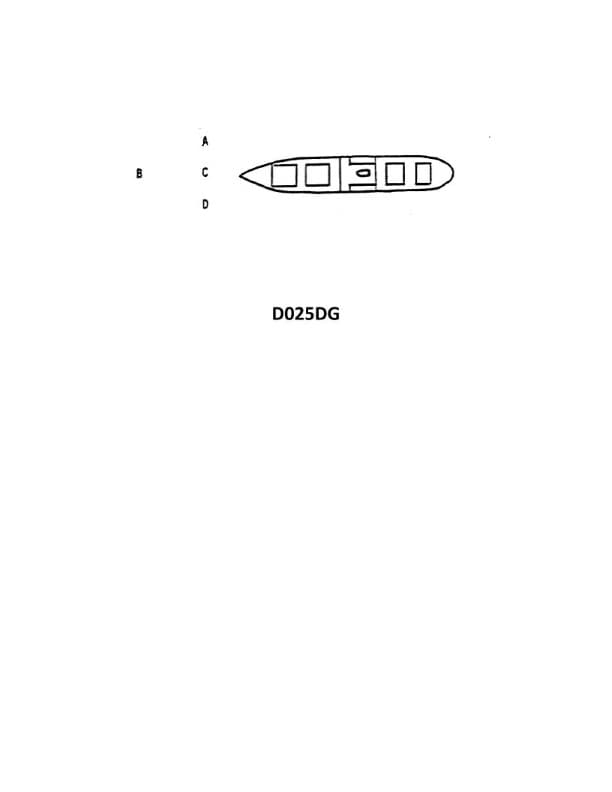
AT01The vessel shown in illustration D025DG has broken down and you are going to take her in tow. The wind is on her starboard beam. Both vessels are making the same amount of leeway. Where should you position your vessel when you start running lines?
AI Explanation
**The Correct Answer is C**
### Explanation for C (Correct)
Option C represents the windward approach position (the starboard side). When maneuvering near a disabled vessel in the presence of wind, the towing vessel (tug) must always position itself on the windward side.
1. **Safety Margin:** Even though both vessels are making the same amount of leeway (drifting equally to port), the tug needs the ability to maneuver freely and pull away if necessary. By approaching windward (from the starboard side), the tug can use its engines to create a gap, fighting the push of the wind.
2. **Control and Line Handling:** Position C (midships/slightly forward on the windward side) allows the tug to stabilize itself relative to the disabled vessel and maintain safe distance until the line is secured.
### Explanation for Other Options (Incorrect)
**A) A and B (Incorrect):**
Options A and B represent the leeward (downwind, port) side approach. This is fundamentally unsafe for running lines. The force of the wind (which is on the starboard beam) would constantly be pushing the smaller towing vessel directly into the side of the larger, disabled vessel. This creates a high risk of collision, damage, and potentially pinning the tug against the hull before the lines are secured.
**D) D (Incorrect):**
Option D is also on the windward side (safe side), but it is positioned too far aft (near the stern). While generally safe from a collision standpoint, the primary running line connection is usually sought slightly forward of midships (Position C) to quickly gain control over the disabled vessel’s movement and secure the initial tow line connection efficiently. D is not the optimal position for the initial approach and running of lines.
Related Questions
#12 Why is a chain bridle preferable to a wire rope towing bridle on a long ocean tow?#13 You have taken another vessel in tow. Which is an indicator that the towing speed is too fast?#15 What are the legs of a tow bridle are joined together with?#16 Which is the most effective method for towing and maneuvering on rivers and other restricted waters where
wave action is limited?#17 You have a large, broken-down vessel in tow with a wire rope and anchor cable towline. Both vessels have
made provision for slipping the tow in an emergency; however, unless there are special circumstances which
is TRUE?