Question 2093Deck General70% to pass
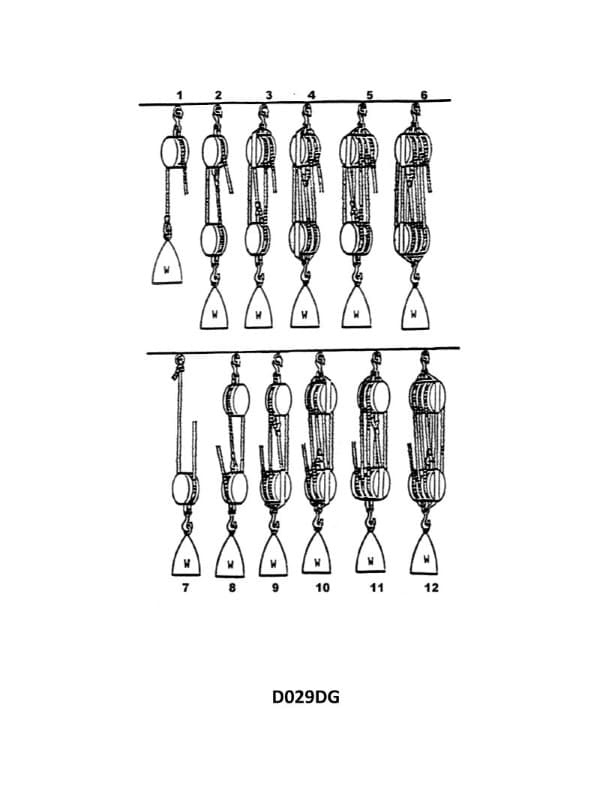
You are using tackle number 2 as shown in illustration D029DG below to lift a weight of 100 lbs. If you include 10 percent of the weight for each sheave for friction, what is the pull on the hauling part required to lift the weight?
AI Explanation
The correct answer is C) 60 lbs.
The reasoning is as follows:
For a tackle system with 2 sheaves, the mechanical advantage is 2. This means that the load weight of 100 lbs is distributed across 2 parts of the line. However, to account for the 10% friction loss per sheave, an additional 20% of the load weight must be added to the hauling part pull. Therefore, the required pull on the hauling part is 100 lbs / 2 + (100 lbs * 0.2) = 60 lbs.
The other options are incorrect because they do not properly account for the 10% friction loss per sheave in the tackle system.
Related Questions
#2091 What is the mechanical advantage of a threefold purchase when rove to disadvantage and neglecting friction? #2092 You are using tackle number 7 in illustration D029DG below to lift a weight of 100 lbs. If you include 10 percent of the weight for each sheave for friction, what is the pull on the hauling part required to lift the weight? #2094 You are using tackle number 5 as shown in illustration D029DG below to lift a weight of 300 lbs. If you include 10 percent of the weight for each sheave for friction, what is the pull on the hauling part required to lift the weight? #2095 You are using tackle number 4 as shown in illustration D029DG below to lift a weight. The hauling part of this tackle is bent to the weight hook (w) of tackle number 10. What is the mechanical advantage of this rig? #2096 You are using tackle number 5 as shown in illustration D029DG below to lift a weight. The hauling part of this tackle is bent to the weight hook of tackle number 9. What is the mechanical advantage of this rig?