Question 3895Deck General70% to pass
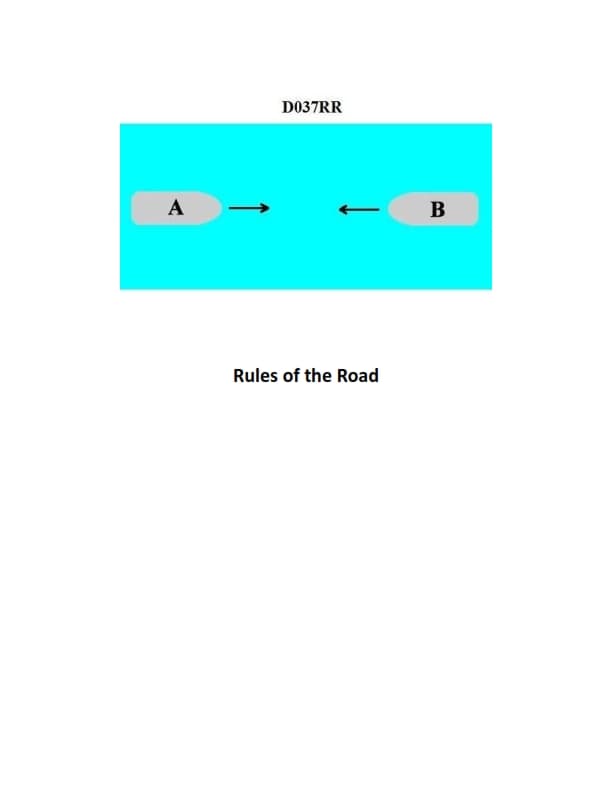
You are aboard vessel "A" in a narrow channel and the pilot is approaching vessel "B" as shown in illustration D037RR below. Which of the following is the reason he has not previously changed course to the starboard side of the channel?
AI Explanation
The correct answer is A) to avoid the effects of bank cushion and bank suction.
In a narrow channel, the vessel's proximity to the bank can create bank cushion and bank suction effects, which can adversely affect the vessel's maneuverability. Bank cushion occurs when the vessel's displacement causes the water to be compressed between the vessel and the bank, making it harder for the vessel to change course. Bank suction occurs when the water accelerates along the bank, creating a low-pressure area that pulls the vessel towards the bank. To avoid these effects, the pilot may choose to keep the vessel in the middle of the channel where these phenomena are less pronounced.
The other options are incorrect because they do not directly address the specific navigation challenges posed by bank cushion and bank suction in a narrow channel.
Related Questions
#3893 You have determined the maneuvering characteristics of your vessel by taking the radar ranges and bearings of an isolated light while making a turn. The results are shown in illustration D035DG below. What is the transfer for a turn of 60°? #3894 When weighing an anchor that was under a heavy strain, a check of the anchor chain can be done by striking each link with a hammer. What sound would indicate that a link is good? #3896 You are arriving in port and are assigned to anchor in anchorage circle B-4. It has a diameter of 500 yards and your vessel's LOA is 484 feet. If you anchor in 8 fathoms at the center of the circle, what is the maximum number of shots of chain you can use and still remain in the circle? #3897 The riding pawl is _______________.#3898 To safely anchor a vessel there must be sufficient "scope" in the anchor cable. Scope is the ratio of _______________.