Question 4179Deck General70% to pass
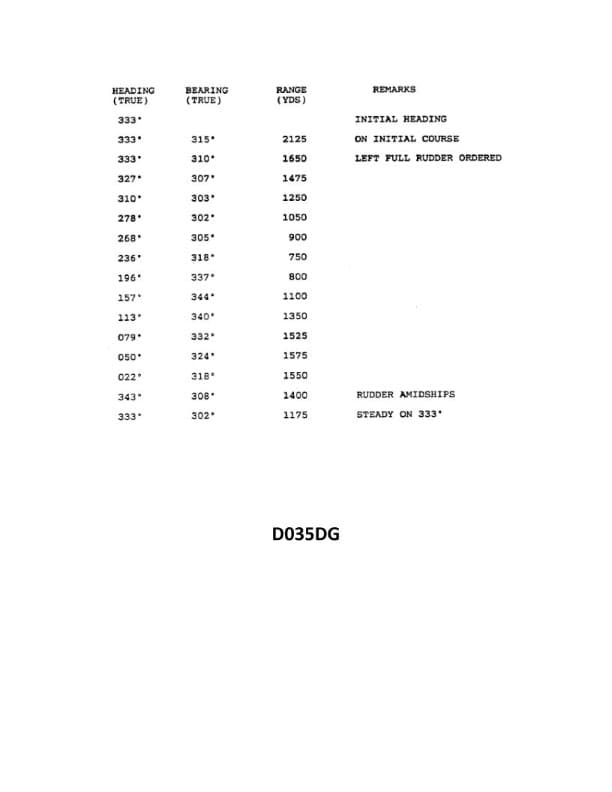
You have determined the maneuvering characteristics of your vessel by taking the radar ranges and bearings of an isolated light while making a turn. The results are shown in illustration D035DG below. What is the transfer for a turn of 30°?
AI Explanation
The correct answer is D) 40 yards.
The transfer for a turn of 30° can be determined from the maneuvering characteristics shown in the illustration D035DG. The transfer is the distance the vessel moves perpendicular to the original course during the turn. From the illustration, the transfer for a 30° turn is approximately 40 yards.
The other answer choices are incorrect because they do not match the value shown in the illustration for a 30° turn. Option A (140 yards) and Option B (190 yards) are significantly larger than the actual transfer, while Option C (230 yards) is even more inaccurate.
Related Questions
#4177 You are on a course of 000°T and put the rudder right 30°. In which direction will the transfer be measured? #4178 You have determined the maneuvering characteristics of your vessel by taking the radar ranges and bearings of an isolated light while making a turn. The results are shown in illustration D035DG below. What is the transfer for a turn of 180°? #4180 You are conducting trials to determine the maneuvering characteristics of your vessel. While making a turn, you take ranges and bearings of an isolated light. The results are shown in illustration D034DG below. What is the transfer for a turn of 90°? #4181 You are conducting trials to determine the maneuvering characteristics of your vessel. While making a turn you take the ranges and bearings of an isolated light. The results are shown in illustration D034DG below. What is the transfer for a turn of 75°? #4182 You have determined the maneuvering characteristics of your vessel by taking radar ranges and bearings of an isolated light while making a turn. The results are shown in illustration D035DG below. What is the transfer for a turn of 90°?