Question 315Electricity/Electronics - Assistant Engineer70% to pass
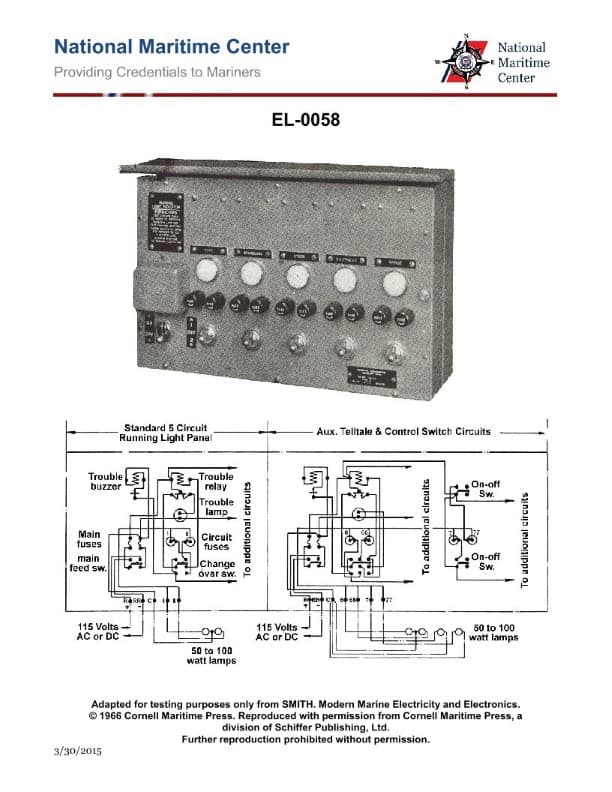
As shown in the illustration of a vessels navigational lighting circuit, if port running light "1" burns out, the trouble buzzer will sound and the port running light trouble lamp will illuminate. Switching to port running light "2" clears the alarm. If port running light "1" is replaced with a light of a smaller wattage and the circuit is switched back to port running light "1", which of the following is true? Illustration EL-0058
AI Explanation
The correct answer is A) There may be insufficient current to energize the trouble relay coil and to open the contacts to silence the alarm.
This is because the trouble alarm circuit is designed to detect a failure or burnout of the primary port running light. When the primary light (port running light "1") burns out, the lower current draw triggers the trouble relay to sound the alarm and illuminate the trouble lamp. Replacing the primary light with a lower wattage bulb may not draw enough current to properly energize the trouble relay coil, preventing the contacts from opening to silence the alarm. The other answer choices are incorrect because:
B) The new lower wattage light may not immediately burn out, but the insufficient current will prevent the trouble alarm from clearing.
C) The trouble buzzer voltage is not dependent on the port running light wattage.
D) The trouble relay coil will not overheat due to the lower wattage of the replacement light.
Related Questions
#313 From the information given in the illustration, what would be the ampere capacity at full load of each of the main ship service diesel-generators if operating at the rated power factor of 0.8? Illustration EL-0106 #314 In an ungrounded distribution system, as compared to a normal indication, what is the indication on a switchboard of a current carrying conductor making an accidental electrical contact with a wiring metal conduit? #316 During the start-up of the circuit shown in figure "B" of the illustration, it is noted that the ends of component "4" remain lighted but the tube does not illuminate. What is likely the cause of this problem? Illustration EL-0081 #317 In order to definitively determine whether or not fuse "1", shown in the illustration is blown using an on-line testing technique, across what points would you connect the voltmeter leads? Illustration EL-0062 #318 As shown in figure "A" of the illustration, what type of ground fault detection system is illustrated? Illustration EL-0132