Question 411Electricity/Electronics - Assistant Engineer70% to pass
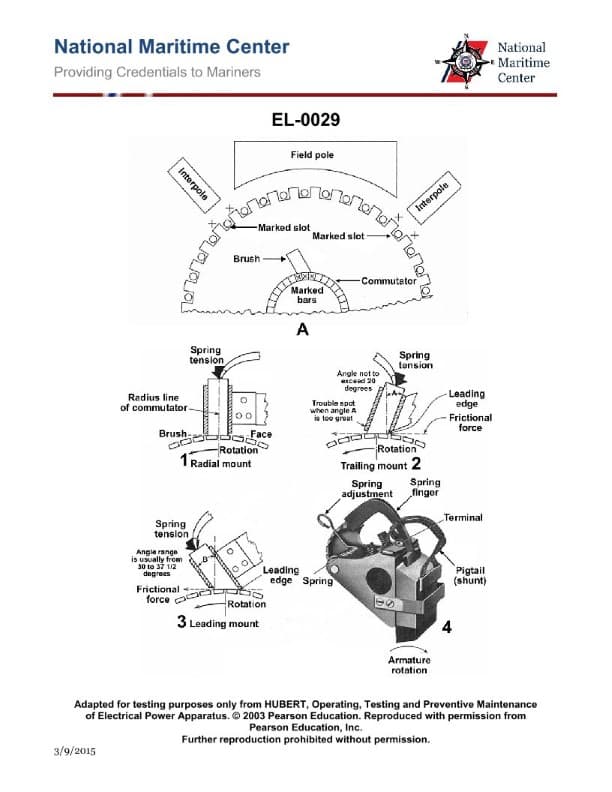
As shown in the illustration, which brush holder is of the reaction type? Illustration EL-0029
AI Explanation
The correct answer is D.
The brush holder labeled 4 in the illustration is of the reaction type. Reaction-type brush holders are used in DC motors and generators to maintain contact between the brushes and the commutator as the armature rotates. This design allows the brushes to move in response to the changing position of the commutator, ensuring continuous electrical contact.
The other brush holder options (1, 2, and 3) are not of the reaction type, as they do not have the necessary mechanisms to allow the brushes to move in response to the commutator's rotation.
Related Questions
#409 The winch shown in the illustration operates in any of the positions with the master switch in the 'lower' direction, but will not 'hoist' in any of the master switch hoist speed positions. Which of the listed faults could be the cause? Illustration EL-0102 #410 Refer to figures "1" and "2" of the basic synchronous transmission system shown in the illustration. Figure "1" shows a properly connected system where the receiver TR remains in correspondence with the transmitter TX. In figure "2", although properly zeroed, the receiver goes out of correspondence with the transmitter due to improper connections resulting in reverse torque direction. Which connection error results in this behavior? Illustration EL-0149 #412 If a DC motor has its armature and field connected across a resistor when the motor is disconnected from its power supply, what statement is true? #413 In terms of voltage potential and current sources, how are shunt wound, series wound, and compound wound DC motors designed to operate? #414 Which of the following statements describes what will happen when both the polarity of the field poles, and the direction of current to the brushes of a DC motor are reversed?