Question 109Electricity/Electronics - 1st Asst/Chief70% to pass
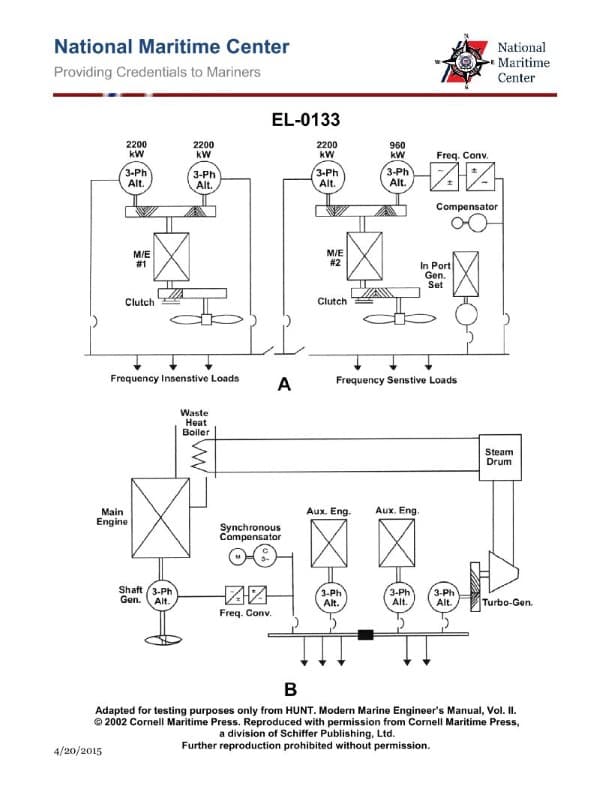
As shown in figure "B" of the illustration, what is the purpose of the synchronous compensator? Illustration EL-0133
AI Explanation
The correct answer is D) provide reactive power to the mains as the frequency converter has the ability to provide only active power.
The purpose of the synchronous compensator, as shown in figure "B" of the illustration, is to provide reactive power to the mains. This is because the frequency converter in this system is designed to only provide active power, and the mains requires both active and reactive power for proper operation. The synchronous compensator compensates for the reactive power that the frequency converter cannot provide, ensuring the mains receives the necessary reactive power.
The other answer choices are incorrect because they do not accurately describe the purpose of the synchronous compensator in this system. The frequency converter is not limited in its ability to provide active power, and the synchronous compensator is not meant to provide additional active power beyond the converter's capabilities.
Related Questions
#107 Upon failure of the normal power supply, how is the emergency generator placed on the line to feed power to the emergency bus? #108 In preparation for paralleling generators, if the electric plant condition is as shown by graph "A", what would be the rotational status of the synchronizing lamps as shown in circuit "B"? Illustration EL-0002 #110 Two AC generators of the same capacity are operating in parallel. One with a zero speed droop setting and the other with a 5% speed droop. If its capacity is not exceeded, what will be the characteristic of the unit whose governor has the zero speed droop setting? #111 When a self-excited alternator's field has lost its residual magnetism due to a prolonged idle period, it will fail to produce a voltage. Flashing the field is the procedure used to restore the residual magnetism. Using a 12 volt storage battery, how is this performed? #112 If it becomes absolutely necessary to run an alternator at lower than 5% below its rated frequency, in terms of output voltage, what must be done?