Question 143Electricity/Electronics - 1st Asst/Chief70% to pass
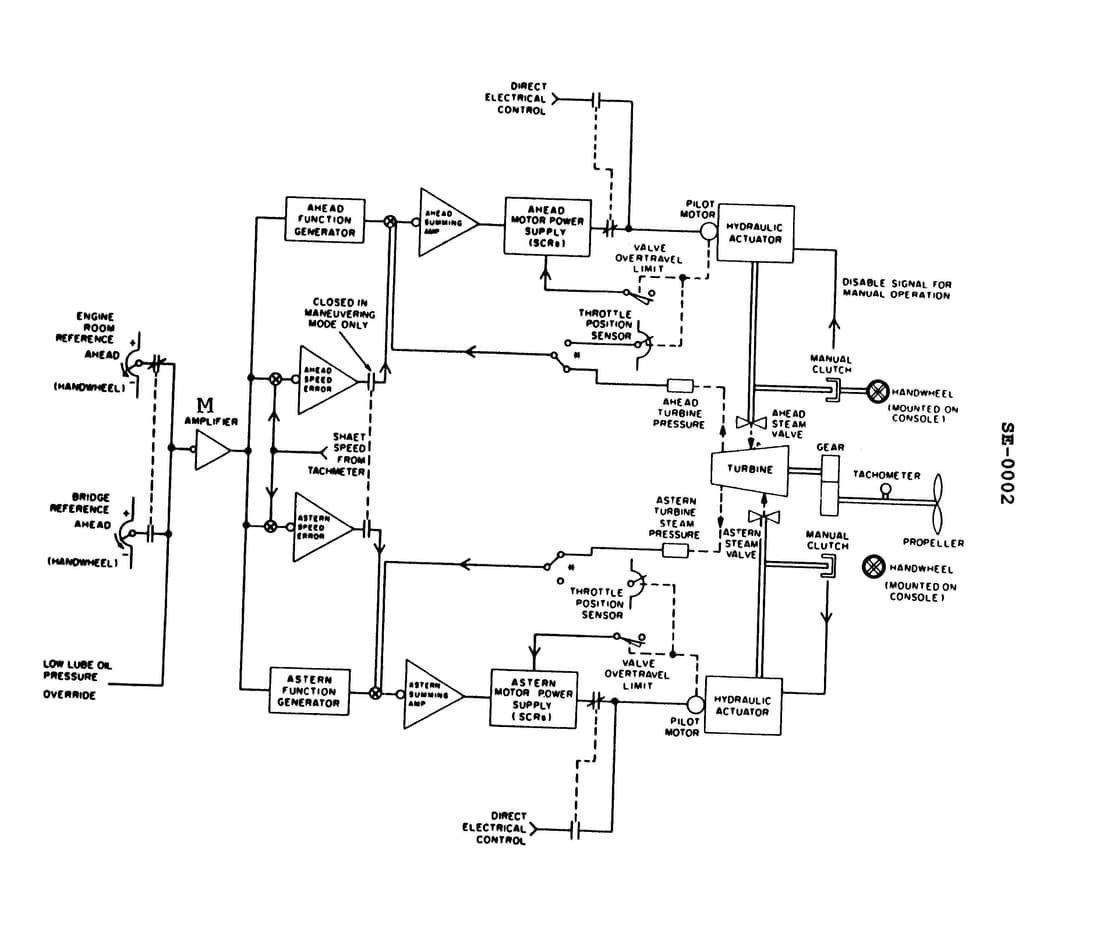
In the illustrated throttle control system, the amplifier 'M" functions to invert the signal received from the engine room or bridge reference potentiometer as appropriate. According to the operating mode selected for in the illustration, moving the engine room reference potentiometer in the direction indicated will have what effect? Illustration SE-0002
AI Explanation
The correct answer is C. According to the information provided, the amplifier "M" functions to invert the signal received from the engine room or bridge reference potentiometer. In the illustrated operating mode, moving the engine room reference potentiometer in the direction indicated will cause a positive signal to be processed by the ahead function generator, ultimately causing the ahead throttle valve to open wider. This is because the amplifier "M" inverts the signal, turning a negative input from the engine room reference potentiometer into a positive signal for the ahead function generator. The other options are incorrect because they do not accurately describe the effect of the inverted signal on the throttle control system.
Related Questions
#141 As shown in figure "B" of the illustrated block diagram of the signal processing flow path, the block "TRANSDUCER" represents a sensing and transmitting device designed to sense and measure a physical parameter and convert it into a proportional force or signal of what type? Illustration EL-0095 #142 As shown in the illustrated block diagram for a digitized echo sounding system, what statement is true concerning the function of the transducer? Illustration EL-0185 #144 As shown in figures "A", "B", and "C" of the illustration, what is the purpose of the differential amplifier segment of the 741 operational amplifier? Illustration EL-0111 #145 As shown in the illustrated block diagram for a distributed automation system, what statement is true concerning the area networks? Illustration EL-0096 #146 In process control terminology, continuously variable values which change without distinct increments, such as temperature, pressure, or level are correctly referred to as what type of values?