Question 182Electricity/Electronics - 1st Asst/Chief70% to pass
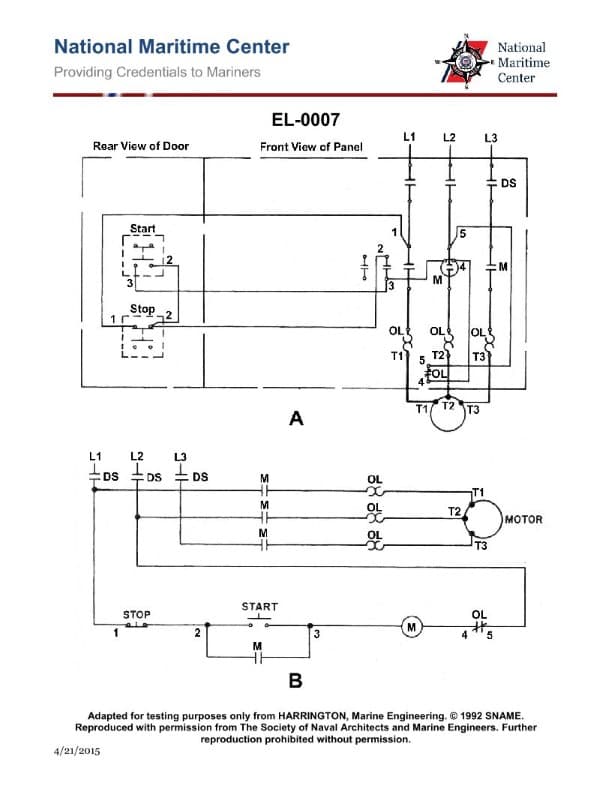
The motor starts when the start button in the illustration is pushed, but stops when the button is released. What is most likely the trouble? Illustration EL-0007
AI Explanation
The correct answer is D) an open auxiliary "M" contact.
When the start button is pushed, it energizes the "M" contactor coil, which then closes the main motor contacts to start the motor. However, when the start button is released, the auxiliary "M" contact is responsible for keeping the "M" contactor coil energized, allowing the motor to continue running. If this auxiliary "M" contact is open, the "M" contactor coil will de-energize as soon as the start button is released, causing the motor to stop.
The other options are incorrect because an open in the stop button contact (A) would not allow the motor to start at all, an open "M" contactor coil (B) would prevent the motor from starting, and a corroded contact on the disconnect switch (C) would not specifically cause the motor to stop when the start button is released.
Related Questions
#180 If the contacts of a motor starter or controller fail to drop out when the 'stop' button is depressed, what could be the cause? #181 If the motor of the illustrated circuit fails to start and gives a loud hum when the start button is pushed, what is most likely the problem? Illustration EL-0007 #183 As shown in figure "A" and "B" of the illustration, the potable water pump is short cycling by the action of the pressure switch as a result of an unusually high level in the potable water hydro pneumatic header tank. What is most likely the cause? Illustration EL-0043 #184 As shown in the illustration, what mechanism will disconnect the motor from the line in case of a sustained motor overload? Illustration EL-0080 #185 As shown in figure "A" of the illustration, if in troubleshooting the control circuit using on-line techniques with a voltmeter with the start button depressed and the following readings are taken, what is the problem? "X1" to "X2" reads 115 VAC; "1" to "X2" reads 0 VAC; "2" to "X2" reads 0 VAC; and "3" to "X2" reads 0 VAC. Illustration EL-0123