Question 217Electricity/Electronics - 1st Asst/Chief70% to pass
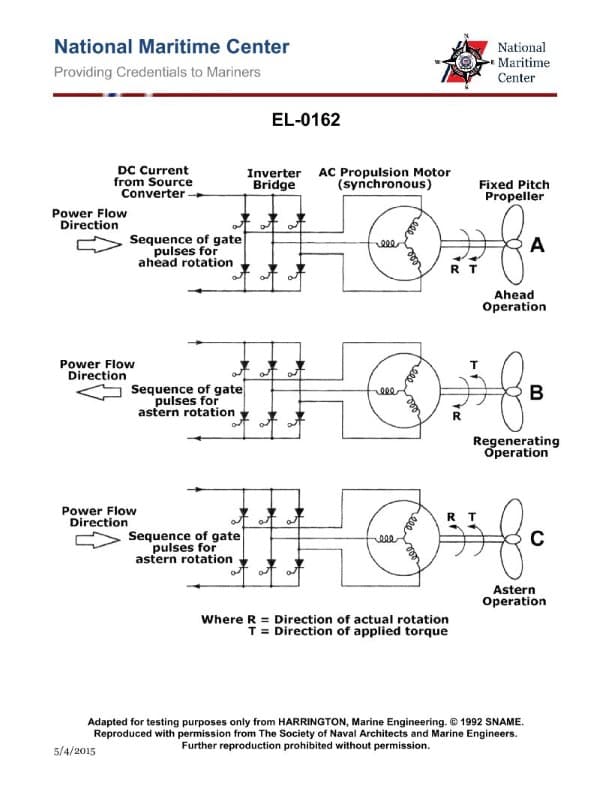
As shown in figure "B" of the illustration, what statement is true concerning "regenerating" operation? Illustration EL-0162
AI Explanation
The correct answer is D) by applying torque in the opposite direction of rotation direction, the motor briefly regenerates power back into the mains, which rapidly slows down the motor.
When a motor is driven in the opposite direction of its current rotation, it acts as a generator, briefly regenerating power back into the electrical mains. This regenerative braking effect rapidly slows down the motor, as the generated power is not used to drive the motor but instead is fed back into the power source.
The other options are incorrect because applying torque in the same direction of rotation would accelerate the motor, not slow it down, and regenerating power into the mains would not rapidly speed up the motor, but rather slow it down.
Related Questions
#215 What statement is TRUE concerning the Azipod propulsion system? #216 Which of the following describes the action when the handle is moved to the "start" position of a drum-type motor controller used with a compound wound DC motor? #218 With an AC synchronous electric propulsion motor driving a fixed-pitch propeller, whenever there is a direction reversal ordered from the bridge, there is a process of regenerative braking that is used to slow the motor down before the shaft actually reverses. Where is the energy associated with the inertia of rotation dissipated before reversal occurs? #219 With an AC synchronous electric propulsion motor driving a fixed-pitch propeller, whenever there is a direction reversal ordered from the bridge, there is a process of electrical braking used to slow the motor down before the shaft actually reverses. What is the name of this process? #220 What is the instrument called a galvanometer used to measure?