Question 64Electricity/Electronics - 1st Asst/Chief70% to pass
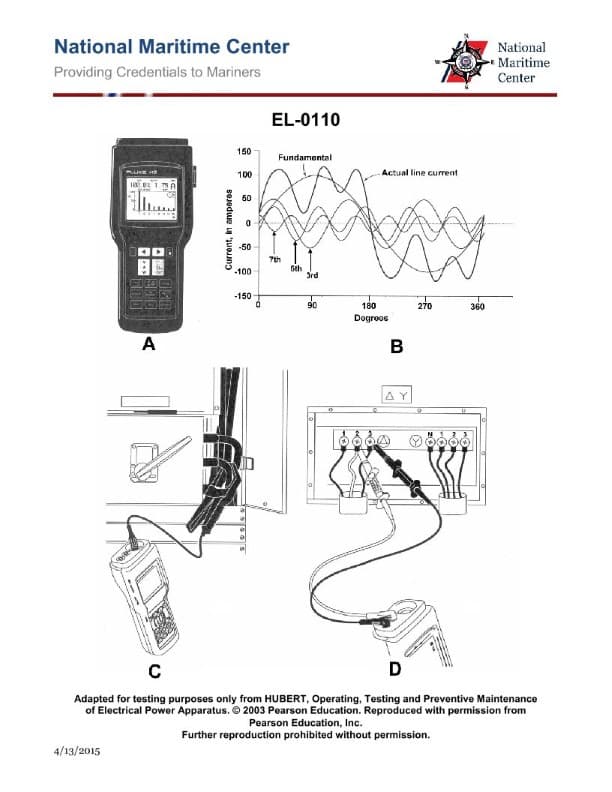
Using the portable harmonic analyzer shown in figure "A", if the clamp-on test lead is connected as shown in figure "C" of the illustration, what is being measured? Illustration EL-0110
AI Explanation
The correct answer is A) the harmonic content of the current of a single conductor at a service entrance.
The illustration shows a portable harmonic analyzer, and when the clamp-on test lead is connected as shown in figure "C", it is measuring the harmonic content of the current in a single conductor, typically at the service entrance. This allows for the analysis of the harmonics present in the current, which is important for understanding power quality and potential issues with non-linear loads.
The other options are incorrect because option B measures the harmonic content of a bundle of conductors, option C measures current leakage to hull ground, and option D measures the harmonic content of the voltage, not the current.
Related Questions
#62 Refer to the two-generator, two-motor, DC diesel-electric drive propulsion system simplified schematic shown in the illustration. While in two-generator, two-motor operation, which of the following conditions would cause the propulsion shaft speed to be approximately one-half the desired speed? Illustration EL-0141 #63 If the values of ‘C1’ and ‘R1’ shown in the illustration were 1 microfarad and 3 megohms respectively, which of the listed intervals of time would equal one 'time constant'? Illustration EL-0086 #65 A fuse is the most common type of protection against a short-circuit fault in LV distribution circuits, motor circuits and for portable appliances. What is a major drawback or deficiency with the use of fuse? #66 Fuses are sometimes placed in series with a thermal trip-type circuit breaker. What is the purpose of a fuse used in this arrangement? #67 Due to the operating characteristics of the system, time lag fuses (or dual-element fuses) are necessary for use in what types of circuits?