Question 78Electricity/Electronics - 1st Asst/Chief70% to pass
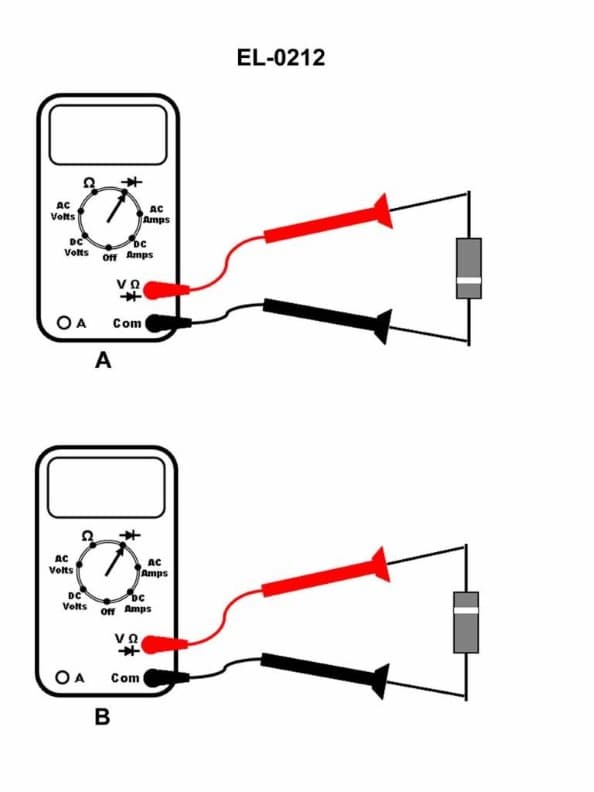
If a digital multimeter is setup as shown in figures "A" and "B" to test a silicon diode, what is the status of the diode if the screen displays 0.70 V when configured as in figure "A" and displays OL V when configured as in figure "B"? Illustration EL-0212
AI Explanation
The correct answer is D) diode is operating properly.
When a digital multimeter is used to test a silicon diode, the expected readings are:
- When configured as in figure "A" (forward bias), the diode should display around 0.70 V, which is the typical forward voltage drop for a silicon diode.
- When configured as in figure "B" (reverse bias), the diode should display "OL" (overload), indicating that the diode is blocking the current flow in the reverse direction, which is the proper operation of a diode.
The readings provided in the question match this expected behavior, confirming that the diode is operating properly. The other answer choices (A, B, C) do not accurately reflect the diode's status based on the given multimeter readings.
Related Questions
#76 To conduct an in-circuit test of a transistor, what meter or tester should be used? #77 When using an ohmmeter to test a semiconductor diode, you find a low resistance in both the forward and reverse bias directions. What condition does this indicate? #79 Which of the following actions can be carried out in order to prevent thermal runaway in a transistor? #80 You have installed a Zener diode in parallel with a load. While measuring the voltage across the Zener diode it is found that it does not change as the current through the load increases. In terms of Zener diode operation, what does this mean? #81 To avoid misleading readings when testing the discrete semiconductor components of a printed circuit board when testing it with a volt-ohmmeter, what practice or practices should be avoided? I. Using resistance scales requiring high power II. Forward biasing of junctions or reversing polarity of the leads