Question 386Electricity/Electronics - QMED70% to pass
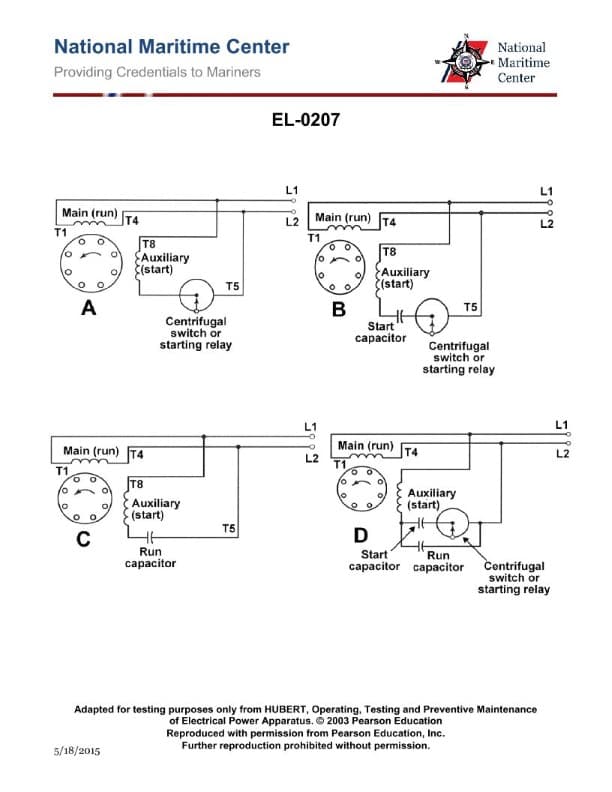
As shown in figures "A", "B", "C", and "D" of the illustration, what is the usual means by which the rotation direction of the motor is reversed? Illustration EL-0207
AI Explanation
The correct answer is C) Interchanging leads T5 and T8.
In an induction motor, the direction of rotation can be reversed by interchanging any two of the three phase leads connected to the motor. In this case, interchanging leads T5 and T8 will effectively reverse the direction of the rotating magnetic field, causing the motor to rotate in the opposite direction.
The other options are incorrect because they do not represent the usual means of reversing the motor's rotation. Interchanging L1 and L2 (option B) or T1 and T5 (option D) would not necessarily reverse the rotation. Interchanging T4 and T8 (option A) is also not the typical method, as it does not involve interchanging two of the three phase leads.
Related Questions
#384 What is the main function in the use of a capacitor for starting a single-phase motor? #385 Within the split phase family of single phase motors, what are the operational characteristics of the motor shown in figure "B" of the illustration? Illustration EL-0207 #387 Of the following listed single-phase induction motors, which has the highest starting torque? #388 Which of the pictured motors within the split phase family of single phase induction motors represents a capacitor start, induction run motor? Illustration EL-0146 #389 If the illustrated device in figure "B" has a step-up ratio of 10 to 1 what voltage would be measured at the secondary shortly after the primary of the device is connected to 110 volts DC with a current of 12 amps? Illustration EL-0055