Question 64General Subjects - Assistant Engineer70% to pass
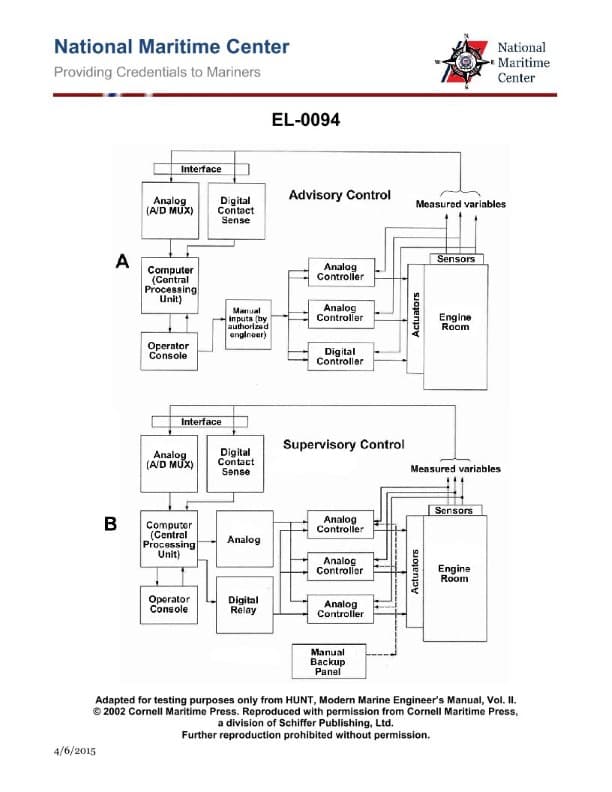
As shown in figure "B" in the illustrated block diagram of a central operating system configured for supervisory control, what is the function of the block "ANALOG (A-D MUX)"? Illustration EL-0094
AI Explanation
The correct answer is A.
The "ANALOG (A-D MUX)" block in the illustrated block diagram of a central operating system configured for supervisory control represents a high-speed solid-state switching device called a multiplexer. This multiplexer is capable of scanning a large number of analog sensors in a short period of time and converting these analog signals to digital values for processing by the CPU.
The other answer choices are incorrect because they describe different types of multiplexer devices that do not match the characteristics of the "ANALOG (A-D MUX)" block as depicted in the diagram. Specifically, options B, C, and D describe low-speed, small-scale, or digital-to-analog multiplexer devices, which do not align with the high-speed, large-scale, and analog-to-digital functionality of the block in question.
Related Questions
#62 Which of the listed central operating system types requires conversion of continuous analog signals from the sensing and transmitting devices to discrete bits of information that can be understood by the system computer for the purposes of processing and control? #63 As shown in figure "B" of the illustrated block diagram for a central operating system configured for supervisory control, what is becoming the industry standard for transmission of analog signals for a measured variable? Illustration EL-0094 #65 As shown in figure "A" of the illustrated block diagram of a central operating system configured for direct digital control, what does the output system block "DIGITAL CONTACT" represent? Illustration EL-0095 #66 As shown in the illustrated block diagram for a distributed automation system, what statement is true concerning the area networks? Illustration EL-0096 #67 As shown in the illustrated block diagram for a distributed automation system, what statement is true concerning the data communication pathways labeled "Dual CAN"? Illustration EL-0096