Question 923Navigation General70% to pass
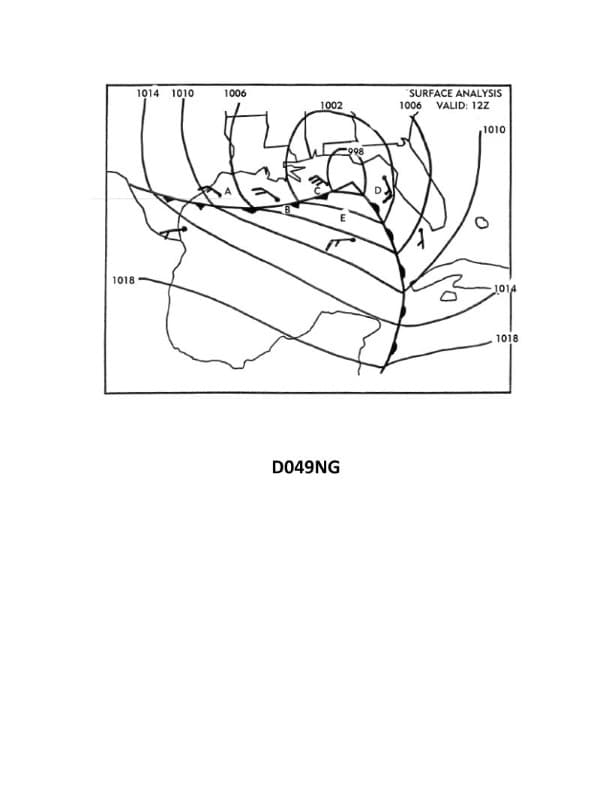
Using the surface analysis in illustration D049NG below, what change in the wind direction could be expected at position "D" if the low were moving northeasterly?
AI Explanation
The correct answer is C) Veering to the west.
When a low-pressure system is moving northeasterly, the wind direction at position "D" would be expected to veer (change clockwise) to the west. This is because the counterclockwise circulation around the low-pressure system would cause the wind to shift in a clockwise direction as the system approaches from the southwest.
The other options are incorrect because backing (changing counterclockwise) to the east or north would be the opposite of what is expected with a northeasterly moving low, and veering to the north would not be the typical wind shift associated with this weather pattern.
Related Questions
#921 While in port, you can follow the approach of a dangerous cyclonic storm by inspecting _______________.#922 Which instrument is used to measure the relative humidity of the air? #924 A weather forecast states that the wind will commence veering. In the Northern Hemisphere this indicates that the wind will _______________.#925 Which data must ECDIS be able to record at one-minute intervals? #926 An isotherm is _______________.