Question 132Rules of the Road90% to pass
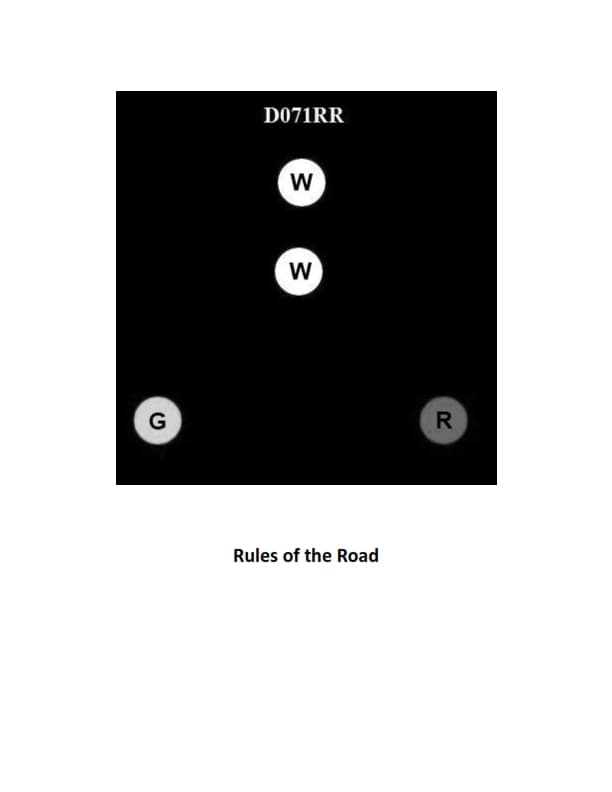
BOTH INTERNATIONAL & INLAND While underway at night, you sight a vessel ahead displaying the lights shown in illustration D071RR below. How should the vessels pass?
AI Explanation
The correct answer is B) Both vessels should alter course to starboard and pass port to port.
This is correct because the lights displayed in illustration D071RR indicate that the vessel ahead is a power-driven vessel underway. According to the International Regulations for Preventing Collisions at Sea (COLREGS), when two power-driven vessels are meeting head-on, they should both alter course to starboard and pass port-to-port.
The other options are incorrect because: A) Sounding an overtaking signal is not appropriate in a head-on situation. C) Altering course to port would result in a starboard-to-starboard pass, which is the opposite of the COLREGS requirement. D) Holding course and speed is not the correct action for a head-on encounter.
Related Questions
#130 INLAND ONLY At night, what lights are required on barges moored in a group formation more than two barges wide? #131 BOTH INTERNATIONAL & INLAND Two vessels are in an overtaking situation. Which of the lights on the overtaken vessel will the overtaking vessel see?#133 BOTH INTERNATIONAL & INLAND When in sight of another vessel and there is sufficient sea room, any action taken to avoid collision must _______________.#134 BOTH INTERNATIONAL & INLAND You are approaching another vessel. She is about one mile distant and is on your starboard bow. You believe she will cross ahead of you. She then sounds a whistle signal of five short blasts. What action should you take? #135 BOTH INTERNATIONAL & INLAND By radar alone, you detect a vessel ahead on a collision course, about 3 miles distant. Your radar plot shows this to be a meeting situation. Which action should you take?