Question 162Rules of the Road90% to pass
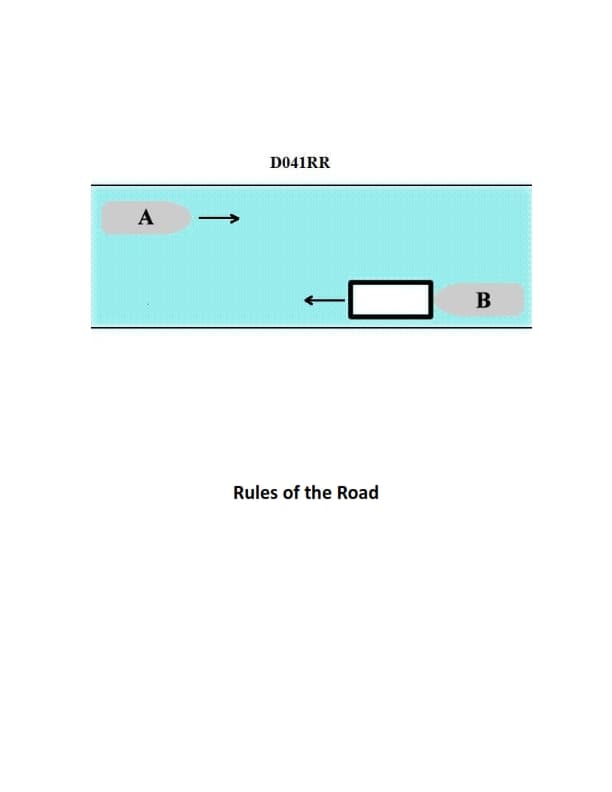
INLAND ONLY Power-driven vessels "A" and "B" are meeting on a river as shown in illustration D041RR below and will pass about 1/4 mile apart. Which action should the vessels take?
AI Explanation
The correct answer is B) The vessels should exchange two blast whistle signals and pass starboard to starboard.
This is the correct answer because under the Inland Navigation Rules, when two power-driven vessels are meeting on a river and will pass about 1/4 mile apart, they should exchange two blast whistle signals to indicate they will pass starboard-to-starboard. This is the appropriate action to take when the vessels are meeting in a head-on or nearly head-on situation.
The other options are incorrect because option A calls for one blast signal instead of two, option C does not require the vessels to exchange any whistle signals, and option D would have the vessels pass without any whistle signals, which is not the proper procedure for this scenario under the Inland Navigation Rules.
Related Questions
#160 BOTH INTERNATIONAL & INLAND Your power-driven vessel is NOT making way, but is not in any way disabled. Another power-driven vessel is approaching you on your starboard beam. Which statement is TRUE? #161 INLAND ONLY You are on a power-driven vessel "I" as shown in illustration D036RR below. Vessel "II" is a power-driven vessel engaged in fishing that will pass within 1/2 a mile of your vessel. You sound one short blast on the whistle. Vessel "II" does not sound any signal. Which action should you take?#163 BOTH INTERNATIONAL & INLAND Your 15-meter vessel is crossing a narrow channel and a large cargo vessel to port is within the channel and crossing your course. What action must you take? #164 BOTH INTERNATIONAL & INLAND Which vessel is NOT to impede the passage of a vessel which can only navigate safely within a narrow channel? #165 BOTH INTERNATIONAL & INLAND A vessel is overtaking when she can see which light(s) of a vessel ahead?