Question 173Rules of the Road90% to pass
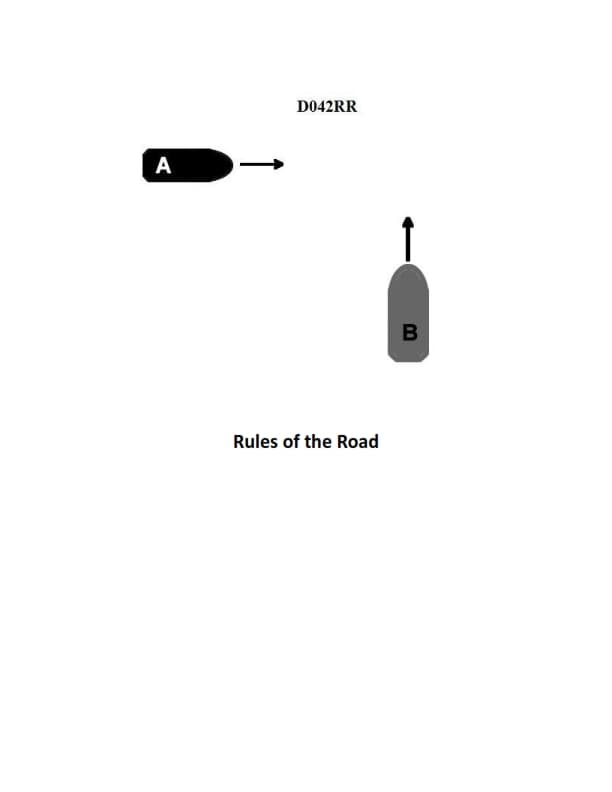
INLAND ONLY Two power-driven vessels are crossing within a half a mile of each other as shown in illustration D042RR below. Vessel "A" sounds one short blast on the whistle. What action should vessel "B" take?
AI Explanation
The correct answer is C) sound one short blast and maintain course and speed.
According to the Inland Navigation Rules, when two power-driven vessels are crossing so as to involve risk of collision, the vessel that has the other on her own starboard side shall alter course to avoid collision (Rule 15). In this scenario, vessel "A" is the give-way vessel and has sounded one short blast to indicate that she intends to alter course to starboard. Vessel "B", the stand-on vessel, should respond by sounding one short blast to acknowledge the intended action and maintain her course and speed.
The other options are incorrect because: A) sounding the danger signal and slowing down is not the appropriate response for the stand-on vessel; B) the stand-on vessel should acknowledge the give-way vessel's intentions; and D) altering course or slowing down is the responsibility of the give-way vessel, not the stand-on vessel.
Related Questions
#171 BOTH INTERNATIONAL & INLAND You are underway in heavy fog. You hear the fog signal of a vessel which is somewhere ahead of your vessel. Which action(s) are your required to take? #172 BOTH INTERNATIONAL & INLAND A sailing vessel shall not impede the safe passage of which vessels? #174 BOTH INTERNATIONAL & INLAND Which is TRUE for a vessel using a traffic separation scheme? #175 BOTH INTERNATIONAL & INLAND A traffic separation zone is that part of a traffic separation scheme which __________. ? #176 BOTH INTERNATIONAL & INLAND The purpose of established traffic separation schemes is to do which of the following?