Question 177Rules of the Road90% to pass
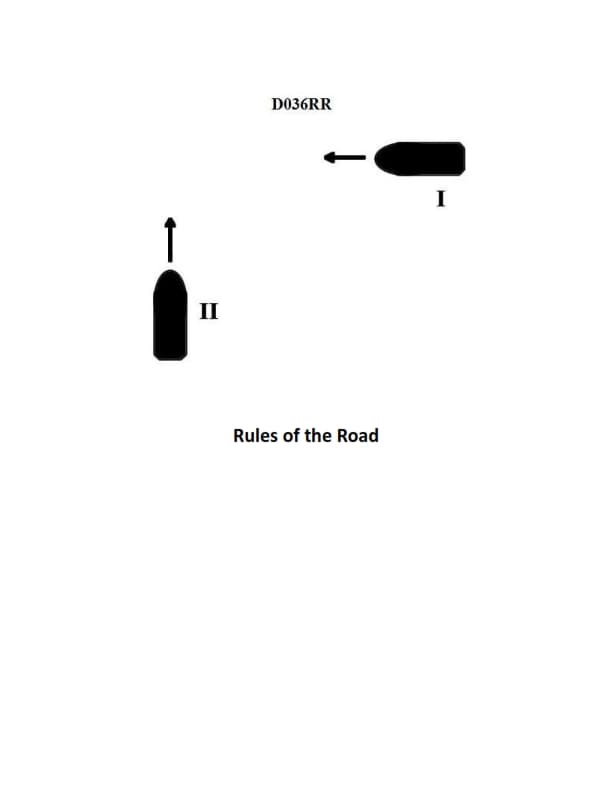
BOTH INTERNATIONAL & INLAND Vessels "I" and "II" are power-driven vessels. You are on vessel "I" as shown in illustration D036RR below. In this scenario you are which of the following?
AI Explanation
The correct answer is B) stand-on vessel.
According to the International Regulations for Preventing Collisions at Sea (COLREGS), when two power-driven vessels are meeting in a crossing situation, the vessel that has the other on its starboard side is the stand-on vessel and must maintain its course and speed, while the vessel that has the other on its port side is the give-way vessel and must take early and substantial action to avoid collision.
In the scenario described, vessel "I" has vessel "II" on its starboard side, so vessel "I" is the stand-on vessel and must maintain its course and speed, while vessel "II" is the give-way vessel and must take action to avoid collision.
Related Questions
#175 BOTH INTERNATIONAL & INLAND A traffic separation zone is that part of a traffic separation scheme which __________. ? #176 BOTH INTERNATIONAL & INLAND The purpose of established traffic separation schemes is to do which of the following? #178 BOTH INTERNATIONAL & INLAND A head-on situation at night is one in which you see dead ahead a vessel showing which light(s)? #180 INLAND ONLY What do the lights shown in illustration D075RR below represent? #181 BOTH INTERNATIONAL & INLAND A vessel hearing a fog signal forward of her beam has not determined if risk of collision exists. What shall she reduce speed to?