Question 18Rules of the Road90% to pass
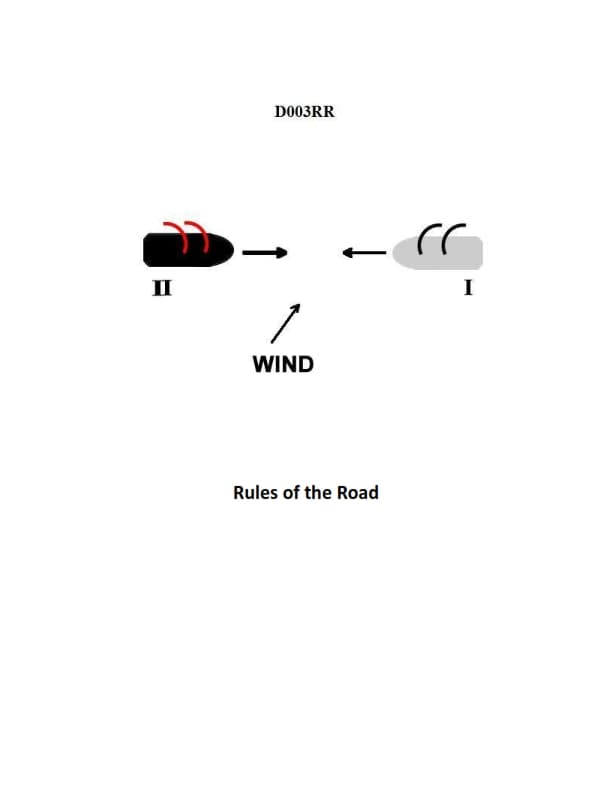
BOTH INTERNATIONAL & INLAND Two sailing vessels are approaching each other as shown in illustration D003RR below. Which statement is correct?
AI Explanation
The correct answer is C) Vessel "II" should stand-on because she has the wind on her starboard side.
According to the International Regulations for Preventing Collisions at Sea (COLREGS), which apply to both international and inland waters, in a head-on situation, the vessel with the wind on her starboard side (Vessel II) is the stand-on vessel and must maintain her course and speed. The other vessel (Vessel I) is the give-way vessel and must take early and substantial action to avoid a collision.
The other options are incorrect because: A) being close-hauled does not determine the stand-on vessel in a head-on situation, and D) both vessels are required to take action in a head-on encounter, with one being the stand-on vessel.
Related Questions
#16 INLAND ONLY You are the stand-on vessel in an overtaking situation. The other vessel is showing an alternately flashing red-and-yellow light. What action should you take?#17 INLAND ONLY You are overtaking a power-driven vessel in a narrow channel and wish to leave her on your starboard side. You may.#19 INTERNATIONAL ONLY Which vessel shall avoid impeding the safe passage of a vessel constrained by her draft? #20 BOTH INTERNATIONAL & INLAND Which is a requirement for a vessel approaching a narrow channel?
#21 INLAND ONLY Which is TRUE of a power-driven vessel, bound downstream, when meeting an upbound vessel on the Western Rivers?