Question 184Rules of the Road90% to pass
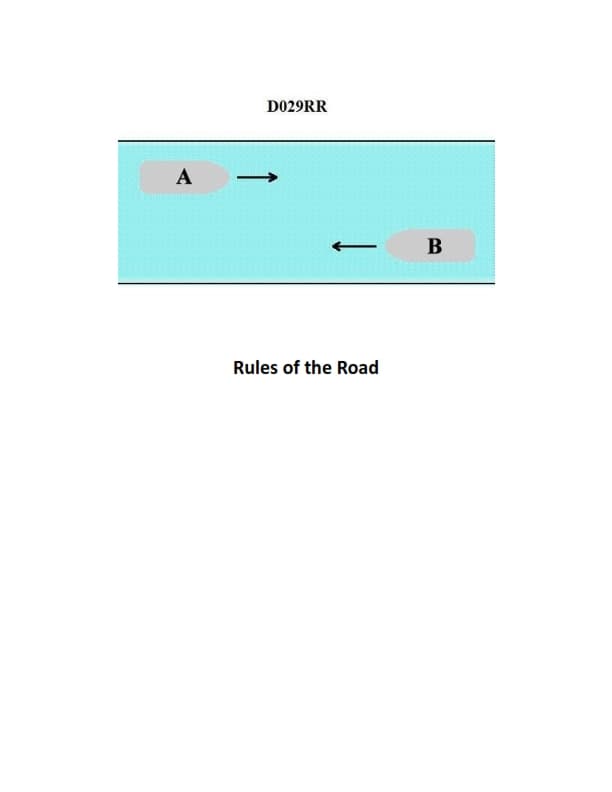
INLAND ONLY Two power-driven vessels are meeting in a narrow channel on the Great lakes as shown in illustration D029RR below. Vessel "A" is downbound with a following current. Vessel "B" should do which of the following?
AI Explanation
The correct answer is A) Take action to permit safe passage.
In this situation, Vessel "B" should take action to permit safe passage because it is the overtaking vessel in a narrow channel. According to the Inland Navigation Rules, the vessel that is overtaking another vessel in a narrow channel must take early and substantial action to permit safe passage. Vessel "A" has the right of way as the downbound vessel, so Vessel "B" must take the necessary steps to safely pass Vessel "A" without impeding its progress.
The other answer choices are incorrect because B) initiating maneuvering signals is not the appropriate action for the overtaking vessel, C) Vessel "A" has the right of way as the downbound vessel, and D) some action must be taken by Vessel "B" to ensure safe passage.
Related Questions
#182 BOTH INTERNATIONAL & INLAND Which statement is TRUE for a vessel using a traffic separation scheme? #183 BOTH INTERNATIONAL & INLAND A vessel using a traffic separation scheme shall NOT take which action? #185 BOTH INTERNATIONAL & INLAND Which statement is TRUE concerning two sailing vessels?#186 BOTH INTERNATIONAL & INLAND In which situation do the Rules require both vessels to change course?#187 BOTH INTERNATIONAL & INLAND When two power-driven vessels are crossing, which vessel is the stand-on vessel?