Question 195Rules of the Road90% to pass
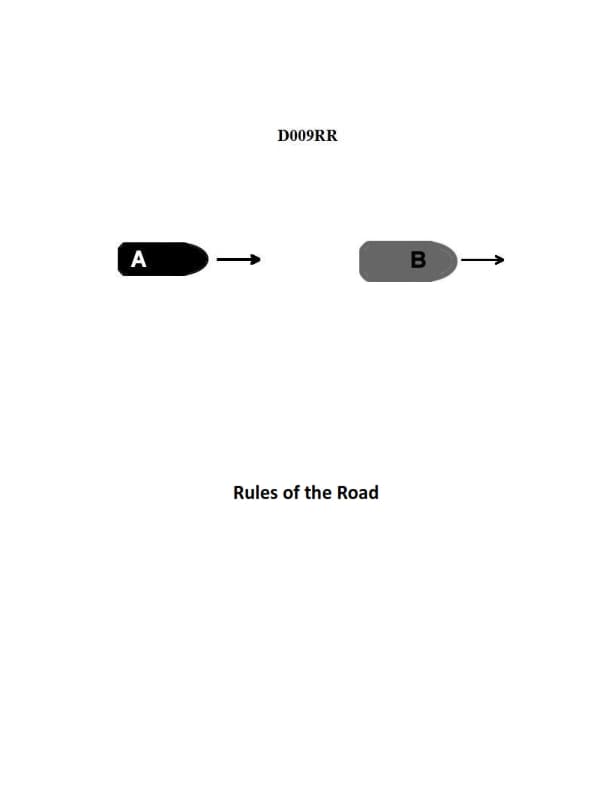
BOTH INTERNATIONAL & INLAND Vessel "A" is overtaking vessel "B" as shown in illustration D009RR below. Which vessel is the stand-on vessel?
AI Explanation
The correct answer is C) Vessel "B".
According to the International Regulations for Preventing Collisions at Sea (COLREGS), when a vessel is overtaking another vessel, the overtaking vessel (Vessel "A") is the give-way vessel and must keep out of the way of the vessel being overtaken (Vessel "B"), which is the stand-on vessel. This rule applies to both international and inland navigation.
The other options are incorrect because: A) Vessel "A" is the give-way vessel, not the stand-on vessel. B) One of the vessels must be the stand-on vessel. D) Only Vessel "A" must keep clear, not both vessels.
Related Questions
#193 BOTH INTERNATIONAL & INLAND You are on vessel "A" and approaching vessel "B" as shown in illustration D015RR below. You are not sure whether your vessel is crossing or overtaking vessel "B". You should take which of the following actions? #194 BOTH INTERNATIONAL & INLAND You are underway on vessel "B" approaching vessel "A" as shown in illustration D038RR below. You are unable to see any sidelights on vessel "A". What type of situation is this? #196 BOTH INTERNATIONAL & INLAND A sailing vessel is overtaking a tug and tow as shown in illustration D043RR below. Which statement is correct?#197 BOTH INTERNATIONAL & INLAND While underway you sight a vessel displaying the shapes shown in illustration D006RR below. What action should you take?#198 BOTH INTERNATIONAL & INLAND Vessel "A" is overtaking vessel "B" as shown in illustration D017RR below and will pass without changing course. Which light will vessel "A" observe on vessel "B"?