Question 213Rules of the Road90% to pass
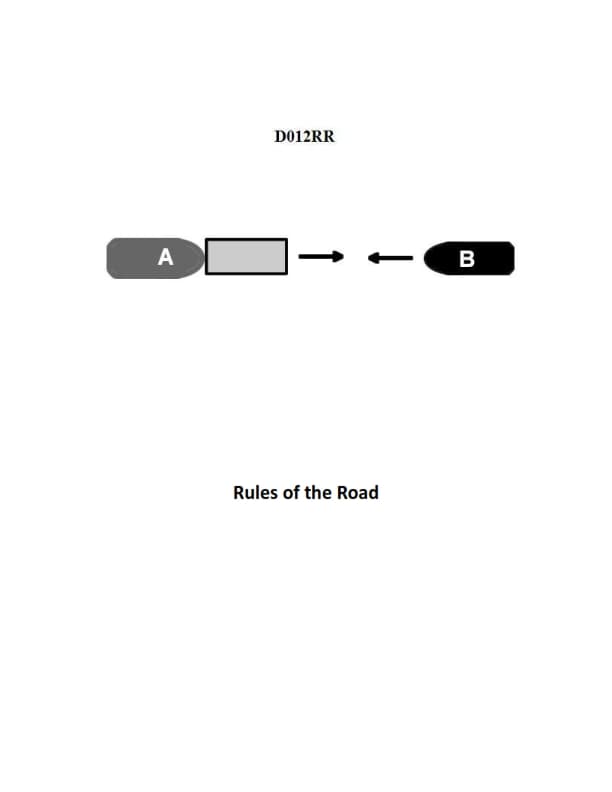
BOTH INTERNATIONAL & INLAND You are on vessel "A" pushing a barge ahead and meeting vessel "B" as shown in illustration D012RR below. How should the vessels pass?
AI Explanation
The correct answer is C) Both vessels must alter course to starboard and pass port to port.
This is the correct answer because the International Regulations for Preventing Collisions at Sea (COLREGS) Rule 14 states that when two power-driven vessels are meeting head-on, each vessel shall alter course to starboard so that they may pass port-to-port. Since the vessels in the illustration are meeting head-on, they must both alter course to starboard to safely pass each other.
The other options are incorrect because A) relying on whistle signals is not the primary method for passing head-on, B) only one vessel altering course goes against the COLREGS requirement for both vessels to take action, and D) passing starboard-to-starboard is the incorrect maneuvering for a head-on meeting situation.
Related Questions
#211 BOTH INTERNATIONAL & INLAND A power-driven vessel has on her port side a sailing vessel which is on a collision course. What action is the power-driven vessel required to take? #212 BOTH INTERNATIONAL & INLAND Which statement is TRUE concerning two approaching sailing vessels? #214 BOTH INTERNATIONAL & INLAND Your power-driven vessel is underway when you sight a sailing vessel on your port bow. Which vessel is the "stand-on" vessel? #215 INLAND ONLY A 150 meter vessel is proceeding down the course of a narrow channel in the Great Lakes System. A 60-meter vessel is starting to cross the channel. Which statement is TRUE?#216 INLAND ONLY Which is a characteristic of a "special flashing light"?