Question 223Rules of the Road90% to pass
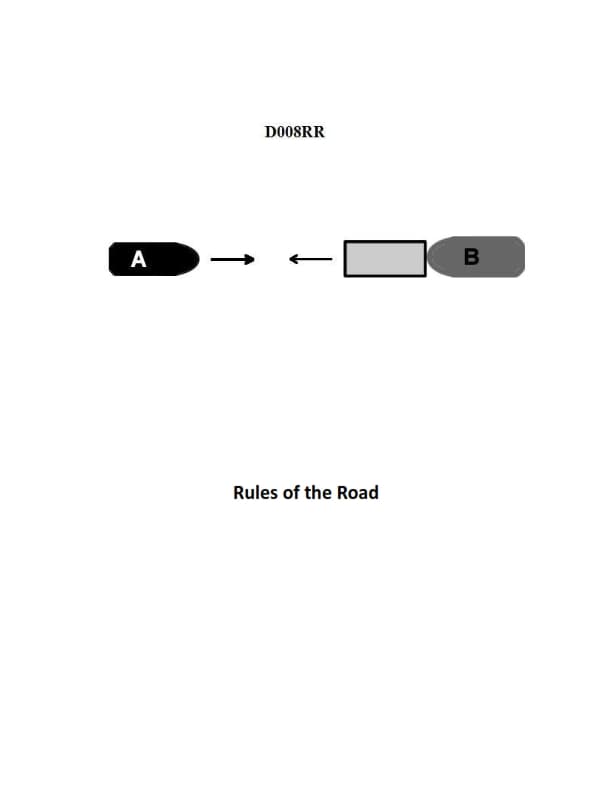
BOTH INTERNATIONAL & INLAND Vessel "A" and vessel "B" (which is pushing ahead) are meeting head-on as shown in illustration D008RR below. How must the vessels pass?
AI Explanation
The correct answer is B) Both vessels should alter course to starboard and pass port to port.
This is the correct answer because under the International Regulations for Preventing Collisions at Sea (COLREGS), when two power-driven vessels are meeting head-on, they must both alter course to starboard to pass port-to-port. This is the standard crossing situation in the COLREGS and applies to both international and inland waters.
The other answer choices are incorrect because: A) Altering only one vessel's course is not the correct action for a head-on meeting situation. C) Passing starboard-to-starboard would be incorrect for a head-on meeting. D) Exchanging whistle signals is not necessary, as the COLREGS clearly dictate the required action for a head-on meeting.
Related Questions
#221 BOTH INTERNATIONAL & INLAND You are under sail and overtaking a tug and tow. Which action is correct?#222 BOTH INTERNATIONAL & INLAND When must a sailing vessel keep her course and speed? #224 BOTH INTERNATIONAL & INLAND Which vessel is the stand-on vessel when two vessels crossing in fog are NOT in sight of one another? #225 BOTH INTERNATIONAL & INLAND You sight another power-driven vessel dead ahead showing both the red and green sidelights. Which action are you required to take? #226 BOTH INTERNATIONAL & INLAND Vessel "A" is on course 000°T. Vessel "B" is on a course such that she is involved in a head-on situation and is bearing 355°T, 2 miles away from vessel "A". To ensure a safe passing, vessel "A" should take which action?