Question 228Rules of the Road90% to pass
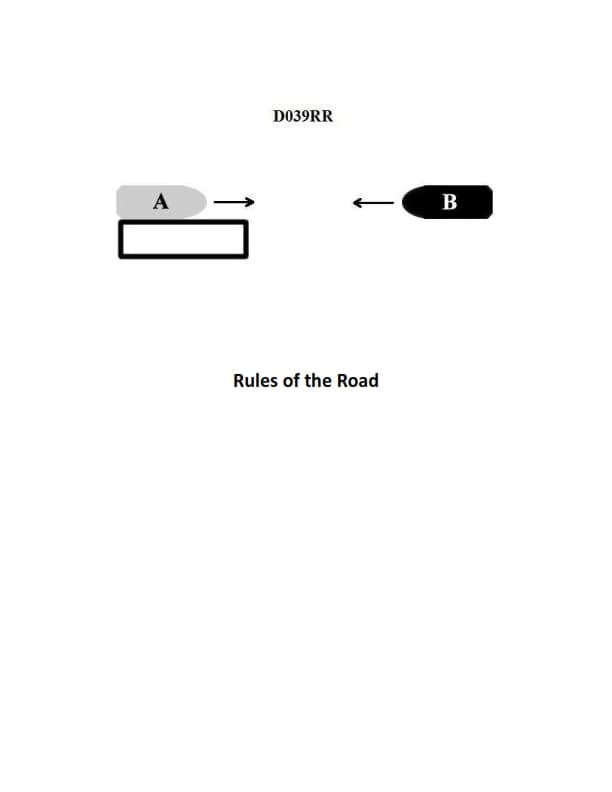
BOTH INTERNATIONAL & INLAND You are on vessel "A" towing a barge alongside and meeting power-driven vessel "B" as shown in illustration D039RR below. Which action should you take?
AI Explanation
The correct answer is C) Alter course to starboard.
According to the International Regulations for Preventing Collisions at Sea (COLREGS), Rule 14 - Head-on Situation, when two power-driven vessels are meeting on reciprocal or nearly reciprocal courses, each vessel shall alter course to starboard to pass with a safe clearance. This applies to both international and inland waterways.
The other options are incorrect because: A) Altering course to port would be the wrong action in a head-on situation; B) Backing down would not be the appropriate action to take in this scenario; and D) Maintaining course and speed would go against the COLREGS requirement to alter course to starboard in a head-on encounter.
Related Questions
#226 BOTH INTERNATIONAL & INLAND Vessel "A" is on course 000°T. Vessel "B" is on a course such that she is involved in a head-on situation and is bearing 355°T, 2 miles away from vessel "A". To ensure a safe passing, vessel "A" should take which action? #227 BOTH INTERNATIONAL & INLAND When shall the stand-on vessel in a crossing situation take action to avoid the other vessel?#229 INLAND ONLY The term "Great Lakes", as defined by the Inland Rules of the Road, includes part of the __________. #230 BOTH INTERNATIONAL & INLAND When shall the stand-on vessel change course and speed? #231 BOTH INTERNATIONAL & INLAND Two vessels are meeting head-on. How must the vessels pass?