Question 275Rules of the Road90% to pass
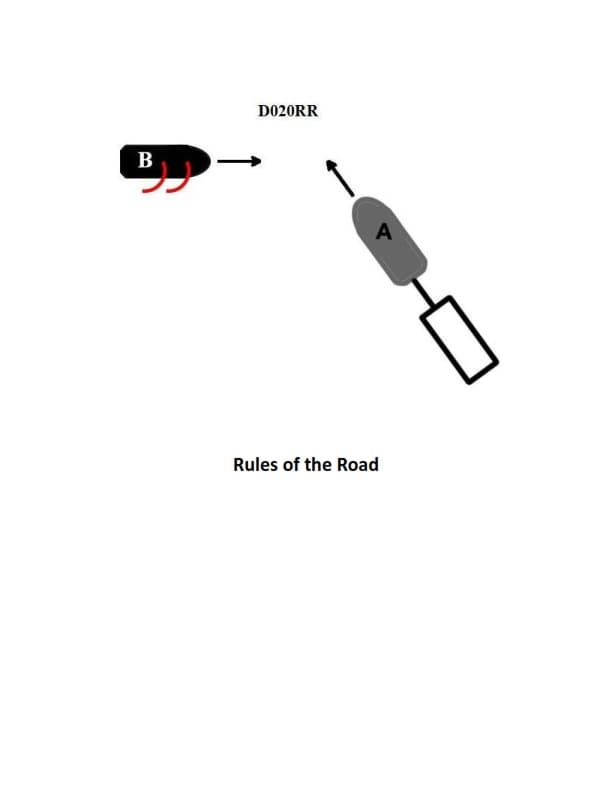
BOTH INTERNATIONAL & INLAND You are aboard vessel "A" which is towing on open waters when vessel "B", a sailing vessel, is sighted off your port bow as shown in illustration D020RR below. Which vessel is the stand-on?
AI Explanation
The correct answer is B. Vessel "B" is the stand-on vessel because it is a sailing vessel.
The International Regulations for Preventing Collisions at Sea (COLREGS) state that in a crossing situation, the vessel that is not under power (the sailing vessel "B") is the stand-on vessel and must maintain its course and speed. The vessel under power (the towing vessel "A") is the give-way vessel and must take early and substantial action to avoid a collision.
The other options are incorrect because the relative positions of the vessels are not the determining factor in this case - the fact that "B" is a sailing vessel makes it the stand-on vessel regardless of its position relative to "A".
Related Questions
#273 BOTH INTERNATIONAL & INLAND You are aboard vessel "A" , a power-driven vessel, on open waters and vessel "B", a sailing vessel, is sighted off your port bow as shown in illustration D027RR below. Which vessel is the stand-on vessel? #274 BOTH INTERNATIONAL & INLAND A fishing vessel is approaching a vessel not under command. Which statement is TRUE? #276 BOTH INTERNATIONAL & INLAND In illustration D002RR below, vessel I is a power-driven vessel. Vessel II is a sailing vessel with the wind dead aft. Which statement about this situation is correct?#277 BOTH INTERNATIONAL & INLAND In open waters, a vessel fishing is in a crossing situation with a vessel sailing. The sailing vessel is located on the fishing vessel's starboard side. Which vessel is the stand-on vessel?#278 BOTH INTERNATIONAL & INLAND A sailing vessel is NOT required to keep out of the way of which vessel?