Question 30Rules of the Road90% to pass
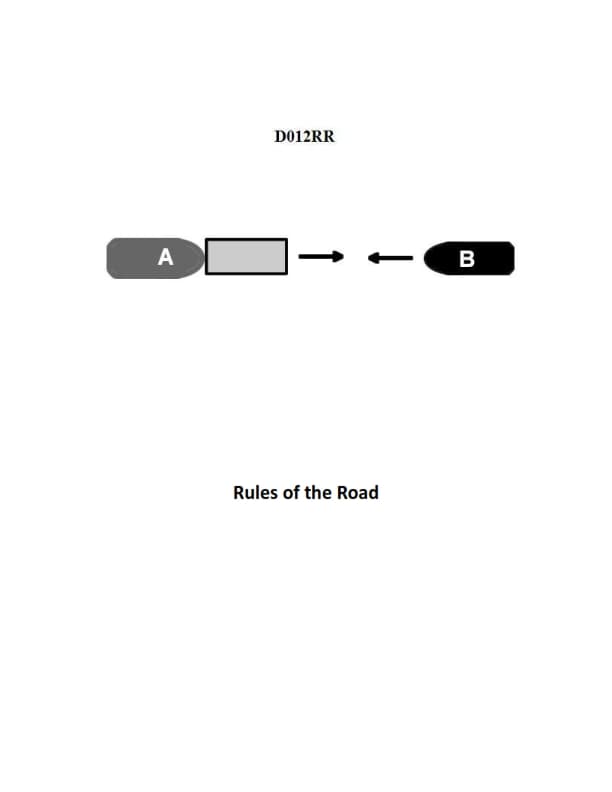
BOTH INTERNATIONAL & INLAND Vessel "A" (towing) and vessel "B" are meeting as shown in illustration D012RR below. In this situation, which statement is TRUE?
AI Explanation
The correct answer is C) Both vessels should alter course to starboard and pass port to port.
This is the correct answer because the International Regulations for Preventing Collisions at Sea (COLREGS) Rule 14 states that when two power-driven vessels are meeting head-on, they shall alter course to starboard so that they will pass port-to-port. Since both vessels "A" (towing) and "B" are meeting head-on, they must both alter course to starboard to pass port-to-port.
The other options are incorrect because A) would be the improper action, B) only requires vessel "B" to alter course when both should do so, and D) is incorrect as vessel "A" is not the stand-on vessel in this head-on meeting situation.
Related Questions
#28 INLAND ONLY Two power-driven vessels are meeting in a narrow channel on the Great Lakes as shown in illustration D037RR below. Vessel "A" is downbound with a following current. Vessel "A" shall do which of the following? #29 INLAND ONLY You are overtaking another power-driven vessel in a narrow channel and wish to leave her on your starboard side. You may. #31 INLAND ONLY The masthead light may be located at other than the fore and aft centerline on which power-driven vessel? #32 INLAND ONLY Maneuvering signals shall be sounded on inland waters by? #33 INLAND ONLY When two power-driven vessels are meeting on the Great Lakes, Western Rivers, or waters specified by the Secretary, where there is a current, which vessel shall sound the first passing signal?