Question 378Rules of the Road90% to pass
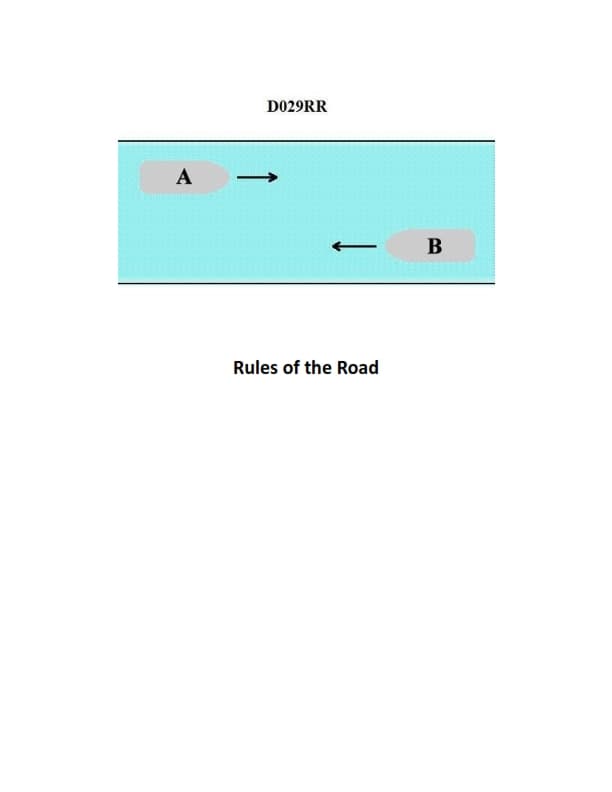
INLAND ONLY Two power-driven vessels, "A" and "B" , are meeting in a narrow channel as shown in illustration D029RR below. Which statement is TRUE concerning whistle signals between the vessels?
AI Explanation
The correct answer is C) Both vessels should sound two short blasts.
This is correct because under the Inland Navigation Rules, when two power-driven vessels are meeting in a narrow channel, both vessels should sound two short blasts to indicate that they intend to pass port-to-port. This is the standard whistle signal for a meeting situation in a narrow channel, where a change of course and/or speed may be necessary to safely pass.
The other answer choices are incorrect because option A would be the wrong signal, option B would not be sufficient, and option D would be incorrect as some whistle signal is required in this meeting situation.
Related Questions
#376 INLAND ONLY You are overtaking another power-driven vessel and sound a whistle signal indicating that you intend to pass the vessel along her starboard side. If the other vessel answers your signal with five short and rapid blasts, what action should you take? #377 INLAND ONLY You are overtaking another power-driven vessel in a narrow channel. The other vessel will have to move to allow you to pass. You wish to overtake the other vessel and leave her on your starboard side. What should be your first whistle signal? #379 INLAND ONLY Which statement is TRUE concerning the fog signal of a canal boat 25 meters in length, anchored in a "special anchorage area" approved by the Secretary?#380 INLAND ONLY Which statement is TRUE concerning the fog signal of a barge 35 meters in length, anchored in a "special anchorage area" approved by the Secretary? #381 INLAND ONLY Which statement is TRUE concerning the fog signal of a vessel 15 meters in length, anchored in a "special anchorage area" approved by the Secretary?