Question 453Rules of the Road90% to pass
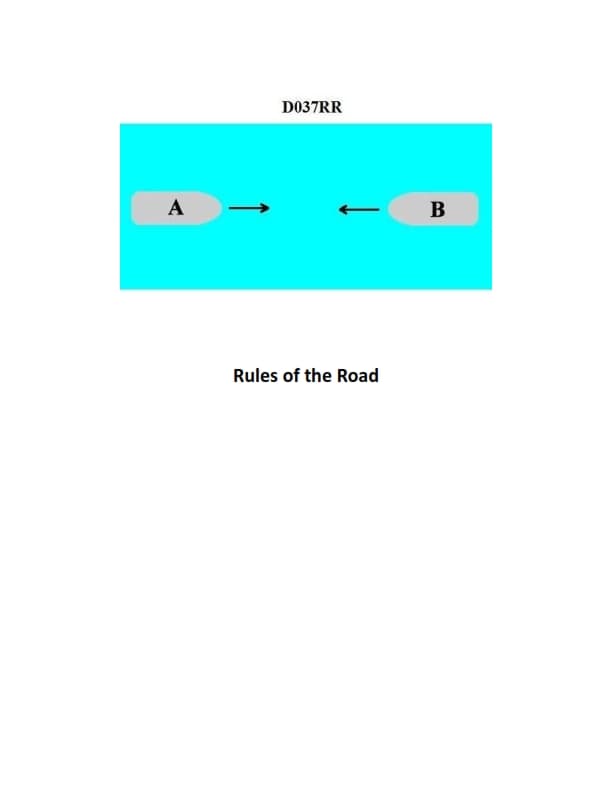
INTERNATIONAL ONLY Two power-driven vessels are meeting in the situation as shown in illustration D037RR below. What does two short blasts from either vessel mean?
AI Explanation
The correct answer is D) "I am altering my course to port."
According to the International Regulations for Preventing Collisions at Sea (COLREGS), two short blasts from a power-driven vessel indicate that the vessel is altering its course to port. This signals to the other vessel that it should maintain its course and speed, as the vessel sounding the two short blasts will be the one to take avoiding action by turning to port.
The other answer choices are incorrect because they do not accurately represent the meaning of two short blasts in the given situation. Altering course to starboard (A), intending to leave the other vessel on the port side (B), and operating astern propulsion (C) are not the appropriate signals for two short blasts in an international meeting situation.
Related Questions
#451 INTERNATIONAL ONLY Two power-driven vessels are meeting in the situation as shown in illustration D037RR below. What does one short blast from either vessel mean? #452 INTERNATIONAL ONLY You are in sight of another vessel in a crossing situation, and the other vessel sounds one short blast. You are going to hold course and speed. Which statement is CORRECT?#454 INTERNATIONAL ONLY Two power-driven vessels are crossing within one half mile of each other as shown in illustration D042RR below. Vessel "A" sounds one short blast of the whistle. What does this signal mean? #455 INTERNATIONAL ONLY Two power-driven vessels are crossing within one half mile of each other as shown in illustration D042RR below. Vessel "A" sounds one short blast of the whistle. What is vessel "B" in this situation? #456 INTERNATIONAL ONLY Two power-driven vessels are crossing within one half mile of each other as shown in illustration D042RR below. Vessel "A" sounds one short blast of the whistle. What signal should vessel "B" sound?