Question 77Rules of the Road90% to pass
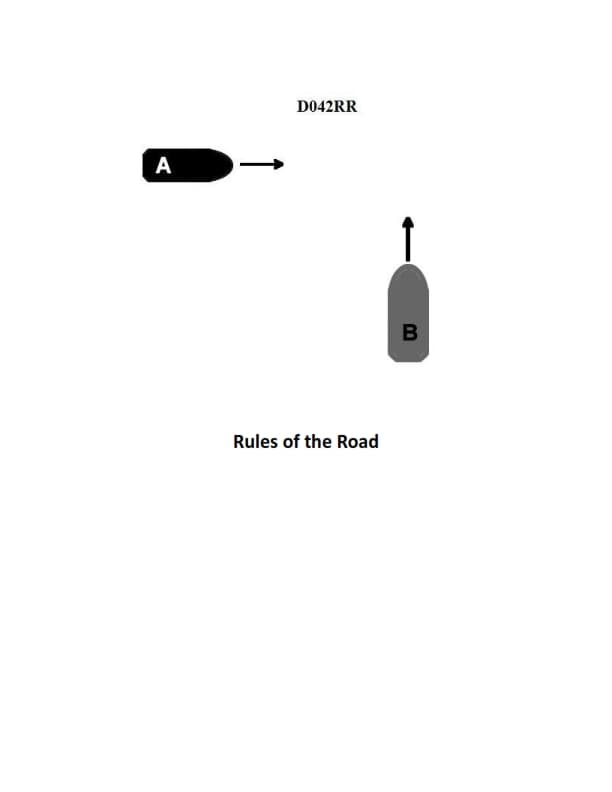
BOTH INTERNATIONAL & INLAND Two power-driven vessels are crossing as shown in illustration D042RR below. Vessel "A" sounds one short blast on the whistle. Vessel "B" is which of the following in this scenario?
AI Explanation
The correct answer is C) stand-on vessel.
In this scenario, Vessel "A" is the give-way vessel, as it has sounded one short blast on the whistle, indicating it intends to alter course to the right. Vessel "B" is the stand-on vessel, which means it must maintain its course and speed, allowing Vessel "A" to pass safely.
The other options are incorrect because: A) Vessel "B" is not the give-way vessel, as it has the right-of-way; B) Vessel "B" is not the overtaking vessel, as it is crossing Vessel "A" at an angle; and D) Vessel "B" is not the burdened vessel, as it has the right-of-way in this crossing situation.
Related Questions
#75 BOTH INTERNATIONAL & INLAND Which vessel should NOT impede the navigation of a power-driven vessel? #76 BOTH INTERNATIONAL & INLAND When is your vessel travelling at a "safe speed" as defined in the COLREGS? #78 BOTH INTERNATIONAL & INLAND Your 15-meter tug is underway and crossing a deep and narrow channel. A large container vessel is off your port bow on a steady bearing. Which statement is TRUE concerning this situation? #79 BOTH INTERNATIONAL & INLAND The Navigation Rules state that a vessel shall be operated at a safe speed at all times so that she can be stopped within . #80 INLAND ONLY Which statement is TRUE concerning a passing agreement made by radiotelephone?