Question 24
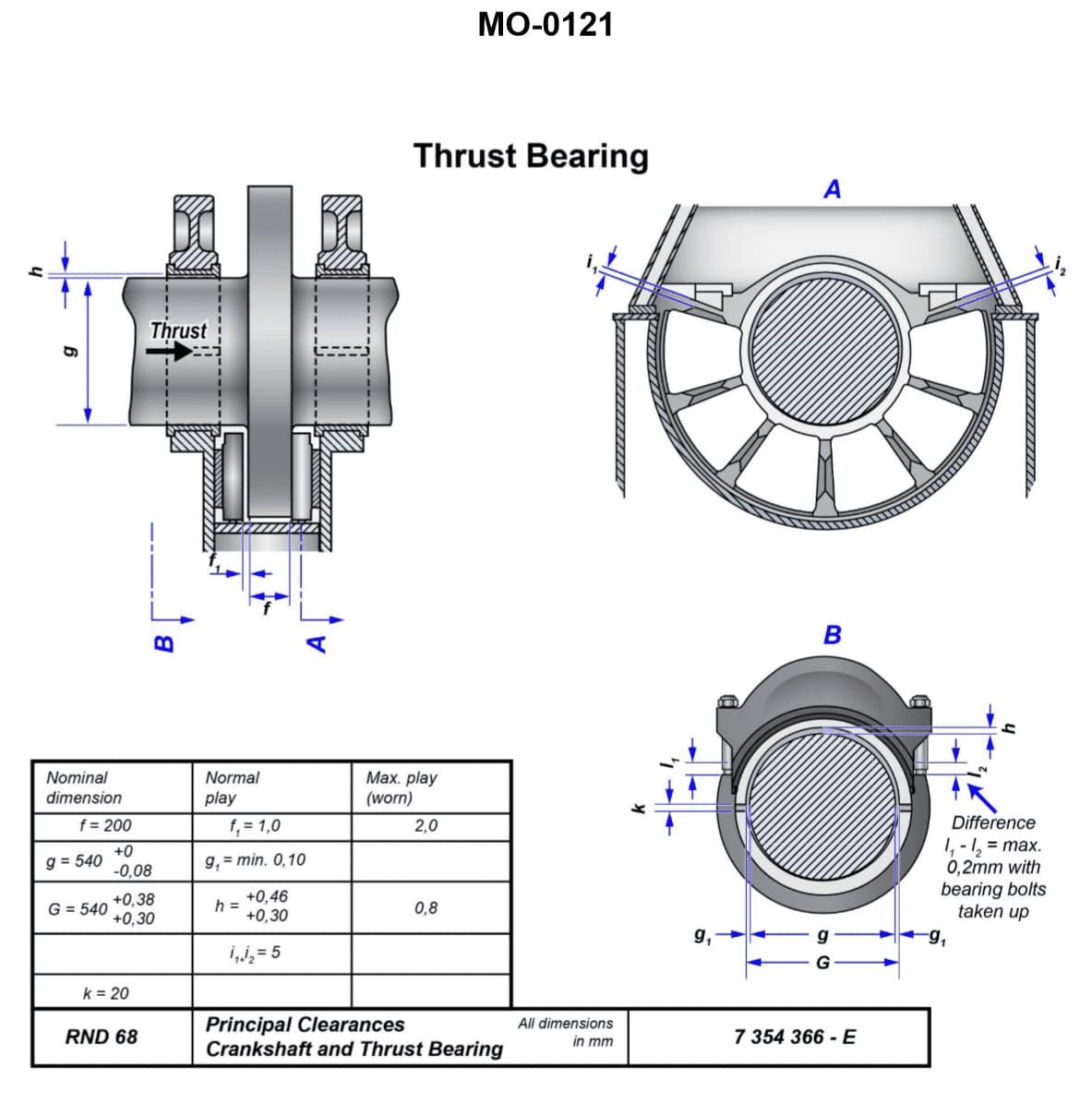
3AE01The thrust bearing shown in the illustration has over eight years of ahead running time. Measurements show "i1" is 4 mm and "i2" is 1 mm. Which of the following conditions is indicated and what steps should be taken, if any? Illustration MO-0121
AI Explanation
The Correct Answer is A
### Explanation for Option A
Option A is correct because the measurements indicate minimal and acceptable wear on the thrust bearing components over the extended running period.
1. **Interpretation of Measurements:** In typical thrust bearing arrangements (such as Kingsbury or Michell designs), $i1$ (4 mm) represents the total axial float or design clearance allowed for the shaft. $i2$ (1 mm) represents the measured movement of the shaft (wear) from its new/zero position toward the ahead stop.
2. **Wear Assessment:** The bearing has run for over eight years, and the total measured wear is only 1 mm against a total design clearance of 4 mm.
3. **Rate of Wear:** The average wear rate is $1 \text{ mm} / 8 \text{ years} = 0.125 \text{ mm}$ per year. This rate is far below typical alarm or excessive limits. Since the wear is minor and the bearing still has 3 mm of allowable movement remaining, the wear is considered non-appreciable.
4. **Conclusion:** Since the wear is minimal and well within operational limits, no extraordinary corrective actions are necessary. The standard prescribed maintenance and monitoring schedule should be continued.
### Explanation of Why Other Options Are Incorrect
**B) A wear rate of 1.6 mm per year occurred. Although not excessive, this condition may require more frequent monitoring.**
This option is incorrect because the calculated wear rate is based on an incorrect calculation. If the wear is 1 mm over 8 years, the rate is $0.125 \text{ mm}$ per year, not 1.6 mm per year. A rate of 1.6 mm per year would result in 12.8 mm of wear over eight years, which contradicts the actual measurement of 1 mm.
**C) The stops in which the thrust bearing block rides are worn, and it is necessary to return these to their original specifications.**
The primary indicator of thrust bearing wear is the change in the axial position ($i2$), which measures the actual wear of the thrust pads/shoes. While the stops may eventually wear, the reading of 1 mm indicates general, acceptable pad wear. If the stops themselves were severely worn, it would likely alter the total float measurement ($i1$) or require a much higher $i2$ reading to be considered critical.
**D) A wear rate of 1.6 mm per year is excessive and requires immediate assistance from the manufacturer's field support.**
This option fails for the same reason as Option B: the calculation of 1.6 mm per year is incorrect. The actual wear rate ($0.125 \text{ mm}$/year) is very low and does not require urgent attention or manufacturer assistance.