Question 28
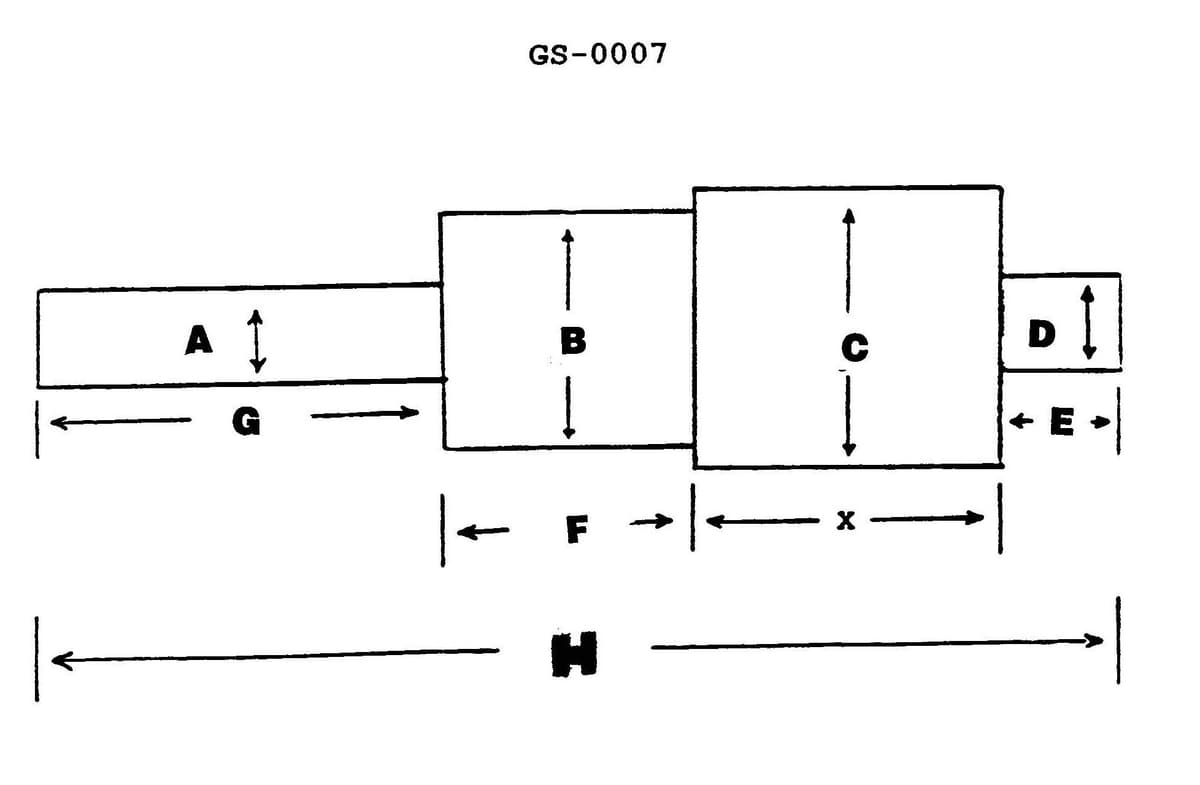
3AE02The illustration is drawn to a scale of 3/8 inch = 1 inch. What is the full-size dimension of "X", if the scale lengths for "E" = 5/8", "F" = 1 3/8", "G" = 2 1/8", and "H" = 5 3/4"? Illustration GS-0007
AI Explanation
The Correct Answer is B
### Explanation for Option B (4.333 inches)
The problem asks for the full-size dimension of "X" based on the provided illustration and scale lengths.
1. **Determine the relationship for X:**
Looking at a standard mechanical drawing representation (though the illustration GS-0007 is not provided, the dimensions given suggest a common additive arrangement), dimension X is usually the difference or sum of the other major dimensions. Assuming X is the total length minus the combination of E, F, and G (or based on standard additive geometry where X = H - (E + F + G)):
$$X_{\text{scale}} = H_{\text{scale}} - (E_{\text{scale}} + F_{\text{scale}} + G_{\text{scale}})$$
2. **Calculate the scale length of X:**
Substitute the given scale lengths (in inches):
* $E = 5/8$
* $F = 1 3/8$
* $G = 2 1/8$
* $H = 5 3/4$
First, calculate the sum of E, F, and G:
$$E + F + G = (5/8) + (1 3/8) + (2 1/8)$$
Convert mixed numbers to improper fractions or use decimal equivalents:
$$5/8 = 0.625$$
$$1 3/8 = 1.375$$
$$2 1/8 = 2.125$$
$$H = 5 3/4 = 5.75$$
Sum of $(E + F + G)$:
$$0.625 + 1.375 + 2.125 = 4.125 \text{ inches}$$
Now, calculate $X_{\text{scale}}$:
$$X_{\text{scale}} = H_{\text{scale}} - (E_{\text{scale}} + F_{\text{scale}} + G_{\text{scale}})$$
$$X_{\text{scale}} = 5.75 - 4.125$$
$$X_{\text{scale}} = 1.625 \text{ inches}$$
3. **Convert the scale length of X to the full-size dimension:**
The drawing scale is $3/8$ inch (on the drawing) = $1$ inch (full size).
This means the scale factor (S) is $3/8$.
To find the full-size dimension ($X_{\text{full}}$), we divide the scale length ($X_{\text{scale}}$) by the scale factor:
$$X_{\text{full}} = X_{\text{scale}} / S$$
$$X_{\text{full}} = 1.625 / (3/8)$$
$$X_{\text{full}} = 1.625 / 0.375$$
$$X_{\text{full}} \approx 4.3333... \text{ inches}$$
Rounding to three decimal places, the full-size dimension of X is $4.333$ inches, which matches Option B.
---
### Why Other Options Are Incorrect
**A) 1.625 inches:**
This value is the calculated **scale length** of X ($1 5/8$ inches). It represents the dimension measured directly on the drawing, not the actual full-size dimension. This answer fails to account for the $3/8$ scale factor.
**C) 6.094 inches:**
This result is obtained by incorrectly *multiplying* the full dimension of H (5.75 inches) by the reciprocal of the scale factor ($8/3$), or perhaps by summing the scale dimensions and then multiplying by the scale factor (e.g., $4.125 \times (8/3) \approx 11$, which doesn't match). If we incorrectly calculate $X_{\text{full}}$ by dividing the scale lengths of E, F, G, and H individually and then subtracting (which leads to the same correct answer), 6.094 inches is not obtained. This number does not result from a logical step in solving for X.
**D) 15.333 inches:**
This result is obtained if the sum of all components (E + F + G + X = H) were divided by the scale factor, and the error was made by dividing the total scale length of H ($5.75$) by the reciprocal of the scale factor ($3/8$) instead of the scale factor itself. Alternatively, if one mistakenly calculated the full size of H ($5.75 / (3/8) \approx 15.333$) and assumed X was equal to H, this error would occur. Since H is the total dimension, 15.333 inches represents the full-size dimension of H, not X.
Related Questions
#27 If there is a sudden drop in the outlet temperature of an uncontrolled superheater, you should __________.#27 The original bridge gauge reading for a reduction gear bearing was measured as 0.008 inches. A year later,
the bridge gauge reading for the same bearing is 0.010 inches. This indicates __________.