Question 6
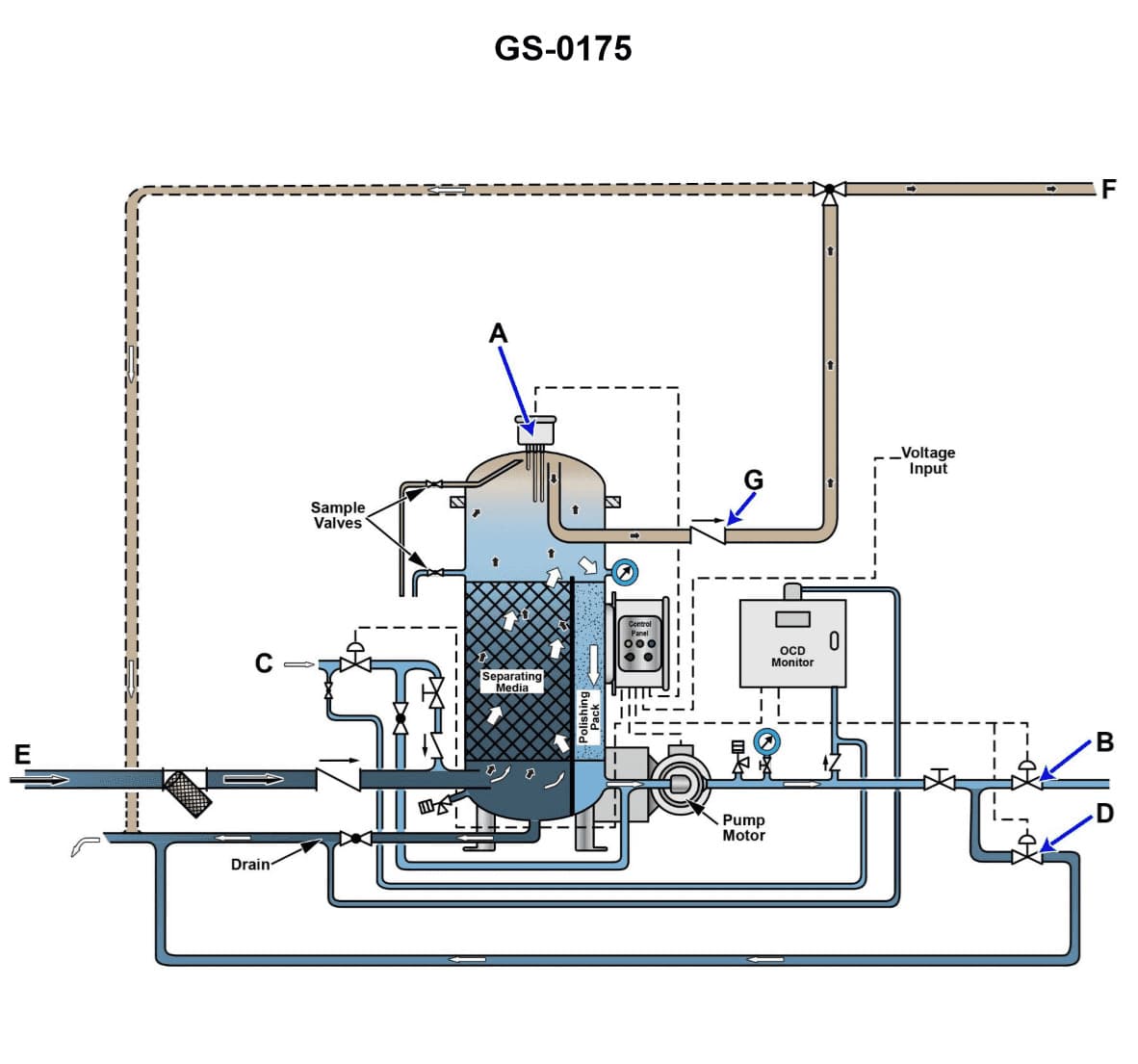
CEL01The line labeled "E", as shown in the illustration, would be identified as the ______. Illustration GS-0175
AI Explanation
The Correct Answer is D
**Explanation for Option D (oily bilge water inlet line):**
In marine engineering illustrations (such as those depicting an Oily Water Separator or Bilge Water Processing Unit, implied by the context of "Illustration GS-0175"), the line labeled "E" typically represents the main input line feeding the raw, untreated oily bilge water mixture from the ship's bilges or holding tank into the separation system. This is the source material that needs processing to remove oil before discharge.
**Explanation for Incorrect Options:**
**A) processed water outlet line:** This line would carry the cleaned (processed) water *away* from the separator unit, usually to a discharge overboard valve or monitoring system, and would typically be positioned high or on the output side of the unit, not as the main inlet.
**B) clean water inlet line:** A separate clean water inlet (if present) is usually for flushing, backwash, or dilution purposes, not for introducing the primary material (bilge water) to be processed.
**C) waste oil outlet line:** This line carries the separated, concentrated oil (the waste) *away* from the unit, usually to a dedicated waste oil tank. It would be an output line located where the oil collects, often at the top of the separator, not the main feed line (inlet).
Related Questions
#5 On a slow-speed diesel engine vessel you are supervising a routine piston pull on a cylinder with 10000 hours
on the liner. The piston rod is disconnected. Why must the ridge on the liner be removed before lifting the
piston?#5 A rigid lifesaving device designed for a group of survivors to hold on to while in the water is defined as a
_______.#7 Referring to the illustration, suppose after initiating the oil discharge mode, the oily-water separator fails to
come out of the oil discharge mode in a timely fashion. Cracking open the upper sampling valve reveals the
presence of oil exiting under positive pressure. What is most likely the cause? Illustration GS-0175