Question 17
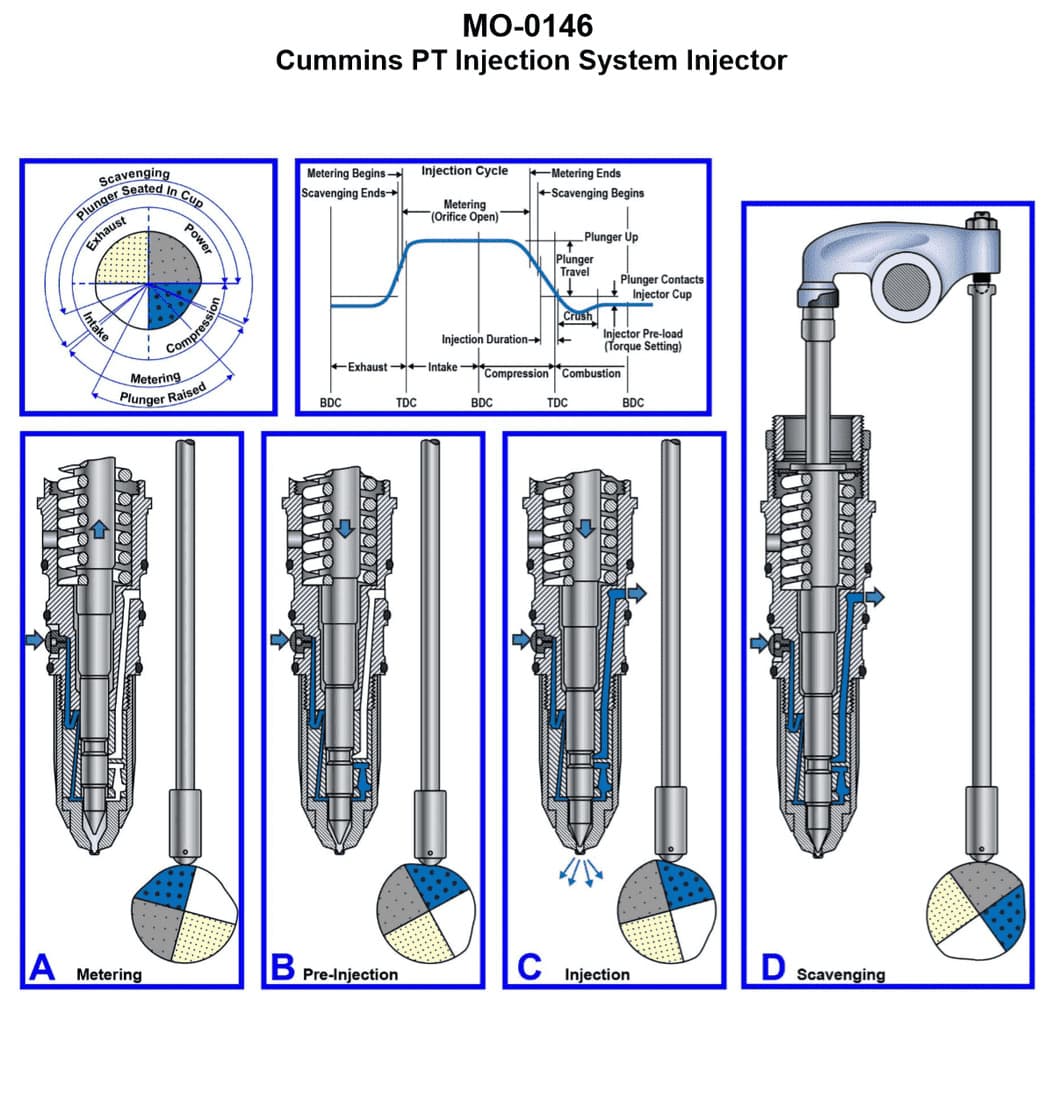
DDE01The harbor tug to which you are assigned has diesel generators fitted with injectors with the operating principle as shown in the illustration. What statement is true concerning the metering principle used in this system? Illustration MO-0146
AI Explanation
The Correct Answer is B
**Explanation for B (Correct Answer):**
The illustration MO-0146 typically depicts a common type of modern diesel fuel injection system, often a High Pressure Common Rail (HPCR) system or an electronic unit injector/pump system, where metering (determining the amount of fuel injected) is precisely controlled electronically. In such systems, the fuel is held at a constant high pressure (either in a rail or delivered to the unit injector) supplied by the inlet pump. The amount of fuel injected is therefore governed by two primary factors:
1. **Pressure of the inlet fuel (or rail pressure):** Higher pressure forces more fuel through the orifice per unit of time.
2. **Length of time the orifice is open (injection duration):** This duration is precisely controlled by the Electronic Control Unit (ECU) activating a solenoid or piezoelectric actuator, which dictates how long the metering orifice (nozzle valve) remains open.
Thus, the total volume (amount) of fuel injected is a direct function of pressure multiplied by the time duration.
**Explanation for A (Incorrect):**
"The amount of fuel injected is dependent upon the distance of plunger travel." This statement describes the metering principle used in older, mechanically governed jerk-pump systems (like the Bosch helix/scroll pump), where rotating and lifting the plunger exposes a varying helix edge to the spill port, thus changing the effective stroke (distance traveled) before fuel delivery ends. This principle is characteristic of mechanical pumps, not the electronically controlled, pressure-duration metering described in Option B and generally associated with modern high-pressure systems.
**Explanation for C (Incorrect):**
"The amount of fuel injected is dependent upon the cylinder compression pressure and the cylinder compression temperature." While cylinder compression pressure and temperature are vital for successful ignition and combustion, they are **not** the controlling factors for the **metering** (determining the quantity) of the fuel delivered by the injector system itself. The fuel quantity is set by the injector's mechanical/electronic controls (pressure and duration), not the conditions within the combustion chamber.
**Explanation for D (Incorrect):**
"The amount of fuel injected depends upon the injector pre-load torque setting." The pre-load torque setting typically refers to the force applied to hold the injector assembly together or the specific pressure setting required to lift the nozzle needle valve (opening pressure). While important for the injector's function and spray pattern, the pre-load torque setting determines **when** injection starts (initial opening pressure) and the quality of the spray, but it does not determine the **quantity** (metered volume) of fuel delivered per cycle.
Related Questions
#16 For the various sizes of tubing and wall thickness used in a hydraulic system, the inside diameter can be
determined if it is remembered that the inside diameter equals the outside diameter less __________.#16 The motor of the illustrated motor controller fails to start on an attempted startup. You ensure the motor has
not tripped out on overload, and you check the disconnect switch closed. With the start button depressed, a
voltmeter reading between 3 and 4, as in figure "A" shown in the illustration, indicates line voltage. After re- opening the disconnect switch and verifying the circuit de-energized, what should be your next step in the
troubleshooting process? Illustration EL-0007