Question 10
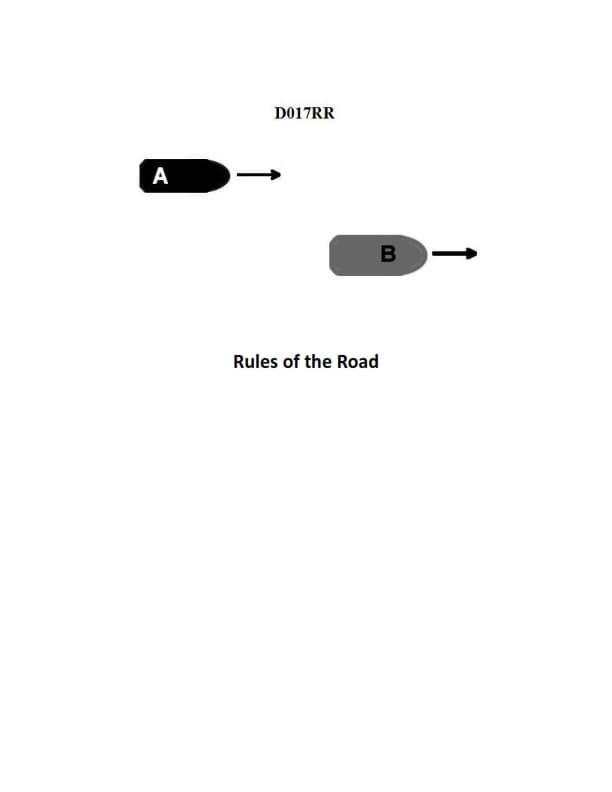
FCP01BOTH INTERNATIONAL & INLAND Vessel "A" is overtaking vessel "B" as shown in illustration D017RR below. Vessel "B" should do which of the following?
AI Explanation
The Correct Answer is B
**Why option B ("should hold her course and speed") is correct:**
The scenario described (Vessel "A" overtaking Vessel "B") is governed by Rule 13 (Overtaking) and Rule 17 (Action by Stand-on Vessel) of the International Regulations for Preventing Collisions at Sea (COLREGs), which apply to both International (COLREGs) and Inland waters (US Inland Rules mirror COLREGs closely in this context).
1. **Rule 13 identifies the roles:** Vessel "A" is the Overtaking vessel (Give-way vessel), and Vessel "B" is the vessel being overtaken (Stand-on vessel).
2. **Rule 17 governs the Stand-on Vessel's action:** Rule 17(a)(i) explicitly states that where one of two vessels is required to keep out of the way, the other vessel shall **keep her course and speed**. Vessel "B" is the stand-on vessel and must maintain predictability for the give-way vessel ("A") to execute a safe passing maneuver.
**Why the other options are incorrect:**
* **A) should slow down until vessel "A" has passed:** This is incorrect because the stand-on vessel (B) is required to hold her speed to maintain predictability. Slowing down could complicate the overtaking maneuver for vessel A and potentially cause a collision.
* **C) may steer various courses and vessel "A" must keep clear:** This is incorrect. The stand-on vessel must maintain a constant course and speed (Rule 17(a)(i)). Changing course unpredictably would violate the basic principles of collision avoidance and significantly increase the risk of collision. While vessel A must keep clear, vessel B must also adhere to her duty as the stand-on vessel.
* **D) should change course to the right:** This is incorrect. Rule 17 requires the vessel being overtaken (stand-on vessel) to maintain course and speed. Changing course (left or right) is specifically prohibited unless a collision cannot be avoided by the action of the give-way vessel alone (Rule 17(b) – the "last minute" action exception), which is not indicated here.
Related Questions
#9 After departing the New Haven terminals, your 1800 position puts the New Haven Harbor Lighted Whistle
Buoy "NH" bearing 130°T at a range of 0.2 mile. From this position you set a course to leave Stratford Shoal
Middle Ground Light 1.0 mile off your starboard beam. Your speed is 12.5 knots. At 1845 you determine your
position to be LAT 41°05.5'N, LONG 73°03.1'W. What were the set and drift of the current?#9 In order to determine what buoys, if any, are in place at Concordia Bar crossing (mile 596.0 AHP), what
should you check?