Question 24
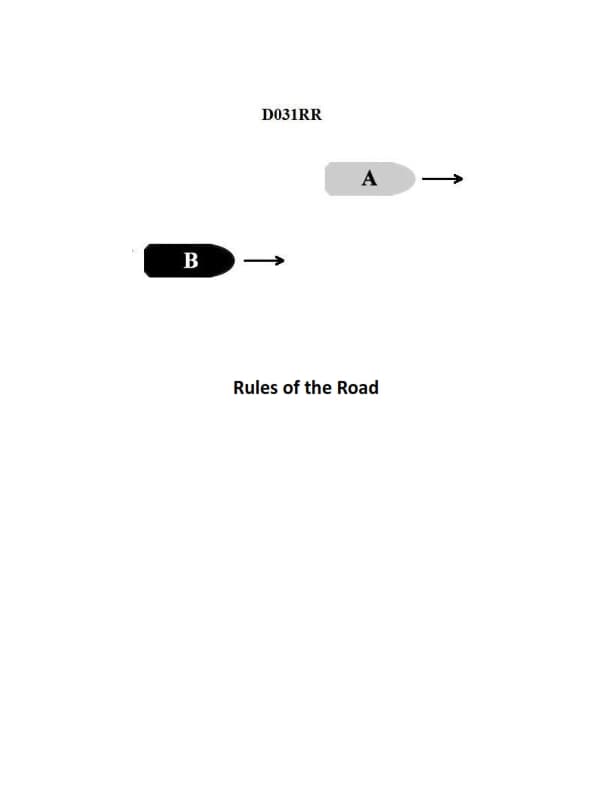
GLI08INLAND ONLY You are on vessel "A", and vessel "B" desires to overtake you on your starboard side as shown in illustration D031RR below. After the vessels have exchanged one blast signals what action should you take?
AI Explanation
The Correct Answer is A
**Explanation for Option A (Hold course and speed):**
Vessel "A" is the vessel being overtaken (the burdened vessel) and vessel "B" is the vessel intending to overtake (the give-way vessel). Under the Inland Navigation Rules, specifically Rule 13 (Overtaking) and Rule 17 (Action by Stand-on Vessel), the vessel being overtaken must **maintain her course and speed** until the other vessel is finally past and clear. When vessel "B" signals one short blast, it means "I intend to overtake you on your starboard side." Vessel "A" must answer with one short blast, confirming the maneuver is safe and indicating assent, and then hold course and speed to allow the overtaking to proceed safely.
**Why the other options are incorrect:**
* **B) Alter course to the left to give vessel "B" more sea room:** This is incorrect. The vessel being overtaken must maintain course and speed. Altering course (especially towards the passing vessel's intended path, which would be an alteration to the left if B is passing to starboard) creates unpredictability and danger, potentially hindering the safe completion of the maneuver.
* **C) Slow your vessel until vessel "B" has passed:** This is incorrect. The vessel being overtaken must maintain her speed. Slowing down could complicate the overtaking calculation for vessel "B" and violates the requirement to hold course and speed.
* **D) Alter course to the right to give vessel "B" more sea room:** This is incorrect. While this action seems helpful, the primary responsibility of the vessel being overtaken is to be predictable. Altering course violates the requirement to maintain course and speed, which is crucial for the safe execution of the overtaking maneuver by vessel "B".
Related Questions
#23 BOTH INTERNATIONAL & INLAND If two sailing vessels are running free with the wind on the same side,
which one must keep clear of the other?#23 You are underway in heavy weather and your bow is into the seas. Which action should you take to prevent
pounding?#25 BOTH INTERNATIONAL & INLAND What is the duration of a "short blast" on the whistle?#25 You are backing on twin engines with rudders amidships, when your port engine stalls. To continue backing
on course, which action should you take?