Question 58
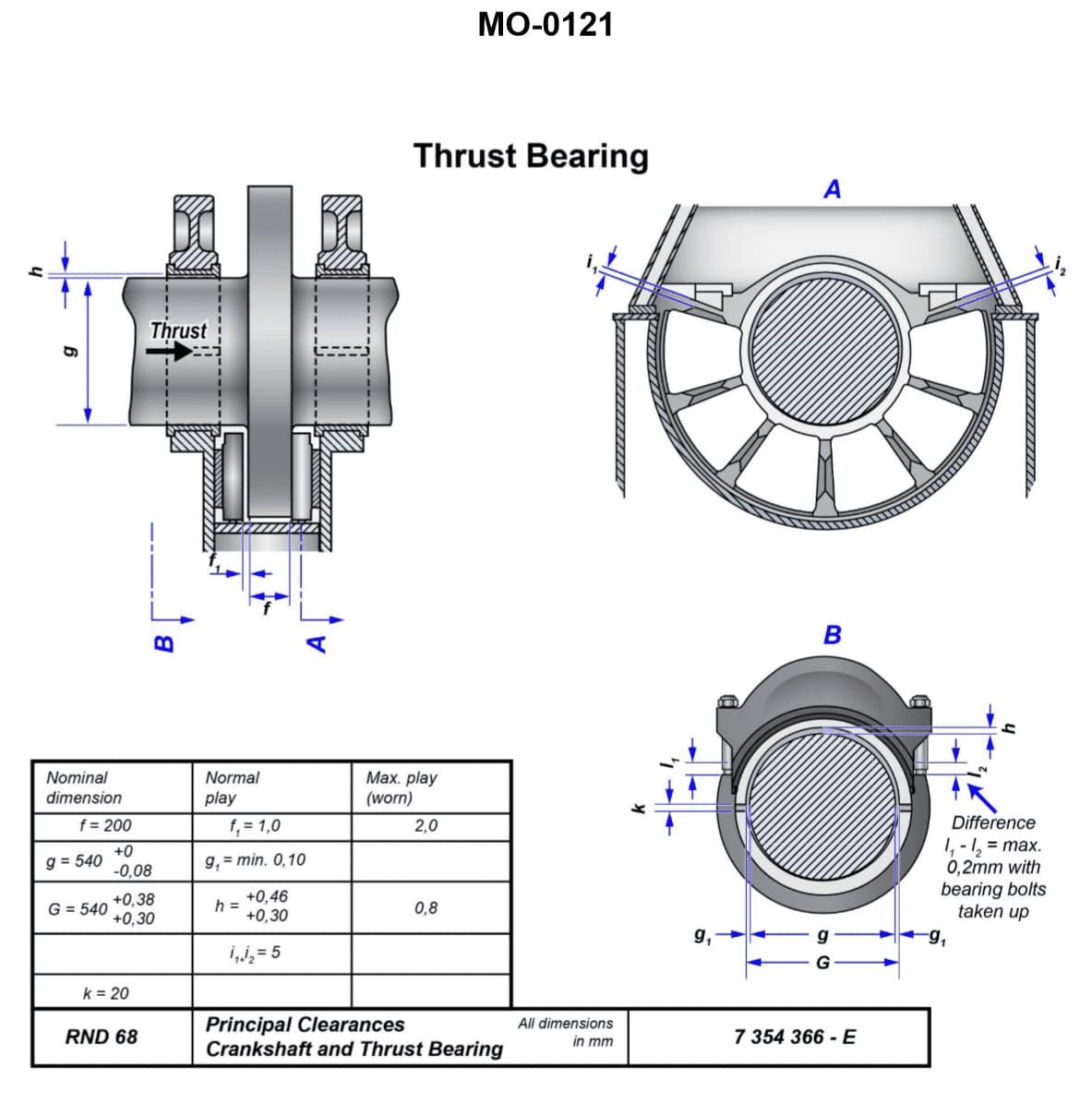
MODE01What is the maximum allowable clearance permitted between the bearing, shown in the illustration and the shaft along its vertical axis? Illustration MO-0121
AI Explanation
The Correct Answer is C
### Why Option C (0.80 mm) is Correct
The question asks for the **maximum allowable clearance** permitted between the bearing and the shaft along the vertical axis, referencing a specific illustration (MO-0121, which typically depicts a main engine crosshead bearing or similar large bearing configuration).
Standard marine engineering and engine manufacturer specifications (particularly for older or specific medium/slow-speed diesel engines like those often tested in marine licensing exams) often define the maximum permissible vertical wear or running clearance for main engine bearings, crankpin bearings, or crosshead bearings.
For larger, slow-speed diesel engine crosshead bearings (which are commonly shown in illustrations referenced by these types of exams, such as those related to vertical clearance measurements), the maximum *allowable* clearance before overhaul or renewal is often specified by manufacturers to be in the range of 0.70 mm to 0.80 mm (or up to 0.90 mm, depending on the engine type and bore).
* **0.80 mm** represents a common and acceptable upper limit for the vertical clearance (wear-down) of a critical, large-bore slow-speed engine bearing system, making it the most accurate maximum value among the choices presented.
### Why Other Options are Incorrect
**A) 0.30 mm:**
* This value is usually within the **initial (new)** manufacturing specifications or the maximum allowable radial clearance for smaller, high-speed engine bearings. For large slow-speed bearings like those depicted in MO-0121, 0.30 mm is far too low to represent the maximum permissible worn clearance.
**B) 0.46 mm:**
* While 0.46 mm (or 0.40 mm to 0.50 mm) might represent the standard maximum allowable running clearance for certain medium-speed or auxiliary engine main bearings, it is generally too low for the absolute maximum wear limit (renewal limit) of a large main engine bearing, such as a crosshead or main bearing.
**D) 1.00 mm:**
* A clearance of 1.00 mm (1.0 mm) is typically considered excessive and potentially dangerous for most large main engine bearings. While some extremely large or older engine types might have renewal limits near 1.0 mm, 0.80 mm is the more widely accepted standard maximum threshold before mandatory corrective action is required, making 1.00 mm an unsafe overestimation of the maximum permissible limit.
Related Questions
#57 The worst atmospheric condition for dispersion of hydrogen sulfide is __________.#57 If there is any doubt that a newly employed engine department crew member is sufficiently familiar with the
engine room equipment, operating and maintenance procedures needed for the proper performance of his or
her duties, what should be done?#59 What is the normal bearing clearance permitted at the horizontal axis of the shaft for the bearing shown in the
illustration? Illustration MO-0121