Question 28
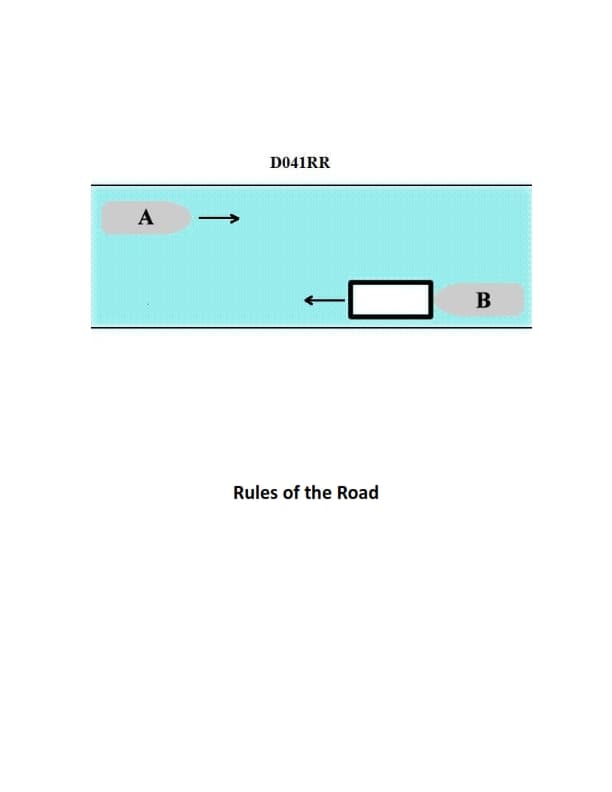
MODU01INLAND ONLY Vessels "A" and "B" are meeting on a river as shown in illustration D041RR below and will pass 1/4 mile apart. Which is one of the lights on vessel "B" that you will see if you are on vessel "A"?
AI Explanation
The Correct Answer is C
### Explanation for Option C (special flashing light)
**The special flashing light is correct because it is a mandatory, identifying light displayed forward on power-driven vessels engaged in a common Inland River operation.**
1. **Inland Rules Mandate:** Under the Inland Navigation Rules (Rule 23(e)), a power-driven vessel pushing ahead or towing alongside on the Western Rivers (or waters specified by the Commandant) must display a **special flashing light**.
2. **Visibility and Purpose:** This light is amber, flashes 50–70 times per minute, and is placed forward. It is visible over a horizontal arc of 180–225 degrees, centered on the centerline, meaning it is specifically designed to be seen by vessels approaching head-on or slightly off the bow.
3. **Conclusion for Scenario:** Since the vessels are "INLAND ONLY" and meeting on a river, Vessel B is likely a towing vessel pushing a tow. If Vessel B is pushing, this special flashing light is displayed at the bow and would be clearly visible to Vessel A during the meeting situation.
***
### Explanation for Incorrect Options
**A) yellow towing light**
The yellow towing light (required under Rule 24 for towing astern) is a white or yellow light positioned vertically above the stern light and is visible only in the **stern sector (135 degrees astern)**. Since Vessel A and Vessel B are meeting, Vessel A is looking at Vessel B's bow. Therefore, Vessel A would not see the towing light.
**B) red sidelight**
While a red sidelight (port side) *may* be seen depending on the final angle of the passing maneuver, it is not a definite identifying light for a vessel meeting head-on (in which case, masthead lights and the special flashing light are primary). More importantly, the sighting of the sidelight depends entirely on A being slightly off B's port bow. The special flashing light (C) is mandatory for the operation and displayed in the forward sector, making it the definitive unique light visible during a meeting in this specific inland context.
**D) All of the above**
This option is incorrect because the yellow towing light (A) is not visible in a meeting situation.
Related Questions
#27 Deck beams on a MODU are generally spaced at equal intervals and run __________.#27 In evacuation from a MODU, an individual without the option of a survival craft or liferaft should enter the
water on the leeward side. This procedure is valid except when which of the following circumstances applies?