Question 20
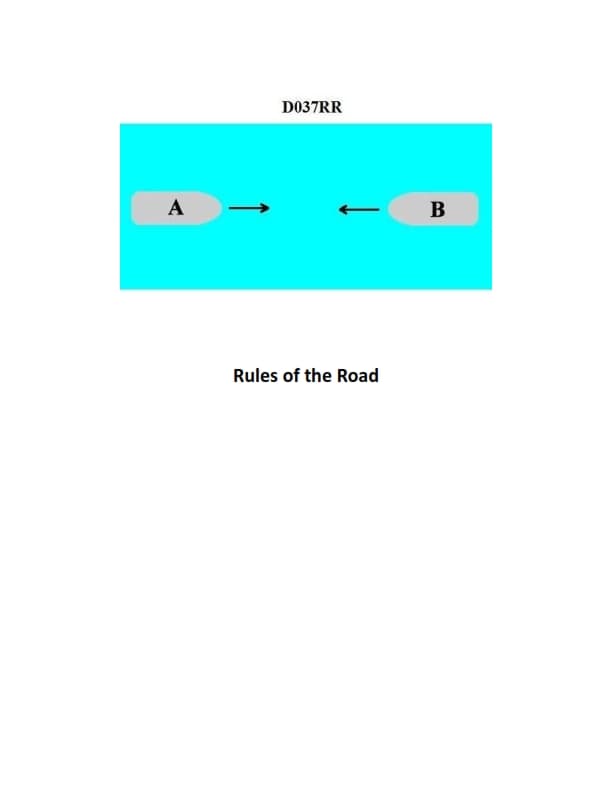
MODU02BOTH INTERNATIONAL & INLAND You are on Vessel "A" engaged in fishing in a narrow channel as shown in illustration D037RR below. Vessel "B" is a tanker proceeding in the channel. Vessel "B" sounds five short and rapid blasts. What action should you take?
AI Explanation
The Correct Answer is D.
**Why option D ("not impede the passage of vessel "B"") is correct:**
Vessel "A" is engaged in fishing, which makes it a Vessel Engaged in Fishing (V.E.F.) and therefore a vessel restricted in its ability to maneuver (Rule 3(g)). However, Rule 9 (Narrow Channels) mandates specific responsibilities. Rule 9(b) states that a V.E.F. shall not impede the passage of any other vessel navigating within a narrow channel. Vessel "B" is a tanker, likely deep-draft, proceeding in the channel. The signal of five short and rapid blasts sounded by Vessel "B" is the danger or doubt signal (Rule 34(d)), indicating that Vessel "B" doubts whether sufficient action is being taken by Vessel "A" to ensure safe passage, or that Vessel "A" is creating a dangerous situation. Regardless of the signal, Vessel "A" (the fishing vessel) has a mandatory obligation under Rule 9(b) not to impede the passage of vessels that can only navigate safely within the channel. Therefore, Vessel "A" must take immediate action to ensure Vessel "B" can proceed unimpeded.
**Why the other options are incorrect:**
* **A) maintain course and speed:** This is incorrect. Maintaining course and speed directly violates Rule 9(b) if it results in impeding Vessel "B". Furthermore, receiving a danger signal (five blasts) requires immediate action to resolve the dangerous situation or doubt, not inaction.
* **B) not answer the whistle signals from vessel "B":** This is incorrect. While five blasts generally do not require a specific answer, taking no action is unacceptable given the mandatory obligation not to impede (Rule 9(b)) and the fact that the five blasts indicate a potential danger or misunderstanding that must be resolved. Vessel "A" must maneuver or take steps to ensure B's passage is not impeded.
* **C) sound one prolonged followed by two short blasts:** This is incorrect. This signal (Rule 35(c)) is the prescribed signal for a vessel engaged in fishing or towing *when underway* in restricted visibility (fog), not a maneuvering signal in clear visibility responding to a doubt signal. Responding with the proper maneuver to ensure B's passage is unimpeded is required, not sounding an unrelated signal.
Related Questions
#19 Which statement describes the primary process by which fires are extinguished by dry chemical?#19 The COASTAL DRILLER is observed to be level at a draft of 10 feet 6 inches. At the same time, the
calculated load form shows the displacement to be 13,445 kips, total longitudinal moments 1,613,466 foot- kips, and total transverse moments -10,000 foot-kips. What is the transverse location of the missing load?#21 BOTH INTERNATIONAL & INLAND When in sight of another vessel and there is sufficient sea room, any
action taken to avoid collision must __________.