Question 10
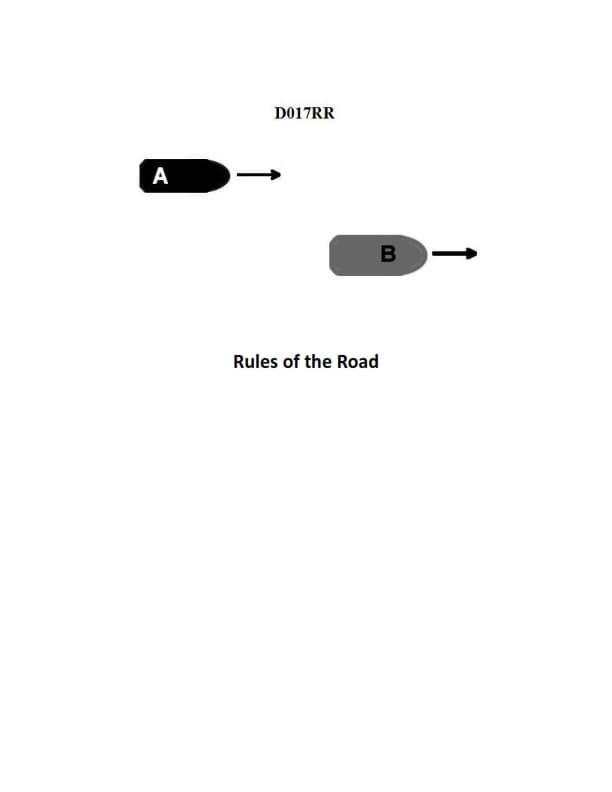
ONC01BOTH INTERNATIONAL & INLAND Vessel "A" is overtaking vessel "B" as shown in illustration D017RR below. Vessel "B" should do which of the following?
AI Explanation
The Correct Answer is B
**Explanation for B (Correct Option):**
The scenario described falls under the rules governing Overtaking. According to both the International Regulations for Preventing Collisions at Sea (COLREGS) Rule 13 (Overtaking) and the U.S. Inland Rules equivalent, the vessel being overtaken (Vessel B) is considered the **stand-on vessel** and the vessel overtaking (Vessel A) is the **give-way vessel**.
Rule 17 (Action by Stand-on Vessel) dictates the duties of the stand-on vessel. It explicitly states that the stand-on vessel "shall keep her course and speed." Therefore, Vessel B's primary duty is to **hold her course and speed** to allow Vessel A (the give-way vessel) to take the necessary avoiding action and pass safely.
**Explanation for Incorrect Options:**
* **A) should slow down until vessel "A" has passed:** This is incorrect. Changing speed (slowing down) would violate Vessel B's duty to maintain her course and speed as the stand-on vessel. Predictable movement by Vessel B is crucial for Vessel A to execute a safe passing maneuver.
* **C) may steer various courses and vessel "A" must keep clear:** This is incorrect. Vessel B is the stand-on vessel and must maintain a predictable course and speed (Rule 17). Steering "various courses" would create confusion and danger, violating the fundamental principle of the stand-on vessel's duty. While Vessel A must keep clear, Vessel B must remain predictable.
* **D) should change course to the right:** This is incorrect. Changing course is an action reserved for the give-way vessel (Vessel A) or for the stand-on vessel only under exceptional circumstances (when collision cannot be avoided by the give-way vessel's action alone). Vessel B's primary duty is to hold course and speed.
Related Questions
#9 On 11 January your vessel's 0655 zone time DR position is LAT 24°30'N, LONG 122°02'W, when an amplitude of the Sun is observed. The Sun's center is on the celestial horizon and bears 101.0° per standard compass. Variation in the area is 11.6°E. The chronometer reads 02h 52m 48s and is 02m 12s slow. What is the deviation of the standard compass?#9 On 3 February your 0547 zone time DR position is LAT 24°18.5'N, LONG 167°25.0'E. Considering their
magnitude, azimuth, and altitude, which group includes the three bodies best suited for a fix at star time?