Question 10
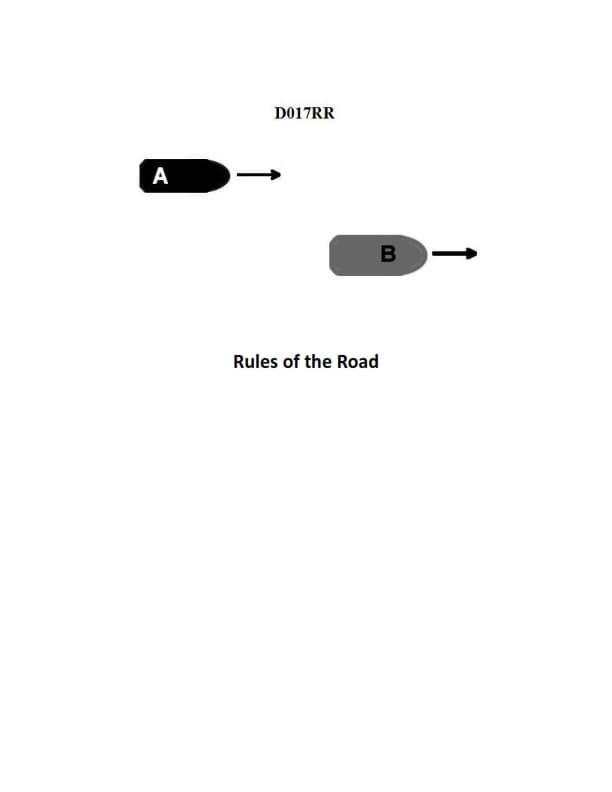
ONC02BOTH INTERNATIONAL & INLAND Vessel "A" is overtaking vessel "B" as shown in illustration D017RR below. Vessel "B" should do which of the following?
AI Explanation
The Correct Answer is B
**Explanation for Option B (Correct Answer):**
This scenario is governed by the International Regulations for Preventing Collisions at Sea (COLREGS) or the equivalent Inland rules regarding Overtaking.
Rule 13 (Overtaking) dictates that any vessel coming up with another vessel from a direction more than $22.5^{\circ}$ abaft her beam (i.e., in the arc of the stern light) shall be the **Overtaking vessel** and must keep clear of the **vessel being overtaken**.
Rule 13(d) explicitly states: "No subsequent alteration of the bearing between the two vessels shall make the overtaking vessel a crossing vessel within the meaning of these Rules or relieve her of the duty of keeping clear until she is finally past and clear."
Crucially, Rule 17 (Action by Stand-on Vessel) applies here. The vessel being overtaken (Vessel B) is the **stand-on vessel**. Rule 17(a)(ii) mandates that the stand-on vessel (Vessel B) **shall keep her course and speed**.
Therefore, Vessel B must maintain its course and speed, and Vessel A (the overtaking vessel) is responsible for taking all necessary action to keep clear.
**Explanation for Incorrect Options:**
* **A) should slow down until vessel "A" has passed:** This is incorrect. The stand-on vessel (Vessel B) is required to maintain speed. Slowing down could complicate the maneuver for Vessel A and violates Rule 17(a)(ii).
* **C) may steer various courses and vessel "A" must keep clear:** This is incorrect. While Vessel A must keep clear, Vessel B is required to **hold her course and speed** to allow Vessel A to execute a predictable passing maneuver. Only in extremis (when collision cannot be avoided by the action of the giveaway vessel alone) may Vessel B deviate (Rule 17(b)).
* **D) should change course to the right:** This is incorrect. Vessel B is the stand-on vessel and must maintain her course and speed. Changing course unnecessarily introduces unpredictability and violates the fundamental responsibility of the stand-on vessel.
Related Questions
#9 You swung ship and compared the magnetic compass against the gyrocompass to find deviation. Gyro error is 2°W. The variation is 8°W. Find the deviation on a magnetic compass heading of 210°.#9 You depart LAT 38°14'N, LONG 12°42'W, for LAT 38°14'N, LONG 46°09'W. What are the course and distance
by parallel sailing?