Question 51
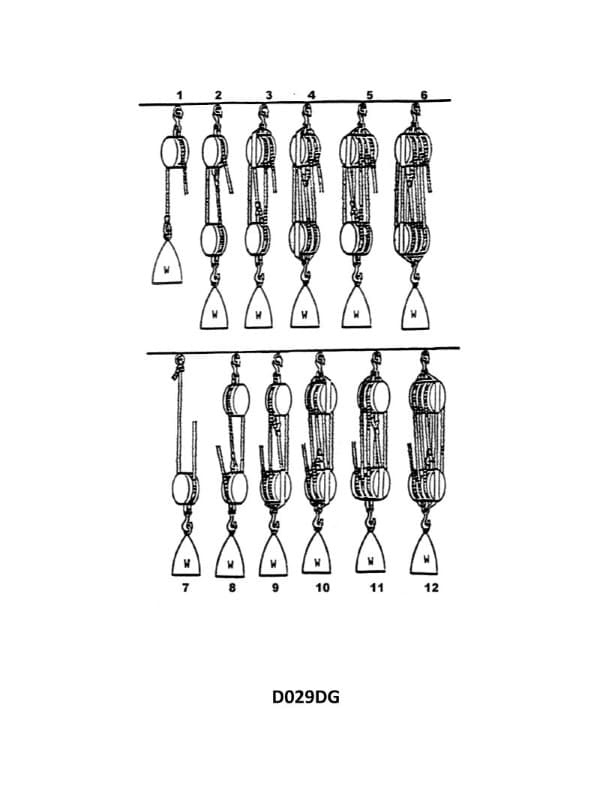
ONC04What is the mechanical advantage of tackle number 6 as shown in illustration D029DG below?
AI Explanation
The Correct Answer is A.
### Explanation for Option A (6.0)
The mechanical advantage (MA) of a block and tackle system is determined by the number of supporting lines carrying the load. In most simple block and tackle systems (especially those used for illustrative purposes like "tackle number 6" typically referring to a system with 6 sheaves or 6 supporting lines), the theoretical mechanical advantage (TMA) is equal to the number of lines leading to and supporting the movable block (or the number of sheaves in the larger block, provided it is rigged correctly).
Assuming "tackle number 6" is a standard six-part tackle (three sheaves in the fixed block and three sheaves in the movable block):
1. **Identify the supporting lines:** Count the number of rope segments that are directly supporting the movable block and the attached load.
2. **Standard Six-Part Tackle Rigging:** When properly rigged, a six-part tackle will have six strands of rope supporting the load, including the strand that exits the system (the hauling part).
3. **Calculate MA:** Since there are 6 supporting lines, the Theoretical Mechanical Advantage (TMA) is 6.0.
Therefore, the mechanical advantage of tackle number 6 is **6.0**.
### Explanation for Other Options
**B) 5.5 is incorrect:** A mechanical advantage is typically a whole integer in theoretical block and tackle systems, matching the number of parts of line supporting the load. 5.5 is not a standard TMA for a common tackle setup. While the **actual** mechanical advantage (AMA) is always less than the TMA due to friction, the question typically asks for the theoretical advantage unless otherwise specified.
**C) 5.0 is incorrect:** This would be the TMA for a five-part tackle (e.g., a luff tackle combined with another single-sheave block, or a system with a total of five supporting lines). Since the system is specified as "tackle number 6," it implies six supporting lines, making 5.0 incorrect.
**D) 3.0 is incorrect:** This would be the TMA for a three-part tackle (e.g., a standard double tackle where the fall is attached to the fixed block, or a luff tackle). This is too low for a "tackle number 6" system.
Related Questions
#50 A vessel's position should be plotted using bearings of __________.#50 Your vessel is proceeding up a channel, and you see a pair of range lights that are in line ahead. The chart
indicates that the direction of this pair of lights is 352°T, and the variation is 4°W. If the heading of your vessel
at the time of the sighting is 359° per standard magnetic compass, what is the correct deviation?