Question 28
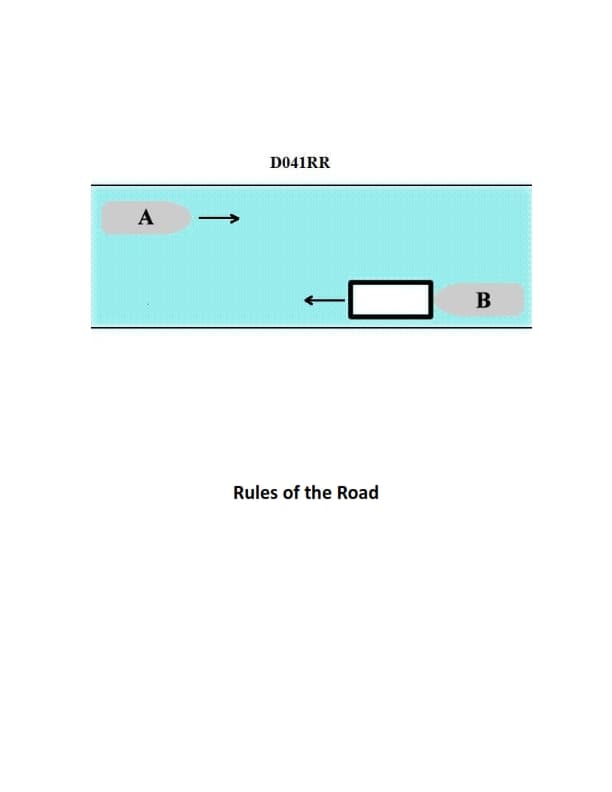
ONC06INLAND ONLY Vessels "A" and "B" are meeting on a river as shown in illustration D041RR below and will pass 1/4 mile apart. Which is one of the lights on vessel "B" that you will see if you are on vessel "A"?
AI Explanation
The Correct Answer is C
### Explanation for Option C (Correct)
Vessel "B" is maneuvering to pass on the starboard side of Vessel "A" (a port-to-port passing situation). However, the crucial piece of information is that both vessels are identified as "INLAND ONLY" vessels. The rules for lights in inland waters differ from international rules, especially concerning certain types of commercial vessels.
Vessel "B" is illustrated as a power-driven vessel pushing ahead or towing alongside (a common configuration on inland waterways). According to the U.S. Inland Navigation Rules (Rule 24, Rule 23, and Rule 27), specific vessels engaged in pushing ahead or towing alongside must display particular lights.
Most importantly, the **special flashing light** (a yellow light flashing at 50 to 70 flashes per minute) is mandatory for a towing vessel (the lead vessel) when the tow is made up of one or more barges being pushed ahead, and the total length of the combined unit exceeds 200 meters, or if the barges are pushing ahead and are rigidly connected (which is the typical operation shown in inland river systems). This light is specifically designed to indicate the head of a tow being pushed ahead on U.S. Inland Waters. Since the question asks what light you will see on Vessel "B" (which is maneuvering and clearly engaged in push-towing operations common on rivers), the special flashing light is one of the specific lights required for this type of vessel configuration on inland waters.
### Explanation for Other Options (Incorrect)
**A) yellow towing light:** The yellow towing light (a specific masthead-like light positioned aft of the white masthead lights) is used when **towing astern** (pulling a vessel behind it). Vessel "B" is clearly engaged in **pushing ahead or towing alongside**, not towing astern. Therefore, the yellow towing light is not required in this configuration.
**B) red sidelight:** A red sidelight is displayed on the **port (left)** side of a vessel. Since Vessels "A" and "B" are meeting and passing approximately 1/4 mile apart, and they are shown nearly head-on or slightly offset, Vessel "A" would see Vessel "B's" **green sidelight** (starboard side), not its red sidelight. Seeing the red sidelight would indicate that Vessel "B" is crossing ahead or turning sharply to port, which is not the typical passing maneuver shown in a head-on meeting situation where both keep to their starboard side of the channel (port-to-port passing).
**D) All of the above:** Since options A and B are incorrect in this scenario, "All of the above" cannot be correct.
Related Questions
#27 Your vessel is proceeding up a channel, and you see a pair of range lights that are in line dead ahead. The
chart indicates that the direction of this pair of lights is 093°T, and the variation is 6°E. If the heading of your
vessel at the time of the sighting is 097° per standard magnetic compass, what is the correct deviation?#27 You have completed stability calculations for your vessel prior to getting underway. Your vessel's GM is small
but positive. Which of the following is true?