Question 44
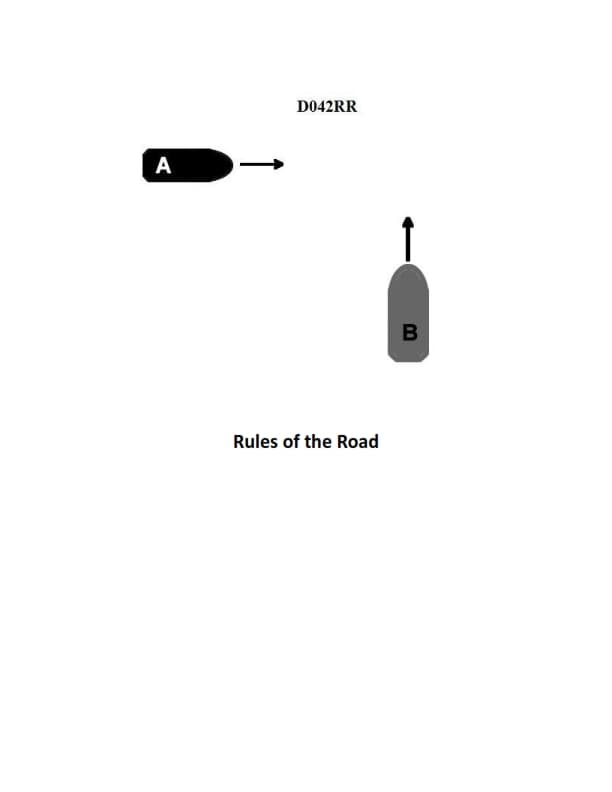
ONC07BOTH INTERNATIONAL & INLAND Two power-driven vessels are crossing as shown in illustration D042RR below. Vessel "A" sounds three short blasts on the whistle. What is the meaning of this signal?
AI Explanation
The Correct Answer is D
1. **Explanation for Option D (Correct Answer):**
According to both the International Regulations for Preventing Collisions at Sea (COLREGs) and the Inland Rules (Subpart C, Rule 34), a power-driven vessel sounding **three short blasts** on the whistle signifies that the vessel is operating its propulsion machinery astern (backing engines). This signal is used to indicate that the vessel is taking action to reduce headway or move backward.
2. **Explanation for Incorrect Options:**
* **A) Vessel "A" intends to hold course and speed:** There is no specific whistle signal in the COLREGs/Inland Rules that means "I intend to hold course and speed." A vessel usually indicates its maneuvering intentions (altering course or speed) when necessary.
* **B) Vessel "A" is sounding a signal of doubt:** A signal of doubt or apprehension regarding the other vessel's intentions (the danger signal) consists of **at least five short and rapid blasts**. Three short blasts does not convey doubt.
* **C) Vessel "A" proposes to cross ahead of the other vessel:** In a crossing situation, signaling intentions usually involves one short blast (I intend to leave you on my port side) or two short blasts (I intend to leave you on my starboard side) in restricted waters (Inland) or the necessary short/long blast maneuvering signals in International waters when meeting/overtaking. Proposing to cross ahead is covered by signals indicating course alterations (e.g., one short blast to turn starboard), not three short blasts.
Related Questions
#43 How does good housekeeping prevent fires on a vessel?#43 Your vessel is steering course 299°psc, variation for the area is 7°W, and deviation is 4°W. The wind is from
the southwest, producing a 3° leeway. What true course are you making good?#45 BOTH INTERNATIONAL & INLAND A vessel nearing a bend where other vessels may be obscured is
required to sound which signal?