Question 44
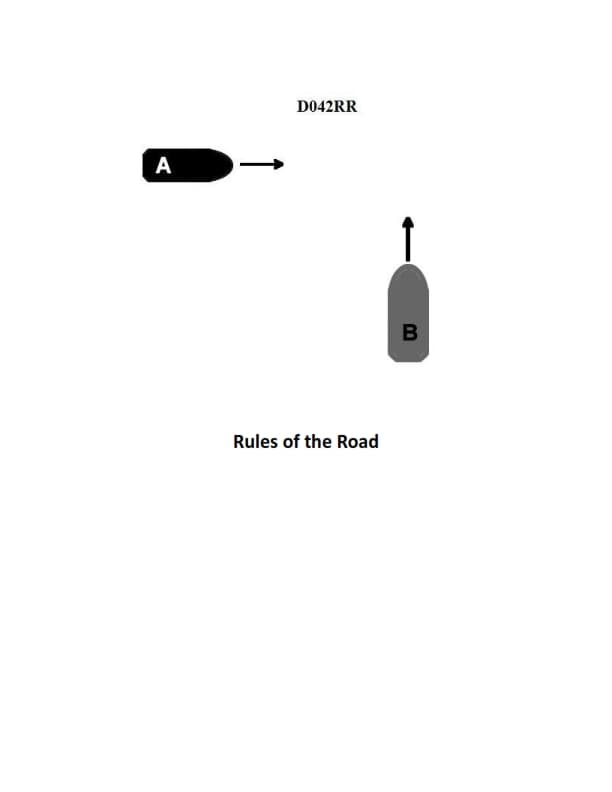
OSV01BOTH INTERNATIONAL & INLAND Two power-driven vessels are crossing as shown in illustration D042RR below. Vessel "A" sounds three short blasts on the whistle. What is the meaning of this signal?
AI Explanation
The Correct Answer is D
1. **Explanation for Option D (Vessel "A" is backing engines):**
According to both the International Regulations for Preventing Collisions at Sea (COLREGs) and the Inland Rules (Rule 34), a power-driven vessel operating in sight of another vessel uses specific whistle signals to indicate maneuvers. Three short blasts means: "My engines are going astern (backing engines)." This is a clear signal that Vessel "A" is slowing down, stopping, or reversing its direction of movement.
2. **Explanation of Incorrect Options:**
* **A) Vessel "A" intends to hold course and speed:** A vessel does not typically use a whistle signal specifically to state intent to hold course and speed unless it is responding to another vessel's action or is indicating that it is the Stand-on vessel in a restricted visibility situation (which requires different signals). Maneuver signals (like one, two, or three blasts) always indicate an *action* being taken, not passive intent to hold status quo.
* **B) Vessel "A" is sounding a signal of doubt:** A signal of doubt or confusion (called the "danger signal") consists of five or more short and rapid blasts, not three short blasts.
* **C) Vessel "A" proposes to cross ahead of the other vessel:** A proposal to cross ahead (which would involve altering course to starboard to pass port-to-port) would be indicated by one short blast ("I am altering my course to starboard"). A proposal to pass to port (starboard-to-starboard) would be two short blasts.