Question 57
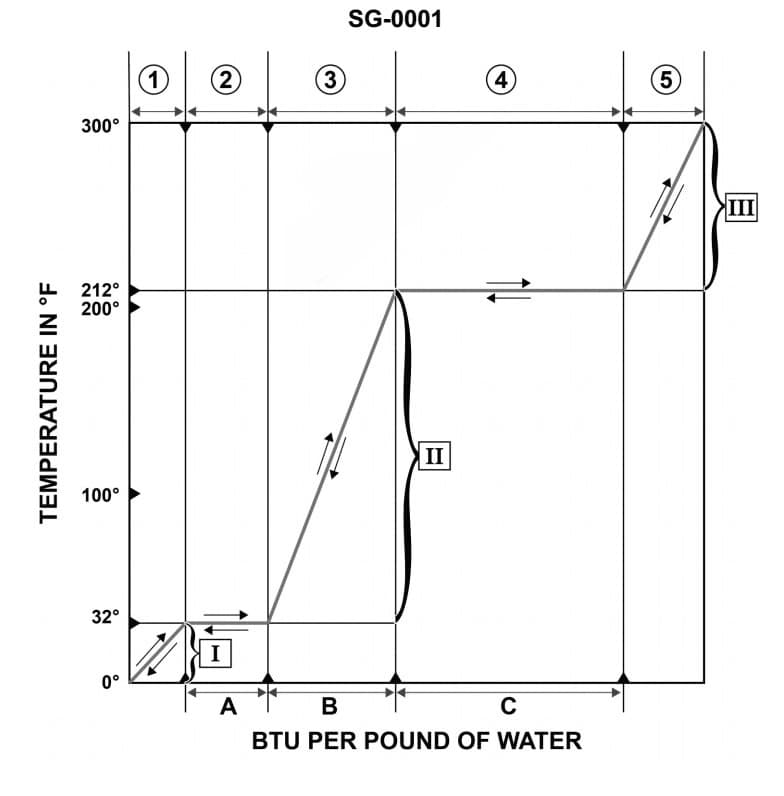
QMED01According to the temperature/enthalpy diagram for water at atmospheric pressure, if the substance is undergoing a heat loss, what heat transfer process is represented by the region associated with "4"? Illustration SG-0001
AI Explanation
The Correct Answer is C.
### Explanation for why Option C is Correct
The illustration SG-0001 represents a temperature/enthalpy diagram (heating/cooling curve) for water at atmospheric pressure, moving from ice to steam (or vice versa). This diagram features distinct regions representing phase changes (isothermal plateaus) and sensible heating/cooling (sloped sections).
Region 4 is the upper plateau (flat section) corresponding to the transition between steam and water, occurring at $100^{\circ} \mathrm{C}$ (the boiling/condensation point at standard pressure).
* **Process Direction:** The question specifies the substance is undergoing a **heat loss** (cooling process).
* **Region 4 (Cooling):** When the system loses heat in this region, the steam is transitioning back into liquid water.
* **Heat Type:** A phase change occurring at a constant temperature involves the latent heat. When steam turns into water, it releases (loses) its **latent heat of condensation**.
Therefore, region 4, under heat loss conditions, represents **Steam losing its latent heat of condensation and changing its physical state to become water.**
### Explanation for why other options are incorrect
**A) Water absorbing its latent heat of vaporization and changing its physical state to become steam.**
* This describes the opposite process (vaporization), which involves **heat gain** (heating), not heat loss. While it occurs in Region 4, the direction of heat transfer is incorrect.
**B) Water absorbing its specific heat and experiencing a rise in temperature.**
* This describes sensible heating of liquid water (Region 3, with heat gain). Region 4 is a phase change (isothermal).
**D) Steam losing its specific heat and experiencing a drop in temperature.**
* This describes sensible cooling of steam (Region 5, with heat loss), where the temperature decreases below $100^{\circ} \mathrm{C}$ (if superheated steam is cooled, or if the saturated vapor is cooled once fully condensed). Region 4 is an isothermal phase change.
Related Questions
#56 When an engine fitted with a hydraulic starting system starts up, the starter is protected from the higher speed
of the engine by ________.#56 On a ship with a continuously manned engine room, with a three-person watch rotation, what is the watch and
rest period rotation?#58 Which of the terms listed below represents the operational speed at which excessive engine vibration is
created?#58 The purpose of try-cocks used on an auxiliary boiler is to __________.