Question 32
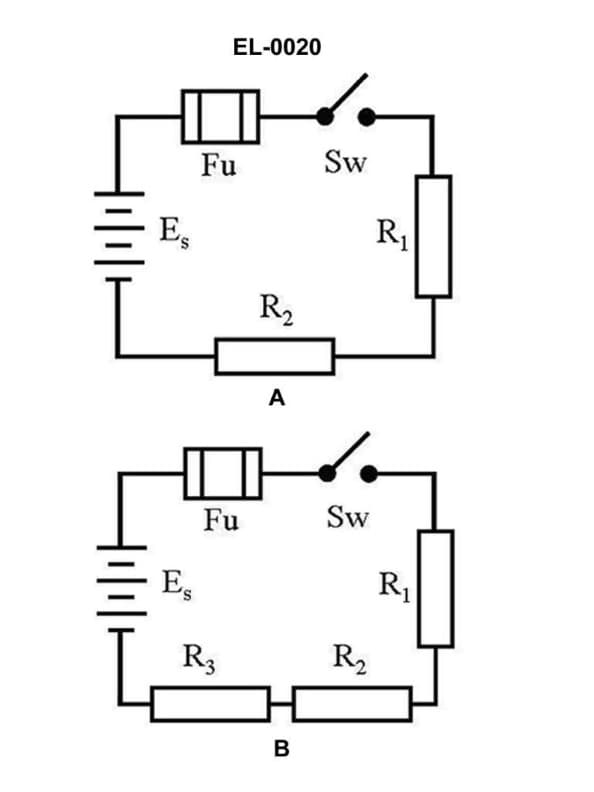
QMED02What is the power consumed by "R2" in the circuit illustrated in figure "B", if the applied voltage is 24 volts and the resistance of R1 is 3 ohms, R2 is 4 ohms, and R3 is 5 ohms, respectively? Illustration EL-0020
AI Explanation
The Correct Answer is A
### Explanation of the Correct Answer (A)
The power consumed by a resistor ($P$) is calculated using the formula $P = I^2 R$, where $I$ is the current flowing through the resistor and $R$ is the resistance value.
Figure B illustrates a series circuit where the total applied voltage ($V_{total}$) is 24 V, and the resistors $R_1$, $R_2$, and $R_3$ are connected end-to-end.
**1. Calculate the Total Resistance ($R_{total}$):**
In a series circuit, the total resistance is the sum of individual resistances:
$R_{total} = R_1 + R_2 + R_3$
$R_{total} = 3 \, \Omega + 4 \, \Omega + 5 \, \Omega = 12 \, \Omega$
**2. Calculate the Total Current ($I_{total}$):**
The current is the same throughout a series circuit. Use Ohm's Law ($I = V/R$):
$I_{total} = V_{total} / R_{total}$
$I_{total} = 24 \, \text{V} / 12 \, \Omega = 2 \, \text{A}$
Since the circuit is in series, the current flowing through $R_2$ ($I_{R2}$) is the total current:
$I_{R2} = 2 \, \text{A}$
**3. Calculate the Power Consumed by $R_2$ ($P_{R2}$):**
Use the power formula $P = I^2 R$:
$P_{R2} = (I_{R2})^2 \times R_2$
$P_{R2} = (2 \, \text{A})^2 \times 4 \, \Omega$
$P_{R2} = 4 \, \text{A}^2 \times 4 \, \Omega = 16 \, \text{W}$
Therefore, the power consumed by $R_2$ is 16 watts.
---
### Explanation of Incorrect Options
**B) 20 watts:**
This value does not correspond to the power dissipation of $R_2$. For comparison, the power dissipated by $R_3$ (5 $\Omega$) is $P_{R3} = (2 \text{ A})^2 \times 5 \, \Omega = 20 \, \text{W}$. This option represents the power consumed by R3, not R2.
**C) 24 watts:**
This value is likely derived from an error such as calculating the power of $R_1$ and $R_2$ combined ($R_1 + R_2 = 7 \, \Omega$) if the current was incorrectly assumed (e.g., $I=2$ A, $P = 4 \times 7 = 28$ W - which is Option D), or perhaps an attempt to calculate the voltage drop across $R_2$ (8V) multiplied by a mistakenly calculated current (3 A, which is incorrect). It does not match the actual power of $R_2$ (16 W).
**D) 28 watts:**
This value is the power consumed by the first two resistors combined ($P_{R1} + P_{R2}$):
$P_{R1} = (2 \, \text{A})^2 \times 3 \, \Omega = 12 \, \text{W}$
$P_{R1} + P_{R2} = 12 \, \text{W} + 16 \, \text{W} = 28 \, \text{W}$. This option represents the combined power of R1 and R2, not the power consumed by R2 alone.
Related Questions
#31 As shown in figures "B" and "C" of the illustration, what should be the switch position and which test lead
terminal jacks should be used if your intent is to measure DC currents anticipated as high as 200 milliamps?
Illustration EL-0047#31 If a magnetic controller relay fails to drop out when the coil voltage is removed from the relay, what is the
probable cause?#33 Which of the following statements represents the important factor that must be considered when replacing a
faulty diode in a generators excitation field rectifier assembly?#33 In DC motor construction, where are the commutating windings wound?