Question 34
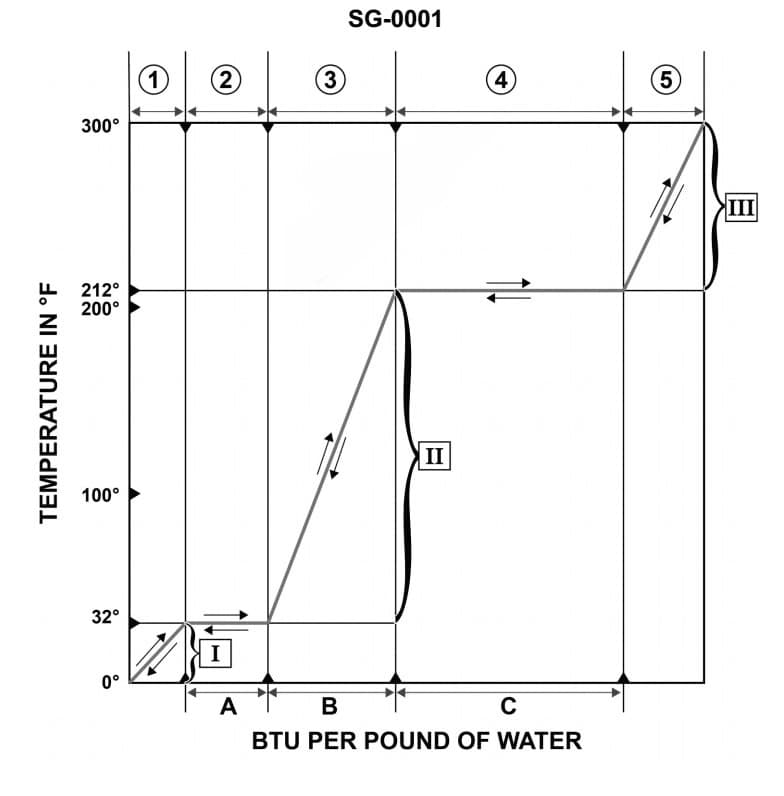
QMED03According to the temperature/enthalpy diagram for water at atmospheric pressure, if the substance is undergoing a heat loss, what heat transfer process is represented by the region associated with "4"? Illustration SG-0001
AI Explanation
The Correct Answer is B
**Explanation for Option B (Correct):**
The standard temperature/enthalpy diagram for water at atmospheric pressure shows five regions. Region 4 is the plateau where the temperature remains constant at 100°C (the boiling/condensation point). This plateau represents a phase change between liquid water and gaseous steam, requiring or releasing the latent heat of vaporization/condensation.
Since the substance is undergoing **heat loss** (moving down the enthalpy scale), the process represented by Region 4 is condensation. In condensation, steam (gas) changes its physical state to become water (liquid) by losing its **latent heat of condensation**.
**Why the Other Options are Incorrect:**
* **A) Water absorbing its latent heat of vaporization and changing its physical state to become steam.** This process is boiling (vaporization) and represents a **heat gain** (enthalpy increase) in Region 4, the reverse of what is described in the question.
* **C) Steam losing its specific heat and experiencing a drop in temperature.** This process occurs in Region 5 (superheated steam) and involves the specific heat of steam, not the latent heat associated with a phase change in Region 4.
* **D) Water absorbing its specific heat and experiencing a rise in temperature.** This process represents heating liquid water and occurs in Region 3 (the sloping line between 0°C and 100°C). It is a process of **heat gain**, not heat loss.
Related Questions
#33 How is accidental flooding of the engine room bilges through the bilge system prevented?#33 In the illustration shown, the sea painter is identified as item number _____. Illustration SF-0043#35 Prior to initial light off of an idle boiler, what must first be done to prevent boiler flareback?#35 With regard to the relative flow patterns through the tubes and the shell of single pass shell-and-tube heat
exchangers, what statement is true?