Question 13
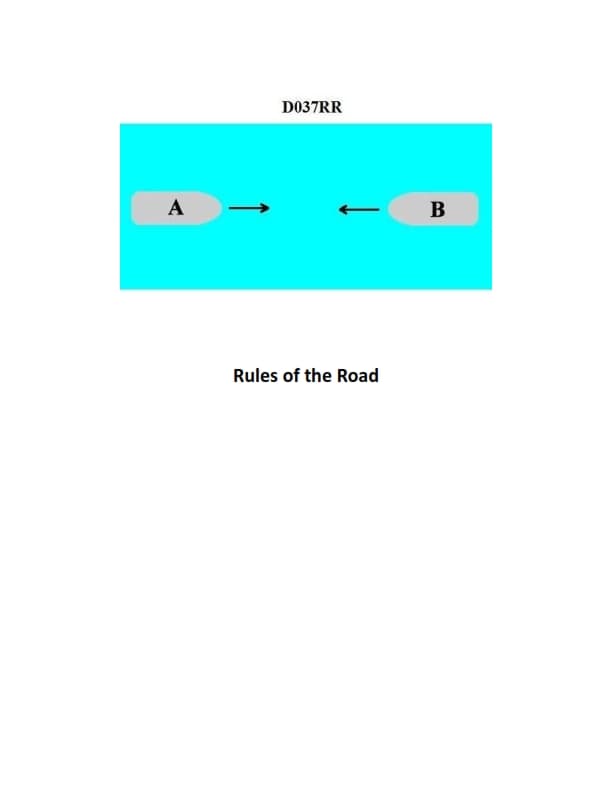
RVR01INLAND ONLY Two power-driven vessels are meeting in a narrow channel on the Great Lakes as shown in illustration D037RR below. Vessel "A" is downbound with a following current. Vessel "A" shall do which of the following?
AI Explanation
The Correct Answer is D
**Explanation for Option D ("All of the above"):**
The scenario describes two power-driven vessels meeting in a narrow channel on the Great Lakes, with Vessel "A" being **downbound with a following current**. This specific situation is governed by the Inland Rules of the Road, particularly Rule 9 (Narrow Channels) and the specific Annex V provisions for the Great Lakes.
1. **Propose the manner of passage (Option A):** Rule 9(a)(ii) for the Great Lakes states that a vessel **downbound with a following current** (Vessel A) "shall have the right-of-way over an upbound vessel" and "shall propose the manner of passage." Therefore, A must propose the manner of passage.
2. **Initiate the maneuvering signals (Option B):** The proposal of passage is communicated via maneuvering signals (whistle blasts) as defined by Rule 34 (Maneuvering and Warning Signals). Since Vessel A must propose the manner of passage, it must initiate the signals to communicate that proposal (e.g., one blast for port-to-port passage, two blasts for starboard-to-starboard passage).
3. **Have the right of way (Option C):** As explicitly stated in Rule 9(a)(ii) for the Great Lakes, a vessel downbound with a following current (Vessel A) "shall have the right-of-way over an upbound vessel."
Since Vessel A must propose the manner of passage, initiate the signals, and has the right of way, **All of the above (D)** is the correct answer.
**Explanation of Why Other Options are Incorrect (as standalone answers):**
* **A) Propose the manner of passage:** While correct, this option is incomplete because Vessel A also has the right of way and must initiate the signals.
* **B) Initiate the maneuvering signals:** While correct, this option is incomplete because Vessel A also has the right of way and must propose the manner of passage (the signals are just the means of proposing).
* **C) Have the right of way:** While correct, this option is incomplete because Vessel A also has specific duties to propose passage and initiate signals.